A knife thrower throws a knife toward a 300 g target that is sliding in her...
A knife thrower throws a knife toward a 300 g target that is sliding in her direction at a speed of 2.20 m/s on a horizontal frictionless surface. She throws a 22.5 g knife at the target with a speed of 36.0 m/s. The target is stopped by the impact and the knife passes through the target. Determine the speed of the knife (in m/s) after passing through the target.
Homework Answers
Solution :-
Energy cannot be conserved,
so working with momentum...
+ direction away from her..
-300*2.20+22.5*36=300*0+22.5V
solve for V
V = 6.67 m/she
Add Answer to:
A knife thrower throws a knife toward a 300 g target that is
sliding in her...
An archer shoots an arrow toward a 300-g target that is sliding in her direction at...
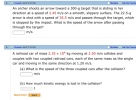 An archer shoots an arrow toward a 300-g target that is sliding in her direction at a speed of 2.45 m/s on a smooth, slippery surface. The 22.5-g arrow is shot with a speed of 35.5 m/s and passes through the target, which is stopped by the impact. What is the speed of the arrow after passing through the target? A railroad car of mass 2.35 times 10^4 kg moving at 2.50 m/s collides and couples with two coupled railroad...
An object with mass 4.0 kg is sliding on a horizontal, frictionless surface at speed 11.5...
An object with mass 4.0 kg is sliding on a horizontal, frictionless surface at speed 11.5 m/s. This object is moving in the positive x-direction. A second object, having mass 5.55 kg, is sliding on the same surface at speed 15.5 m/s. The second object is moving in a direction 75 degrees counterclockwise from the positive x-direction. If the objects stick after impact how fast would it move?
PROBLEM THREE (25 1 A 3.0 kg block sliding on a horizontal frictionless surface is attached...
 PROBLEM THREE (25 1 A 3.0 kg block sliding on a horizontal frictionless surface is attached to one end of a horizontal spring (k 250 N/m) which has the other end fixed. If the block has a speed of 5.0 m/s as it passes through equilibrium, what is its speed when it is 15 cm from the equilibrium postion?
A block of mass 2.0 kg sliding on a horizontal frictionless surface is attached to one...
 A block of mass 2.0 kg sliding on a horizontal frictionless surface is attached to one end of a horizontal spring (k = 800 N/m) which has its other end fixed. If the speed of the block as it passes through the equilibrium position is 4.0 m/s, what is its speed when it is a distance of 10 cm from the equilibrium position? a) 3.2 m/s b) 3.5 m/s c) 2.9 m/s d) 2.4 m/s
A 300-g object is attached to a spring that has a force constant of 80 N/m....
 A 300-g object is attached to a spring that has a force constant of 80 N/m. The object is pulled 8 cm to the right of equilibrium and released from rest to slide on a horizontal frictionless table. (a) Calculate the maximum speed of the object. An object (m0.300 kg) attached to a spring (k 80 N/m) is pulled A 0.08 m to the right of equilibrium and released from rest. It begins to oscillate on a horizontal, frictionless table....
A student throws a water balloon with speed vo from a height h = 1.52 m at an angle θ=39° above the horizontal toward a target on the ground.
 A student throws a water balloon with speed vo from a height h = 1.52 m at an angle θ=39° above the horizontal toward a target on the ground. The target is located a horizontal distance d = 7.5 m from the student's feet. Assume that the balloon moves without air resistance. Use a Cartesian coordinate system with the origin at the balloon's initial position. Part (a) what is the position vector, Rtarget that originates from the balloon's original position and...
1 5. An arrow slow originally at rest and sped up to 0.44 m/s, the mass...
 1 5. An arrow slow originally at rest and sped up to 0.44 m/s, the mass of the arrow is A. 5.0 g B. 7.7 g C. 14 g s down from 43 m/s to 28 m/s as it passes through an apple. If the 493-g apple was D. 29 g E. 7.7 kg A force of 4.0 N [S] is applied to a 2.0-kg block sliding west at 3.0 m/s on a smooth surface. The puck will be moving...
A 5.00-g bullet moving with an initial speed of 450 m/s passes through a 1.00-kg block,...
 A 5.00-g bullet moving with an initial speed of 450 m/s passes through a 1.00-kg block, as shown in the figure. The block is initially at rest on a frictionless, horizontal surface and is connected to a spring that has a spring-force constant of 900 N/m. The block moves a distance d = 3.34 cm to the right after the collision. Note that the block only starts moving after the bullet has completely passed through the block. IWW d Round...
0.150 kg stone rests on a frictionless, horizontal surface. A bullet of mass 7.00 g ,...
0.150 kg stone rests on a frictionless, horizontal surface. A bullet of mass 7.00 g , traveling horizontally at 300 m/s , strikes the stone and rebounds horizontally at right angles to its original direction with a speed of 240 m/s . A)Compute the magnitude of the velocity of the stone after it is struck. B)Compute the direction of the velocity of the stone after it is struck. C)Is the collision perfectly elastic?
Not A 5.00-g bullet moving with an initial speed of v 410 m/s is fired into...
 Not A 5.00-g bullet moving with an initial speed of v 410 m/s is fired into and passes through a 1.00-kg block as shown in the figure below. The block, initially at rest on a frictionless, horizontal surface, is connected to a spring with force constant 940 N/m. The block moves d-5.60 cm to the right after impact before being brought to rest by the spring (a) Find the speed at which the bullet emerges from the block 146 your-esponse...
 An archer shoots an arrow toward a 300-g target that is sliding in her direction at a speed of 2.45 m/s on a smooth, slippery surface. The 22.5-g arrow is shot with a speed of 35.5 m/s and passes through the target, which is stopped by the impact. What is the speed of the arrow after passing through the target? A railroad car of mass 2.35 times 10^4 kg moving at 2.50 m/s collides and couples with two coupled railroad...
 PROBLEM THREE (25 1 A 3.0 kg block sliding on a horizontal frictionless surface is attached to one end of a horizontal spring (k 250 N/m) which has the other end fixed. If the block has a speed of 5.0 m/s as it passes through equilibrium, what is its speed when it is 15 cm from the equilibrium postion?
 A block of mass 2.0 kg sliding on a horizontal frictionless surface is attached to one end of a horizontal spring (k = 800 N/m) which has its other end fixed. If the speed of the block as it passes through the equilibrium position is 4.0 m/s, what is its speed when it is a distance of 10 cm from the equilibrium position? a) 3.2 m/s b) 3.5 m/s c) 2.9 m/s d) 2.4 m/s
 A 300-g object is attached to a spring that has a force constant of 80 N/m. The object is pulled 8 cm to the right of equilibrium and released from rest to slide on a horizontal frictionless table. (a) Calculate the maximum speed of the object. An object (m0.300 kg) attached to a spring (k 80 N/m) is pulled A 0.08 m to the right of equilibrium and released from rest. It begins to oscillate on a horizontal, frictionless table....
 1 5. An arrow slow originally at rest and sped up to 0.44 m/s, the mass of the arrow is A. 5.0 g B. 7.7 g C. 14 g s down from 43 m/s to 28 m/s as it passes through an apple. If the 493-g apple was D. 29 g E. 7.7 kg A force of 4.0 N [S] is applied to a 2.0-kg block sliding west at 3.0 m/s on a smooth surface. The puck will be moving...
 A 5.00-g bullet moving with an initial speed of 450 m/s passes through a 1.00-kg block, as shown in the figure. The block is initially at rest on a frictionless, horizontal surface and is connected to a spring that has a spring-force constant of 900 N/m. The block moves a distance d = 3.34 cm to the right after the collision. Note that the block only starts moving after the bullet has completely passed through the block. IWW d Round...
 Not A 5.00-g bullet moving with an initial speed of v 410 m/s is fired into and passes through a 1.00-kg block as shown in the figure below. The block, initially at rest on a frictionless, horizontal surface, is connected to a spring with force constant 940 N/m. The block moves d-5.60 cm to the right after impact before being brought to rest by the spring (a) Find the speed at which the bullet emerges from the block 146 your-esponse...
Most questions answered within 3 hours.
-
Where is the error in this code sequence?
String s1 = "Hello";
String s2 = "ello";...
asked 10 months ago -
Financial data for Joel de Paris, Inc., for last year
follow:
Joel de Paris, Inc.
Balance...
asked 10 months ago -
Consider this reaction:
Al2(SO4)3 (aq)+ BaCl3
(aq) Al2Cl6 (aq)- +
3BaSO4(s) . What is the...
asked 10 months ago -
Suppose that Savneet is considering increasing her
recent random sample from 20 car rentals to 40...
asked 10 months ago -
Trucks arrive at an unloading terminal at an average rate of 120
per hour.
Trucks arrive...
asked 10 months ago -
Why are methanol and ethanol completely soluble in water while
octanol is not very little soluble....
asked 10 months ago -
A facilities manager at a university reads in a research report
that the mean amount of...
asked 10 months ago -
When the CuSO4 is rehydrated by adding water to the anhydrous
compound, is this an endothermic...
asked 10 months ago -
A ray of sunlight is passing from diamond into crown glass; the
angle of incidence is...
asked 10 months ago -
A block of mass 0.249 kg is placed on top of a light, vertical
spring of...
asked 10 months ago -
how do the kidneys compensate in the presences of acidosis
a) trigger hyperventilate
b) reserve acid...
asked 10 months ago -
Question 501 pts
The rental rate of capital to the firm increases. Which of the
following...
asked 10 months ago