If you have leftover starting material (2-naphthol and 1-iodobutane), where would the resulting molecular ion peaks...
Homework Answers

Add Answer to:
If
you have leftover starting material (2-naphthol and 1-iodobutane),
where would the resulting molecular ion peaks...
15. The mass spectrum of a compound appears below. The molecular ion, M+1, and M+2 peaks...
 15. The mass spectrum of a compound appears below. The molecular ion, M+1, and M+2 peaks have intensities of 100, 6.8, and 31.8 respectively. Use the information provided to determine the formula of the compound 100 MS-NW-5495 80 60 40 20 шшшl 110 10 20 30 40 50 60 70 80 90 100 m/z Relative Intensity
15. The mass spectrum of a compound appears below. The molecular ion, M+1, and M+2 peaks have intensities of 100, 6.8, and 31.8 respectively....
15. The mass spectrum of a compound appears below. The molecular ion, M+1, and M+2 peaks have intensities of 100, 6.8, and 31.8 respectively. Use the information provided to determine the formula of the compound 100 MS-NW-5495 80 60 40 20 шшшl 110 10 20 30 40 50 60 70 80 90 100 m/z Relative Intensity
15. The mass spectrum of a compound appears below. The molecular ion, M+1, and M+2 peaks have intensities of 100, 6.8, and 31.8 respectively....
3) For the reaction below, would the starting material (chalcone) or the product have longer retention...
 3) For the reaction below, would the starting material (chalcone) or the product have longer retention times in a GC analysis using a non-polar column? Please explain. What is the difference in molecular weight between starting material and product? Pd/C + H2
Scenario: You are responsible for preparing 2-butoxynaphthalene, a flavouring agent that has a strong raspberry taste....
Scenario: You are responsible for preparing 2-butoxynaphthalene, a flavouring agent that has a strong raspberry taste. You look up the procedure for the preparation of your target compound and find the following: Sodium hydroxide (0.560 g) is added to a solution of 2-naphthol (0.995 g) in ethanol (14 mL) and the solution is heated to reflux. Once both the sodium hydroxide and the 2-naphthol go into solution, the 1-iodobutane (1.00 mL) is added slowly. After 15 minutes, the reaction mixture...
Synthesize the following, using only the starting material provided. 1) with only acetylene ion 2) with...
 Synthesize the following, using only the starting material
provided. 1) with only acetylene ion 2) with only Grignard
Boule UI LUI DUL acetylene as you require). Place a circle or box around your answer for grading. so HH A) Synthesis using ONLY acetylide ions for C-C bond forming reactions (i.e. NO GRIGNARD!) B) Synthesis using ONLY Grignard for C-C bond forming reaction (i.e. NO ACETYLIDE ION!)
Synthesize the following, using only the starting material
provided. 1) with only acetylene ion 2) with only Grignard
Boule UI LUI DUL acetylene as you require). Place a circle or box around your answer for grading. so HH A) Synthesis using ONLY acetylide ions for C-C bond forming reactions (i.e. NO GRIGNARD!) B) Synthesis using ONLY Grignard for C-C bond forming reaction (i.e. NO ACETYLIDE ION!)
2) (4) Show the structure of both the starting material and reagent that would give you the product indicated, as t...
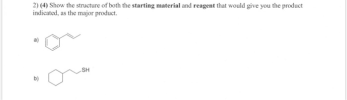 2) (4) Show the structure of both the starting material and reagent that would give you the product indicated, as the major product.
Scenario: You are responsible for preparing 2-butoxynaphthalene, a flavouring agent that has a strong raspberry taste....
 Scenario: You are responsible for preparing 2-butoxynaphthalene, a flavouring agent that has a strong raspberry taste. You look up the procedure for the preparation of your target compound and find the following: Sodium hydroxide (0.560 g) is added to a solution of 2-naphthol (0.995 g) in ethanol (14 mL) and the solution is heated to reflux. Once both the sodium hydroxide and the 2-naphthol go into solution, the 1-iodobutane (1.00 mL) is added slowly. After 15 minutes, the reaction mixture...
Show how you would prepare this product from the given starting material. Where more than one...
 Show how you would prepare this product from the given starting
material. Where more than one step is required, show each step
distinctly.
Los olosu losan w Ref. [71] KIO
Show how you would prepare this product from the given starting
material. Where more than one step is required, show each step
distinctly.
Los olosu losan w Ref. [71] KIO
1. An C-NMR of tetraphenylcyclopentadienone would have peaks where? (Could be multiple answers) a. 210 ppm...
1. An C-NMR of tetraphenylcyclopentadienone would have peaks where? (Could be multiple answers) a. 210 ppm b. 15 ppm c. 30 ppm d. 110-170 ppm 2. An IR of tetraphenylcyclopentadienone would have absorbances at which of the following frequencies? (Could be mulitple answers) a. 2200 cm-1 b. just below 3000 cm-1 c. 1720 cm-1 d. just above 3000 cm-1 3. What would your percent yield be if you obtained 0.25 g of the tetraphenylcyclopentadienone when you had used 0.145 g...
Name: Starting with the mass spectrum of n-heptane What is the molecular ion? What fragment is...
 Name: Starting with the mass spectrum of n-heptane What is the molecular ion? What fragment is lost to generate the ion with m/z =71? What cation does the peak at m/z = 43 represent? What group does the spacing between each set of ions represent? Why is the peak at (M-15), corresponding to loss of -CH3 so small? Draw the structure of 2,4-dimethylpentane What is the structure of the ion responsible for m/z = 85? Relative Intensity What is the...
1) Which base yields the most SN2 when treated with the same starting material? (draw this...
 1) Which base yields the most SN2 when treated with the same
starting material? (draw this structure with stereochemistry)
2)Which base would have the least yield of SN2?
3) What conclusions are made about the amount of SN2 product
formed as a function of base strength?
4) Discuss stereospecificity of an SN2 reaction and draw the
SN2 transition state intermediate formed when benzoate is treated
with starting material.
4. When the starting material shown below is treated with a variety...
1) Which base yields the most SN2 when treated with the same
starting material? (draw this structure with stereochemistry)
2)Which base would have the least yield of SN2?
3) What conclusions are made about the amount of SN2 product
formed as a function of base strength?
4) Discuss stereospecificity of an SN2 reaction and draw the
SN2 transition state intermediate formed when benzoate is treated
with starting material.
4. When the starting material shown below is treated with a variety...
 15. The mass spectrum of a compound appears below. The molecular ion, M+1, and M+2 peaks have intensities of 100, 6.8, and 31.8 respectively. Use the information provided to determine the formula of the compound 100 MS-NW-5495 80 60 40 20 шшшl 110 10 20 30 40 50 60 70 80 90 100 m/z Relative Intensity
15. The mass spectrum of a compound appears below. The molecular ion, M+1, and M+2 peaks have intensities of 100, 6.8, and 31.8 respectively....
15. The mass spectrum of a compound appears below. The molecular ion, M+1, and M+2 peaks have intensities of 100, 6.8, and 31.8 respectively. Use the information provided to determine the formula of the compound 100 MS-NW-5495 80 60 40 20 шшшl 110 10 20 30 40 50 60 70 80 90 100 m/z Relative Intensity
15. The mass spectrum of a compound appears below. The molecular ion, M+1, and M+2 peaks have intensities of 100, 6.8, and 31.8 respectively....
 3) For the reaction below, would the starting material (chalcone) or the product have longer retention times in a GC analysis using a non-polar column? Please explain. What is the difference in molecular weight between starting material and product? Pd/C + H2
 Synthesize the following, using only the starting material
provided. 1) with only acetylene ion 2) with only Grignard
Boule UI LUI DUL acetylene as you require). Place a circle or box around your answer for grading. so HH A) Synthesis using ONLY acetylide ions for C-C bond forming reactions (i.e. NO GRIGNARD!) B) Synthesis using ONLY Grignard for C-C bond forming reaction (i.e. NO ACETYLIDE ION!)
Synthesize the following, using only the starting material
provided. 1) with only acetylene ion 2) with only Grignard
Boule UI LUI DUL acetylene as you require). Place a circle or box around your answer for grading. so HH A) Synthesis using ONLY acetylide ions for C-C bond forming reactions (i.e. NO GRIGNARD!) B) Synthesis using ONLY Grignard for C-C bond forming reaction (i.e. NO ACETYLIDE ION!)
 2) (4) Show the structure of both the starting material and reagent that would give you the product indicated, as the major product.
 Scenario: You are responsible for preparing 2-butoxynaphthalene, a flavouring agent that has a strong raspberry taste. You look up the procedure for the preparation of your target compound and find the following: Sodium hydroxide (0.560 g) is added to a solution of 2-naphthol (0.995 g) in ethanol (14 mL) and the solution is heated to reflux. Once both the sodium hydroxide and the 2-naphthol go into solution, the 1-iodobutane (1.00 mL) is added slowly. After 15 minutes, the reaction mixture...
 Show how you would prepare this product from the given starting
material. Where more than one step is required, show each step
distinctly.
Los olosu losan w Ref. [71] KIO
Show how you would prepare this product from the given starting
material. Where more than one step is required, show each step
distinctly.
Los olosu losan w Ref. [71] KIO
 Name: Starting with the mass spectrum of n-heptane What is the molecular ion? What fragment is lost to generate the ion with m/z =71? What cation does the peak at m/z = 43 represent? What group does the spacing between each set of ions represent? Why is the peak at (M-15), corresponding to loss of -CH3 so small? Draw the structure of 2,4-dimethylpentane What is the structure of the ion responsible for m/z = 85? Relative Intensity What is the...
 1) Which base yields the most SN2 when treated with the same
starting material? (draw this structure with stereochemistry)
2)Which base would have the least yield of SN2?
3) What conclusions are made about the amount of SN2 product
formed as a function of base strength?
4) Discuss stereospecificity of an SN2 reaction and draw the
SN2 transition state intermediate formed when benzoate is treated
with starting material.
4. When the starting material shown below is treated with a variety...
1) Which base yields the most SN2 when treated with the same
starting material? (draw this structure with stereochemistry)
2)Which base would have the least yield of SN2?
3) What conclusions are made about the amount of SN2 product
formed as a function of base strength?
4) Discuss stereospecificity of an SN2 reaction and draw the
SN2 transition state intermediate formed when benzoate is treated
with starting material.
4. When the starting material shown below is treated with a variety...
Most questions answered within 3 hours.
-
Where is the error in this code sequence?
String s1 = "Hello";
String s2 = "ello";...
asked 10 months ago -
Financial data for Joel de Paris, Inc., for last year
follow:
Joel de Paris, Inc.
Balance...
asked 10 months ago -
Consider this reaction:
Al2(SO4)3 (aq)+ BaCl3
(aq) Al2Cl6 (aq)- +
3BaSO4(s) . What is the...
asked 10 months ago -
Suppose that Savneet is considering increasing her
recent random sample from 20 car rentals to 40...
asked 10 months ago -
Trucks arrive at an unloading terminal at an average rate of 120
per hour.
Trucks arrive...
asked 10 months ago -
Why are methanol and ethanol completely soluble in water while
octanol is not very little soluble....
asked 10 months ago -
A facilities manager at a university reads in a research report
that the mean amount of...
asked 10 months ago -
When the CuSO4 is rehydrated by adding water to the anhydrous
compound, is this an endothermic...
asked 10 months ago -
A ray of sunlight is passing from diamond into crown glass; the
angle of incidence is...
asked 10 months ago -
A block of mass 0.249 kg is placed on top of a light, vertical
spring of...
asked 10 months ago -
how do the kidneys compensate in the presences of acidosis
a) trigger hyperventilate
b) reserve acid...
asked 10 months ago -
Question 501 pts
The rental rate of capital to the firm increases. Which of the
following...
asked 10 months ago