Use the loanable funds market to illustrate the effect of the following events on the equilibrium....
Use the loanable funds market to illustrate the effect of the following events on the equilibrium. Illustrate the effects on the interest rate and quantity of investment-savings (explain thoroughly):
a) The proportion of retired people in the population goes up. Think that usually retired people generally save less than working people at any interest rate.
b) At any given interest rate, consumers decide to save more (assume the budget balance is zero).
c) At any given interest rate, businesses become very optimistic about the future profitability of investment spending (assume the budget balance is zero).
Homework Answers


Add Answer to:
Use the loanable funds market to illustrate the effect of the
following events on the equilibrium....
Use the loanable funds market to illustrate the effect of the following events on the equilibrium....
Use the loanable funds market to illustrate the effect of the following events on the equilibrium. Illustrate the effects on the interest rate and quantity of investment-savings (explain thoroughly): At any given interest rate, businesses become very optimistic about the future profitability of investment spending (assume the budget balance is zero).
The market for loanable funds and government policy
The following graph shows the market for loanable funds. For each of the given scenarios, adjust the appropriate curve on the graph to help you complete the questions that follow. (Note: You will not be graded on any changes you make to the graph.)DemandSupplyINTEREST RATE (Percent)LOANABLE FUNDS (Billions of dollars)Demand Supply Registered retirement savings plans (RRSPs) allow people to shelter some of their income from taxation. Suppose the maximum annual contribution to such accounts is $5,000 per person. Now suppose there is...
4. Assume that the equilibrium in the loanable funds market is at interest rate of 1.25%...
4. Assume that the equilibrium in the loanable funds market is at interest rate of 1.25% and quantity of funds at $20 billion. Suppose the current government deficit is zero so government is not borrowing any money. a) Suppose now government increases spending by $2 billion and finances it entirely by borrowing. This deficit increases equilibrium interest rate to 2% and equilibrium quantity of funds to $21.5. Show the changes on the graph. b) What happens to private investment (I)...
4. Assume that the equilibrium in the loanable funds market is at interest rate of 1.25%...
4. Assume that the equilibrium in the loanable funds market is at interest rate of 1.25% and quantity of funds at $20 billion. Suppose the current government deficit is zero so government is not borrowing any money. a) Suppose now government increases spending by $2 billion and finances it entirely by borrowing. This deficit increases equilibrium interest rate to 2% and equilibrium quantity of funds to $21.5. Show the changes on the graph. b) What happens to private investment (I)...
Retired people generally save less than working people at any interest rate. The proportion of retired...
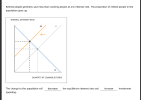 Retired people generally save less than working people at any interest rate. The proportion of retired people in the population goes up. NOMINAL INTEREST RATE S2 S1 QUANTITY OF LOANABLE FUNDS The change to the population wil decrease the equilibrium interest rate andincrease investment spending
5. The market for loanable funds and government policy The following graph shows the market for...
 5. The market for loanable funds and government policy The following graph shows the market for loanable funds. For each of the given scenarios, adjust the appropriate curve on the graph to help you complete the questions that follow. Treat each scenario separately by resetting the graph to its original state before examining the effect of each individual scenario. (Note: You will not be graded on any changes you make to the graph.) Demand - 0 Supply INTEREST RATE (Percent)...
5. The market for loanable funds and government policy The following graph shows the market for...
 5. The market for loanable funds and government policy The following graph shows the market for loanable funds. For each of the given scenarios, adjust the appropriate curve on the graph to help you complete the questions that follow. Treat each scenario separately by resetting the graph to its original state before examining the effect of each Individual scenario. (Note: You will not be graded on any changes you make to the graph.) Demand Supply ATE (Percent) Supply Homework (Ch...
5. The market for loanable funds and government policy The following graph shows the market for...
 5. The market for loanable funds and government policy The following graph shows the market for loanable funds. For each of the given scenarios, adjust the appropriate curve on the graph to help you complete the questions that follow. Treat each scenario separately by resetting the graph to its original state before examining the effect of each individual scenario. (Note: You will not be graded on any changes you make to the graph.) Demand Supply Supply Demand LOANABLE FUNDS (Billions...
5. The market for loanable funds and government policy The following graph shows the market for...
 5. The market for loanable funds and government policy The following graph shows the market for loanable funds. For each of the given scenarios, adjust the appropriate curve on the graph to help you complete the questions that follow. Treat each scenario separately by resetting the graph to its original state before examining the effect of each Individual scenario. (Note: You will not be graded on any changes you make to the graph.) INTERESTREP LOANASLE PUNOS Scenario 1: Individual Retirement...
The following graph shows the market for loanable funds. For each of the given scenarios, adjust...
 The following graph shows the market for loanable funds. For
each of the given scenarios, adjust the appropriate curve on the
graph to help you complete the questions that follow. Treat each
scenario separately by resetting the graph to its original state
before examining the effect of each individual scenario.
Demand Supply Supply INTEREST RATE (Percent) Demand LOANABLE FUNDS (Billions of dollars) Scenario 1: Individual Retirement Accounts (IRAS) allow people to shelter some of their income from taxation. Suppose the...
The following graph shows the market for loanable funds. For
each of the given scenarios, adjust the appropriate curve on the
graph to help you complete the questions that follow. Treat each
scenario separately by resetting the graph to its original state
before examining the effect of each individual scenario.
Demand Supply Supply INTEREST RATE (Percent) Demand LOANABLE FUNDS (Billions of dollars) Scenario 1: Individual Retirement Accounts (IRAS) allow people to shelter some of their income from taxation. Suppose the...
 Retired people generally save less than working people at any interest rate. The proportion of retired people in the population goes up. NOMINAL INTEREST RATE S2 S1 QUANTITY OF LOANABLE FUNDS The change to the population wil decrease the equilibrium interest rate andincrease investment spending
 5. The market for loanable funds and government policy The following graph shows the market for loanable funds. For each of the given scenarios, adjust the appropriate curve on the graph to help you complete the questions that follow. Treat each scenario separately by resetting the graph to its original state before examining the effect of each individual scenario. (Note: You will not be graded on any changes you make to the graph.) Demand - 0 Supply INTEREST RATE (Percent)...
 5. The market for loanable funds and government policy The following graph shows the market for loanable funds. For each of the given scenarios, adjust the appropriate curve on the graph to help you complete the questions that follow. Treat each scenario separately by resetting the graph to its original state before examining the effect of each Individual scenario. (Note: You will not be graded on any changes you make to the graph.) Demand Supply ATE (Percent) Supply Homework (Ch...
 5. The market for loanable funds and government policy The following graph shows the market for loanable funds. For each of the given scenarios, adjust the appropriate curve on the graph to help you complete the questions that follow. Treat each scenario separately by resetting the graph to its original state before examining the effect of each individual scenario. (Note: You will not be graded on any changes you make to the graph.) Demand Supply Supply Demand LOANABLE FUNDS (Billions...
 5. The market for loanable funds and government policy The following graph shows the market for loanable funds. For each of the given scenarios, adjust the appropriate curve on the graph to help you complete the questions that follow. Treat each scenario separately by resetting the graph to its original state before examining the effect of each Individual scenario. (Note: You will not be graded on any changes you make to the graph.) INTERESTREP LOANASLE PUNOS Scenario 1: Individual Retirement...
 The following graph shows the market for loanable funds. For
each of the given scenarios, adjust the appropriate curve on the
graph to help you complete the questions that follow. Treat each
scenario separately by resetting the graph to its original state
before examining the effect of each individual scenario.
Demand Supply Supply INTEREST RATE (Percent) Demand LOANABLE FUNDS (Billions of dollars) Scenario 1: Individual Retirement Accounts (IRAS) allow people to shelter some of their income from taxation. Suppose the...
The following graph shows the market for loanable funds. For
each of the given scenarios, adjust the appropriate curve on the
graph to help you complete the questions that follow. Treat each
scenario separately by resetting the graph to its original state
before examining the effect of each individual scenario.
Demand Supply Supply INTEREST RATE (Percent) Demand LOANABLE FUNDS (Billions of dollars) Scenario 1: Individual Retirement Accounts (IRAS) allow people to shelter some of their income from taxation. Suppose the...
Most questions answered within 3 hours.
-
Where is the error in this code sequence?
String s1 = "Hello";
String s2 = "ello";...
asked 11 months ago -
Financial data for Joel de Paris, Inc., for last year
follow:
Joel de Paris, Inc.
Balance...
asked 11 months ago -
Consider this reaction:
Al2(SO4)3 (aq)+ BaCl3
(aq) Al2Cl6 (aq)- +
3BaSO4(s) . What is the...
asked 11 months ago -
Suppose that Savneet is considering increasing her
recent random sample from 20 car rentals to 40...
asked 11 months ago -
Trucks arrive at an unloading terminal at an average rate of 120
per hour.
Trucks arrive...
asked 11 months ago -
Why are methanol and ethanol completely soluble in water while
octanol is not very little soluble....
asked 11 months ago -
A facilities manager at a university reads in a research report
that the mean amount of...
asked 11 months ago -
When the CuSO4 is rehydrated by adding water to the anhydrous
compound, is this an endothermic...
asked 11 months ago -
A ray of sunlight is passing from diamond into crown glass; the
angle of incidence is...
asked 11 months ago -
A block of mass 0.249 kg is placed on top of a light, vertical
spring of...
asked 11 months ago -
how do the kidneys compensate in the presences of acidosis
a) trigger hyperventilate
b) reserve acid...
asked 11 months ago -
Question 501 pts
The rental rate of capital to the firm increases. Which of the
following...
asked 11 months ago