Determine the required raise of temperature from 723oC to increase the number of vacancies by a...
Determine the required raise of temperature from 723oC to increase the number of vacancies by a factor of 6.5. Assuming that the density of the metal remains constant. (The gas constant is 8.314 J/mol-K and the activation energy for vacancy formation is 163 kJ/mol). Na=6.022x23 atoms/mol.
Homework Answers

Add Answer to:
Determine the required raise of temperature from
723oC to increase the number of vacancies by a...
Chapter 04, Reserve Problem 01: Energy from temperature x Incorrect The number of vacancies in some...
 Chapter 04, Reserve Problem 01: Energy from temperature x Incorrect The number of vacancies in some hypothetical metal increases by a factor of 4 when the temperature is increased from 1000 K to 1180 K. Calculate the energy (in kJ/mol) for vacancy formation assuming that the density of the metal remains the same over this temperature range. || 1.255e-22 kJ/mol
The number of vacancies in some hypothetical metal increases by a factor of 4 when the...
 The number of vacancies in some hypothetical metal increases by a factor of 4 when the temperature is increased from 1070 K to 1140 K. Calculate the energy (in kJ/mol for vacancy formation assuming that the density of the metal remains the same over this temperature range. kJ/mol
The number of vacancies in some hypothetical metal increases by a factor of 5 when the...
The number of vacancies in some hypothetical metal increases by a factor of 5 when the temperature is increased from 1000 K to 1160 K. Calculate the energy (in kJ/mol) for vacancy formation assuming that the density of the metal remains the same over this temperature range.
The number of vacancies in some hypothetical metal increases by a factor of 4 when the...
The number of vacancies in some hypothetical metal increases by a factor of 4 when the temperature is increased from 900 ˚C to 1130 ˚C. Calculate the energy for vacancy formation (in J/mol) assuming that the density of the metal remains the same over this temperature range.
The number of vacancies in some hypothetical metal increases by a factor of 6 when the...
The number of vacancies in some hypothetical metal increases by a factor of 6 when the temperature is increased from 1040 ˚C to 1280 ˚C. Calculate the energy for vacancy formation (in J/mol) assuming that the density of the metal remains the same over this temperature range.
Calculate the activation energy for vacancy formation in aluminum, given that the equilibrium number of vacancies...
Calculate the activation energy for vacancy formation in aluminum, given that the equilibrium number of vacancies at 500°C (773 K) is 7.57 × 10²³ m−3. The atomic weight and density (at 500°C) for aluminum are, respectively, 26.98 g/mol and 2.62 g/cm3.
At room temperature, the equilibrium number of vacancies in pure aluminum is one vacancy every 107...
At room temperature, the equilibrium number of vacancies in pure aluminum is one vacancy every 107 atoms. Pure aluminum is heated to 650 oC where it has 1 vacancy every 1000 atoms at equilibrium. The crystal is then rapidly quenched to room temperature to prevent any vacancy from escaping or from reaching the equilibrium number of vacancies. After this rapid quenching, the density is accurately measured and found to be 2.698 g/cm3. (i) Compare this density with the theoretical density...
The number of vacancies present in some metal at 729 Celsius is 1.4E24 m^-3. calculate the...
The number of vacancies present in some metal at 729 Celsius is 1.4E24 m^-3. calculate the number of vacancies at 472 Celsius given that the energy for vacancy formation is 1.18 eV/atom; assume that the density at both temperature is the same
Calculate the equilibrium concentration of vacancies per cubic meter in pure copper at 800°C. Assume that...
Calculate the equilibrium concentration of vacancies per cubic meter in pure copper at 800°C. Assume that the energy of formation of a vacancy in pure copper is 0.98 eV. What is the vacancy fraction at 850°C? (Given the Avogadro’s number, NA=6.023×10²³ atoms/mol, Boltzmann’s constant, k = 8.62×10⁻⁵ eV/atom.K. Cu=8.96 g/cm3 and ACu=63.54 g/mol.
MME 223: Engineering Materials Practice/Example Problems for Chapter 4 Calculate the number of vacancies in aluminum...
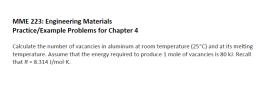 MME 223: Engineering Materials Practice/Example Problems for Chapter 4 Calculate the number of vacancies in aluminum at room temperature (25°C) and at its melting temperature. Assume that the energy required to produce 1 mole of vacancies is 80 kJ. Recall that R 8.314 J/mol K
 Chapter 04, Reserve Problem 01: Energy from temperature x Incorrect The number of vacancies in some hypothetical metal increases by a factor of 4 when the temperature is increased from 1000 K to 1180 K. Calculate the energy (in kJ/mol) for vacancy formation assuming that the density of the metal remains the same over this temperature range. || 1.255e-22 kJ/mol
 The number of vacancies in some hypothetical metal increases by a factor of 4 when the temperature is increased from 1070 K to 1140 K. Calculate the energy (in kJ/mol for vacancy formation assuming that the density of the metal remains the same over this temperature range. kJ/mol
 MME 223: Engineering Materials Practice/Example Problems for Chapter 4 Calculate the number of vacancies in aluminum at room temperature (25°C) and at its melting temperature. Assume that the energy required to produce 1 mole of vacancies is 80 kJ. Recall that R 8.314 J/mol K
Most questions answered within 3 hours.
-
Where is the error in this code sequence?
String s1 = "Hello";
String s2 = "ello";...
asked 11 months ago -
Financial data for Joel de Paris, Inc., for last year
follow:
Joel de Paris, Inc.
Balance...
asked 11 months ago -
Consider this reaction:
Al2(SO4)3 (aq)+ BaCl3
(aq) Al2Cl6 (aq)- +
3BaSO4(s) . What is the...
asked 11 months ago -
Suppose that Savneet is considering increasing her
recent random sample from 20 car rentals to 40...
asked 11 months ago -
Trucks arrive at an unloading terminal at an average rate of 120
per hour.
Trucks arrive...
asked 11 months ago -
Why are methanol and ethanol completely soluble in water while
octanol is not very little soluble....
asked 11 months ago -
A facilities manager at a university reads in a research report
that the mean amount of...
asked 11 months ago -
When the CuSO4 is rehydrated by adding water to the anhydrous
compound, is this an endothermic...
asked 11 months ago -
A ray of sunlight is passing from diamond into crown glass; the
angle of incidence is...
asked 11 months ago -
A block of mass 0.249 kg is placed on top of a light, vertical
spring of...
asked 11 months ago -
how do the kidneys compensate in the presences of acidosis
a) trigger hyperventilate
b) reserve acid...
asked 11 months ago -
Question 501 pts
The rental rate of capital to the firm increases. Which of the
following...
asked 11 months ago