2a.(i) State Hooke's Law's (ii) An experiment was carried out in the laboratory on an elastic...
2a.(i) State Hooke's Law's
(ii) An experiment was carried out in the laboratory on an elastic
material ,if the Fn was plotted against Extension ΔL,with suitable
diagram show the following :(a) Yield Point (b) Elastic limit (c)
Permanent deformation point (d) Fracture point
Hence ,highlights sections on the graph where's Hooke's law is
obeyed and where there is no proportionality between stress and
strain
(b) (i)From the extensive work of Leonardo da Vinci (1452-1519) and
that of Charles coloumb (1736-1806),list the Laws of Friction as
regard to forced between two surfaces.
(ii)A proton travelling at 107m/s collides with
stationery particles and bounces back at 2 x 10⁶m/s .if
the particles moves forwards at 3 x 10⁸m/s ,find it's
massive [Mass of proton =1.67 x 10⁻²⁷kg]
Homework Answers
i.
Hooke's laws are:
1.The force needed to extend or compress a spring by some distance is proportional to that distance.
Mathematically, F=-kX where F is the force applied, k is the spring constant and X is the displacement of the spring.
2.Hooke's law states the strain on the material is directly proportional to the stress applied to the material
ii.
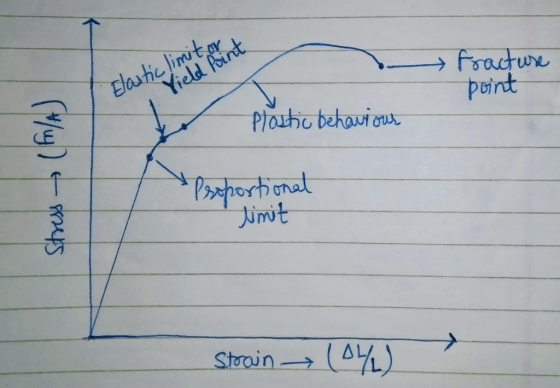
Till the proportional limit point ,Hooke's law is followed.Afterwards there is no proportionality.
iii.LAWS OF FRICTION:
1. When a body is moving, the friction is directly proportional to normal force and frictional force direction is perpendicular to the normal force.
2.Friction doesn't depend on area of contact till there is an area of contact.
3.The coefficient of static friction is higher than the coefficient of kinetic friction.
4.Kinetic friction is independent of the velocity of the body
5.Friction depends on the type of the surfaces in contact.
iv.
Here we have to conserve the momentum.
m1u1+m2u2=m1v1+m2v2
Here ,
m1 = mass of proton , m2 is the mass of unknown matter, u1,u2 are the initial velocity and v1,v2 are the final velocity of proton and the unknown mass respectively.
Putting the values we get,
[u2 =0 as given]
(1.67 x 10⁻²⁷kG)(107m/s) + m2(0) =(1.67 x 10⁻²⁷kG)(-2 x 10⁶m/s) + m2(3 x 10⁸m/s)
Solving this , we get
m2 =6.68 x10⁻²⁹kG
Add Answer to:
2a.(i) State Hooke's Law's
(ii) An experiment was carried out in the laboratory on an elastic...
Most questions answered within 3 hours.
-
Where is the error in this code sequence?
String s1 = "Hello";
String s2 = "ello";...
asked 11 months ago -
Financial data for Joel de Paris, Inc., for last year
follow:
Joel de Paris, Inc.
Balance...
asked 11 months ago -
Consider this reaction:
Al2(SO4)3 (aq)+ BaCl3
(aq) Al2Cl6 (aq)- +
3BaSO4(s) . What is the...
asked 11 months ago -
Suppose that Savneet is considering increasing her
recent random sample from 20 car rentals to 40...
asked 11 months ago -
Trucks arrive at an unloading terminal at an average rate of 120
per hour.
Trucks arrive...
asked 11 months ago -
Why are methanol and ethanol completely soluble in water while
octanol is not very little soluble....
asked 11 months ago -
A facilities manager at a university reads in a research report
that the mean amount of...
asked 11 months ago -
When the CuSO4 is rehydrated by adding water to the anhydrous
compound, is this an endothermic...
asked 11 months ago -
A ray of sunlight is passing from diamond into crown glass; the
angle of incidence is...
asked 11 months ago -
A block of mass 0.249 kg is placed on top of a light, vertical
spring of...
asked 11 months ago -
how do the kidneys compensate in the presences of acidosis
a) trigger hyperventilate
b) reserve acid...
asked 11 months ago -
Question 501 pts
The rental rate of capital to the firm increases. Which of the
following...
asked 11 months ago