Find the constant volume combustion adiabatic flame temperature for stoichiometric methane and air initially at standard...
Find the constant volume combustion adiabatic flame temperature for stoichiometric methane and air initially at standard conditions. Assume complete combustion. The constant pressure AFT for methane and air is 2327 K. Why is the AFT is higher for constant volume combustion?
Homework Answers
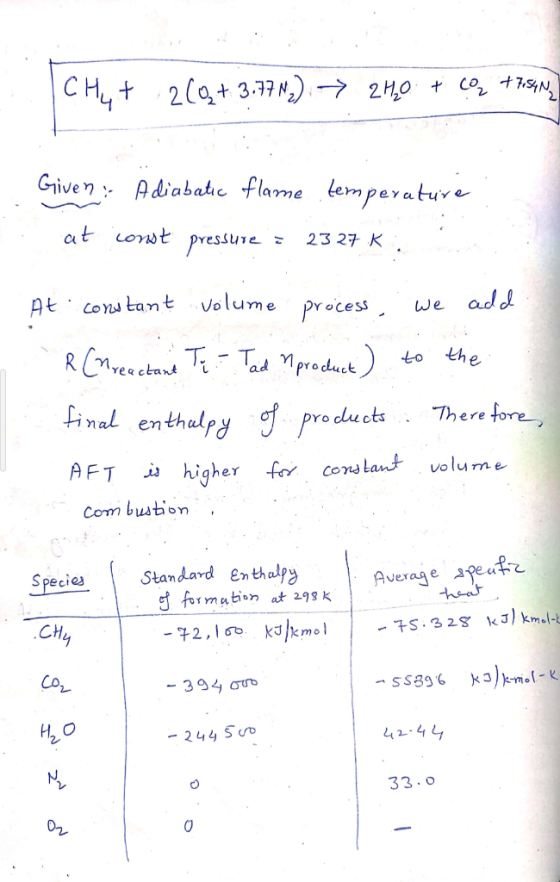
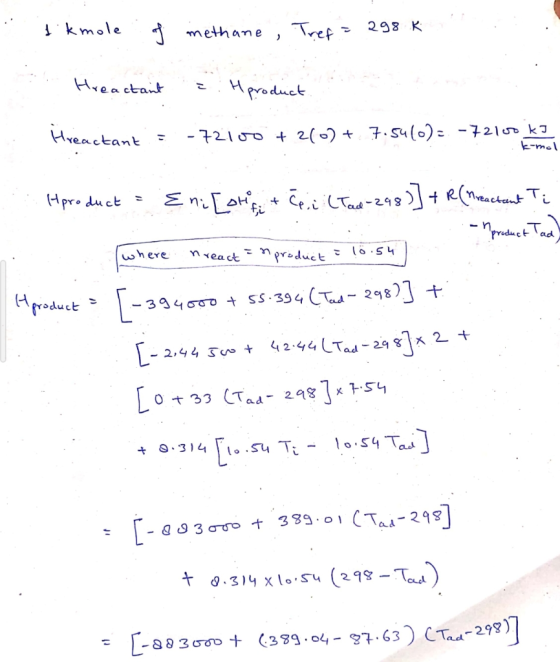
 thus AFT at constant volume is
2988.35 K
thus AFT at constant volume is
2988.35 K
AFT at constant volume is greater than AFT at constant pressure because no energy is utilised to change the volume of the system (work done is zero for constant volume process)
Add Answer to:
Find the constant volume combustion adiabatic flame temperature
for stoichiometric methane and air initially at standard...
Write the balanced stoichiometric combustion equation of dimethyl ether(CH3OCH3) and calculate the adiabatic flame temperature by...
Write the balanced stoichiometric combustion equation of dimethyl ether(CH3OCH3) and calculate the adiabatic flame temperature by hand.
For calculating an "adiabatic flame temperature" it is customary to assume that the reactants (input) are...
 For
calculating an "adiabatic flame temperature" it is customary to
assume that the reactants (input) are at the reference temperature
(298 K or 537 oR).
Psi is equal to 3
Your assigned value of wis (You will lose 1 pt if this is blank). Methane (CH) is burned with (110 +0.3 )% of theoretical air. (Hence, if y = 3 the methane is burned with 110.9% theoretical air). The mixture enters the combustion chamber at 25°C. A) Find the Air/Fuel...
For
calculating an "adiabatic flame temperature" it is customary to
assume that the reactants (input) are at the reference temperature
(298 K or 537 oR).
Psi is equal to 3
Your assigned value of wis (You will lose 1 pt if this is blank). Methane (CH) is burned with (110 +0.3 )% of theoretical air. (Hence, if y = 3 the methane is burned with 110.9% theoretical air). The mixture enters the combustion chamber at 25°C. A) Find the Air/Fuel...
What is the adiabatic flame temperature of methane (CH4) when it is burned with 30 percent excess...
What is the adiabatic flame temperature of methane (CH4) when it is burned with 30 percent excess air? Use data from the tables. The adiabatic flame temperature of methane is ____°C.
Methane (CH4) is burned with 110.9 % of theoretical air. The mixture enters the combustion chamber...
 Methane (CH4) is burned with 110.9 % of theoretical air. The mixture enters the combustion chamber at 25°C. 1) Find the Air/Fuel ratio for this mixture: AF = (+ 0.03) 2) Find the adiabatic flame temperature for the mixture. Tadiabitic flame = OC (+ 20°C) 3) Find the mole fraction of the N2 in the exhaust. YN2 =
A stoichiometric mixture of methane air, initially at 298 K and 1 atm pressure, combust to...
 A stoichiometric mixture of methane air, initially at 298 K and 1 atm pressure, combust to form products in a large room. It is wise to read Example 5.2 before doing the next set of problems. $15. The thermal diffusivity, a, is a thermodynamic property because it is a function of other thermodynamic properties. Determine a for air at 1300 K. Note that the temperatures in Appendix B are in K. Example 5.2 Estimate the laminar flame speed of a...
B. Butane at room temperature is fed to an adiabatic reactor where it undergoes a combustion...
 B. Butane at room temperature is fed to an adiabatic reactor where it undergoes a combustion reaction. Consider the following two feed conditions, both of which include a stoichiometric amount of oxygen: (1) air at room temperature and (2) pure oxygen at room temperature. Assuming that the combustion reaction goes to completion in both cases, which will result in the highest outlet temperature? Circle and explain your answer to receive full credit. (4 pts) a. It doesn't matter, the temperature...
Help with a combustion problem! A flame exhaust has the composition (by volume) of 14% CO2,...
 Help with a combustion problem!
A flame exhaust has the composition (by volume) of 14% CO2, 2% O2, 12% H20, the rest N2 and a flame temperature of 1900 K at a pressure of 31 atm. Calculate the equilibrium mole fraction of H from the dissociation reaction: H2O H2H + 1202 Assume that the effect on the mole fractions of the major species is negligible.
Help with a combustion problem!
A flame exhaust has the composition (by volume) of 14% CO2, 2% O2, 12% H20, the rest N2 and a flame temperature of 1900 K at a pressure of 31 atm. Calculate the equilibrium mole fraction of H from the dissociation reaction: H2O H2H + 1202 Assume that the effect on the mole fractions of the major species is negligible.
Help with a combustion problem! A flame exhaust has the composition (by volume) of 14% CO2,...
 Help with a combustion problem!
A flame exhaust has the composition (by volume) of 14% CO2, 2% O2, 12% H20, the rest N2 and a flame temperature of 1900 K at a pressure of 31 atm. Calculate the equilibrium mole fraction of H from the dissociation reaction: H2O H2H + 1202 Assume that the effect on the mole fractions of the major species is negligible.
Help with a combustion problem!
A flame exhaust has the composition (by volume) of 14% CO2, 2% O2, 12% H20, the rest N2 and a flame temperature of 1900 K at a pressure of 31 atm. Calculate the equilibrium mole fraction of H from the dissociation reaction: H2O H2H + 1202 Assume that the effect on the mole fractions of the major species is negligible.
ead of , It a stoichiometric mixture of natural &h adiabatic combustor. Note: Assume all gases...
 ead of , It a stoichiometric mixture of natural &h adiabatic combustor. Note: Assume all gases Oz are ideal, complete combustion, Air:(20%?2.80%N2. ide gas anua N2 3.5 CO2 4.5 CH4 H20 Gas 3.5 4 A heavy duty spherical balloon full of water at 20 °C and 1.1 bar is placed , and after some time, the temperature of the water rises to 33°C, he diameter of the balloon increases by 0.1%. Determine the pressure after in the sun, inside the...
Consider the combustion products of decane (C_10H_22) with air in a steady state, steady flow process...
 Consider the combustion products of decane (C_10H_22) with air in a steady state, steady flow process at an equivalence ratio of 1.25 and pressure of 1 atm. Estimate the mixture composition assuming no dissociation except for water gas shift equilibrium if the exit temperature is fixed at 2200 K. Estimate the mixture composition and constant pressure adiabatic flame temperature of the process assuming no dissociation except for water gas shift equilibrium.
 For
calculating an "adiabatic flame temperature" it is customary to
assume that the reactants (input) are at the reference temperature
(298 K or 537 oR).
Psi is equal to 3
Your assigned value of wis (You will lose 1 pt if this is blank). Methane (CH) is burned with (110 +0.3 )% of theoretical air. (Hence, if y = 3 the methane is burned with 110.9% theoretical air). The mixture enters the combustion chamber at 25°C. A) Find the Air/Fuel...
For
calculating an "adiabatic flame temperature" it is customary to
assume that the reactants (input) are at the reference temperature
(298 K or 537 oR).
Psi is equal to 3
Your assigned value of wis (You will lose 1 pt if this is blank). Methane (CH) is burned with (110 +0.3 )% of theoretical air. (Hence, if y = 3 the methane is burned with 110.9% theoretical air). The mixture enters the combustion chamber at 25°C. A) Find the Air/Fuel...
 Methane (CH4) is burned with 110.9 % of theoretical air. The mixture enters the combustion chamber at 25°C. 1) Find the Air/Fuel ratio for this mixture: AF = (+ 0.03) 2) Find the adiabatic flame temperature for the mixture. Tadiabitic flame = OC (+ 20°C) 3) Find the mole fraction of the N2 in the exhaust. YN2 =
 A stoichiometric mixture of methane air, initially at 298 K and 1 atm pressure, combust to form products in a large room. It is wise to read Example 5.2 before doing the next set of problems. $15. The thermal diffusivity, a, is a thermodynamic property because it is a function of other thermodynamic properties. Determine a for air at 1300 K. Note that the temperatures in Appendix B are in K. Example 5.2 Estimate the laminar flame speed of a...
 B. Butane at room temperature is fed to an adiabatic reactor where it undergoes a combustion reaction. Consider the following two feed conditions, both of which include a stoichiometric amount of oxygen: (1) air at room temperature and (2) pure oxygen at room temperature. Assuming that the combustion reaction goes to completion in both cases, which will result in the highest outlet temperature? Circle and explain your answer to receive full credit. (4 pts) a. It doesn't matter, the temperature...
 Help with a combustion problem!
A flame exhaust has the composition (by volume) of 14% CO2, 2% O2, 12% H20, the rest N2 and a flame temperature of 1900 K at a pressure of 31 atm. Calculate the equilibrium mole fraction of H from the dissociation reaction: H2O H2H + 1202 Assume that the effect on the mole fractions of the major species is negligible.
Help with a combustion problem!
A flame exhaust has the composition (by volume) of 14% CO2, 2% O2, 12% H20, the rest N2 and a flame temperature of 1900 K at a pressure of 31 atm. Calculate the equilibrium mole fraction of H from the dissociation reaction: H2O H2H + 1202 Assume that the effect on the mole fractions of the major species is negligible.
 Help with a combustion problem!
A flame exhaust has the composition (by volume) of 14% CO2, 2% O2, 12% H20, the rest N2 and a flame temperature of 1900 K at a pressure of 31 atm. Calculate the equilibrium mole fraction of H from the dissociation reaction: H2O H2H + 1202 Assume that the effect on the mole fractions of the major species is negligible.
Help with a combustion problem!
A flame exhaust has the composition (by volume) of 14% CO2, 2% O2, 12% H20, the rest N2 and a flame temperature of 1900 K at a pressure of 31 atm. Calculate the equilibrium mole fraction of H from the dissociation reaction: H2O H2H + 1202 Assume that the effect on the mole fractions of the major species is negligible.
 ead of , It a stoichiometric mixture of natural &h adiabatic combustor. Note: Assume all gases Oz are ideal, complete combustion, Air:(20%?2.80%N2. ide gas anua N2 3.5 CO2 4.5 CH4 H20 Gas 3.5 4 A heavy duty spherical balloon full of water at 20 °C and 1.1 bar is placed , and after some time, the temperature of the water rises to 33°C, he diameter of the balloon increases by 0.1%. Determine the pressure after in the sun, inside the...
 Consider the combustion products of decane (C_10H_22) with air in a steady state, steady flow process at an equivalence ratio of 1.25 and pressure of 1 atm. Estimate the mixture composition assuming no dissociation except for water gas shift equilibrium if the exit temperature is fixed at 2200 K. Estimate the mixture composition and constant pressure adiabatic flame temperature of the process assuming no dissociation except for water gas shift equilibrium.
Most questions answered within 3 hours.
-
Where is the error in this code sequence?
String s1 = "Hello";
String s2 = "ello";...
asked 11 months ago -
Financial data for Joel de Paris, Inc., for last year
follow:
Joel de Paris, Inc.
Balance...
asked 11 months ago -
Consider this reaction:
Al2(SO4)3 (aq)+ BaCl3
(aq) Al2Cl6 (aq)- +
3BaSO4(s) . What is the...
asked 11 months ago -
Suppose that Savneet is considering increasing her
recent random sample from 20 car rentals to 40...
asked 11 months ago -
Trucks arrive at an unloading terminal at an average rate of 120
per hour.
Trucks arrive...
asked 11 months ago -
Why are methanol and ethanol completely soluble in water while
octanol is not very little soluble....
asked 11 months ago -
A facilities manager at a university reads in a research report
that the mean amount of...
asked 11 months ago -
When the CuSO4 is rehydrated by adding water to the anhydrous
compound, is this an endothermic...
asked 11 months ago -
A ray of sunlight is passing from diamond into crown glass; the
angle of incidence is...
asked 11 months ago -
A block of mass 0.249 kg is placed on top of a light, vertical
spring of...
asked 11 months ago -
how do the kidneys compensate in the presences of acidosis
a) trigger hyperventilate
b) reserve acid...
asked 11 months ago -
Question 501 pts
The rental rate of capital to the firm increases. Which of the
following...
asked 11 months ago