I mixed 160 ul of serum with 40ul of water. I then pipetted 1000ul of glucose...
I mixed 160 ul of serum with 40ul of water. I then pipetted 1000ul of glucose oxidase reagent into the tube. I ran the test and got a glucose result of 107 mg/dL.
Using that result what is the expected glucose concentration of the original sample.
Homework Answers
Concentration of glucose in final solution (M2) = 107 mg/dL.
Volume of the serum solution (V2) = (160+40) ul = 200 ul.
Initial volume of the serum (V1) = 160 ul.
Initial concentration of glucose in serum = M1 .
For dilution,
Moles of glucose = M1V1= M2V2
Or , M1 × 160 (ul) = 107 (mg/dL) × 200(ul)
Or, M1 = {(107×200)/160)}
Or, M1 = 133.75 mg/dL.
Therefore,
expected glucose concentration of the orginal sample is 133.75 mg/dL.
Add Answer to:
I mixed 160 ul of serum with 40ul of water. I then
pipetted 1000ul of glucose...
-What is the molarity of 1.5 N CaCl2? -You take 1 mL of patient serum and...
-What is the molarity of 1.5 N CaCl2? -You take 1 mL of patient serum and add it to 3 mL of water. Next, you take 1 mL of the dilution you just made and add it to 4 mL of water. You perform a glucose test using this final sample and receive a result of 6 mg/dL. a. What is the dilution factor of the final sample? b. Is the patient’s glucose value in the reference range?
1) Well 1 contains 20 uL of serum. Wells 2-6 contain 90 uL of water. To...
1) Well 1 contains 20 uL of serum. Wells 2-6 contain 90 uL of water. To do a serial dilution of 10% concentration (not volume) for each dilution, how many uL of liquid do you move between each well? ype your answer as a whole number of uL, but do not type the "uL" label. 2) Well 1 contains 20 uL of serum. Wells 2-6 contain 90 uL of water. What is the final concentration of well 6 if you...
1-4 Pipette 0.1 ml serum and 0.3 mL DI water to a small tube and mix....
 1-4
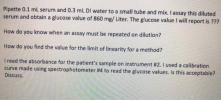
Pipette 0.1 ml serum and 0.3 mL DI water to a small tube and mix. I assay this diluted serum and obtain a glucose value of 860 mg/ Liter. The glucose value I will report is ??? How do you know when an assay must be repeated on dilution? How do you find the value for the limit of linearity for a method? I read the absorbance for the patient's sample on instrument #2. I used a calibration curve...
1-4
Pipette 0.1 ml serum and 0.3 mL DI water to a small tube and mix. I assay this diluted serum and obtain a glucose value of 860 mg/ Liter. The glucose value I will report is ??? How do you know when an assay must be repeated on dilution? How do you find the value for the limit of linearity for a method? I read the absorbance for the patient's sample on instrument #2. I used a calibration curve...
dilutions dilutions What are the resulting dilutions? Notice units of measurement. a) b) c) 500 L...
 dilutions
What are the resulting dilutions? Notice units of measurement. a) b) c) 500 L of serum is diluted to 2.0 mL 50 uL of whole blood is pipetted into 0.95 mL of diluent 500 mL of liquid K is added to 4.5 L of water 7. If 10 uL of urine is added to 90 uL of water, and the resulting solution is brought to a final volume of 0.50 mL with water, what is the final dilution...
dilutions
dilutions
What are the resulting dilutions? Notice units of measurement. a) b) c) 500 L of serum is diluted to 2.0 mL 50 uL of whole blood is pipetted into 0.95 mL of diluent 500 mL of liquid K is added to 4.5 L of water 7. If 10 uL of urine is added to 90 uL of water, and the resulting solution is brought to a final volume of 0.50 mL with water, what is the final dilution...
please answer questions 1 through 6 with the information provided. Enzyme Specificity Are Sucrase and Lactase...
 please answer questions 1 through 6 with the
information provided.
Enzyme Specificity Are Sucrase and Lactase specific to Sucrose and Lactose? I: Experimental Procedure 1. Add 0.3 g of sucrose to three different test tubes. Make sure to remember to label them 1 to 3. 2. Add 5 mL of Dl water to test tube number 1. Add 5 mL of sucrase to test tube 2. Add 5 ml of lactase to test tube 3. 3. Add 0.3 g of...
please answer questions 1 through 6 with the
information provided.
Enzyme Specificity Are Sucrase and Lactase specific to Sucrose and Lactose? I: Experimental Procedure 1. Add 0.3 g of sucrose to three different test tubes. Make sure to remember to label them 1 to 3. 2. Add 5 mL of Dl water to test tube number 1. Add 5 mL of sucrase to test tube 2. Add 5 ml of lactase to test tube 3. 3. Add 0.3 g of...
1) if 5 parts sample is added to 10 parts diluents, what is the dilution that...
1) if 5 parts sample is added to 10 parts diluents, what is the dilution that was just made? 2. What is the ratio if 5 parts sample volume is added to 10 parts diluents volume? 3. In a 1 to 3 dilution, what is the dilution FACTOR? 4. In a 1 to 10 dilution, what is the dilution FACTOR? 5. What is the dilution FACTOR if 40 mcL of sample added to 260 mcL of diluent? 6. What is...
I need to write a conclusion for this lab. Based off these results what kinds of...
 I need to write a conclusion for this lab. Based off these
results what kinds of conclusions can be drawn?
S OY Orre tes. A, B. Color, pH, Specific Gravity, and Electrolytes "Normal Urine Specimen" Test A. Color I clear "Abnormal Urine Specimen" slightly cloudy PH 2 1.10 gime! Specific gravity 0.70 glume - B. Electrolytes (Indicate absent - present +, strongly present ++) nornal Nat CI SO,2- PO,- 219 C-F. Glucose, Ketone Bodies, Protein, and Urobilinogen "Normal Urine Specimen"...
I need to write a conclusion for this lab. Based off these
results what kinds of conclusions can be drawn?
S OY Orre tes. A, B. Color, pH, Specific Gravity, and Electrolytes "Normal Urine Specimen" Test A. Color I clear "Abnormal Urine Specimen" slightly cloudy PH 2 1.10 gime! Specific gravity 0.70 glume - B. Electrolytes (Indicate absent - present +, strongly present ++) nornal Nat CI SO,2- PO,- 219 C-F. Glucose, Ketone Bodies, Protein, and Urobilinogen "Normal Urine Specimen"...
Glucose in biological material may be determined by reaction with o-toluidine in 6% glacial acetic acid...
Glucose in biological material may be determined by reaction with o-toluidine in 6% glacial acetic acid at 100 C, after deproteinization with 3% (w/v) trichloroacetic acid, forming a 1:1 glucose-o-toluidine complex that is blue-green in colour and that absorbs radiation at 630 nm and 635 nm. The reagent is stable for many months at room temperature, and the reaction follows Beer's Law over a very wide range of concentrations. A standard glucose sample containing 100.0 mg/dL was reacted with excess...
Glucose in biological material may be determined by reaction with o-toluidine in 6% glacial acetic acid...
Glucose in biological material may be determined by reaction with o-toluidine in 6% glacial acetic acid at 100 C, after deproteinization with 3% (w/v) trichloroacetic acid, forming a 1:1 glucose-o-toluidine complex that is blue-green in colour and that absorbs radiation at 630 nm and 635 nm. The reagent is stable for many months at room temperature, and the reaction follows Beer's Law over a very wide range of concentrations. A standard glucose sample containing 100.0 mg/dL was reacted with excess...
Five milliliters of 5% alcohol are added to 5 mL of urine. Two milliliters of this solution is diluted to 50 mL with wat...
Five milliliters of 5% alcohol are added to 5 mL of urine. Two milliliters of this solution is diluted to 50 mL with water, and 5 mL of this are used for analysis. How many milliliters of urine are in the analysis sample? You are doing a procedure that calls for 5 mL of undiluted urine. You use 3 mL of a 1/5 dilution of urine instead. The answer obtained is 50 mg/dL. What result should be reported? A procedure...
 1-4
Pipette 0.1 ml serum and 0.3 mL DI water to a small tube and mix. I assay this diluted serum and obtain a glucose value of 860 mg/ Liter. The glucose value I will report is ??? How do you know when an assay must be repeated on dilution? How do you find the value for the limit of linearity for a method? I read the absorbance for the patient's sample on instrument #2. I used a calibration curve...
1-4
Pipette 0.1 ml serum and 0.3 mL DI water to a small tube and mix. I assay this diluted serum and obtain a glucose value of 860 mg/ Liter. The glucose value I will report is ??? How do you know when an assay must be repeated on dilution? How do you find the value for the limit of linearity for a method? I read the absorbance for the patient's sample on instrument #2. I used a calibration curve...
 dilutions
What are the resulting dilutions? Notice units of measurement. a) b) c) 500 L of serum is diluted to 2.0 mL 50 uL of whole blood is pipetted into 0.95 mL of diluent 500 mL of liquid K is added to 4.5 L of water 7. If 10 uL of urine is added to 90 uL of water, and the resulting solution is brought to a final volume of 0.50 mL with water, what is the final dilution...
dilutions
dilutions
What are the resulting dilutions? Notice units of measurement. a) b) c) 500 L of serum is diluted to 2.0 mL 50 uL of whole blood is pipetted into 0.95 mL of diluent 500 mL of liquid K is added to 4.5 L of water 7. If 10 uL of urine is added to 90 uL of water, and the resulting solution is brought to a final volume of 0.50 mL with water, what is the final dilution...
 please answer questions 1 through 6 with the
information provided.
Enzyme Specificity Are Sucrase and Lactase specific to Sucrose and Lactose? I: Experimental Procedure 1. Add 0.3 g of sucrose to three different test tubes. Make sure to remember to label them 1 to 3. 2. Add 5 mL of Dl water to test tube number 1. Add 5 mL of sucrase to test tube 2. Add 5 ml of lactase to test tube 3. 3. Add 0.3 g of...
please answer questions 1 through 6 with the
information provided.
Enzyme Specificity Are Sucrase and Lactase specific to Sucrose and Lactose? I: Experimental Procedure 1. Add 0.3 g of sucrose to three different test tubes. Make sure to remember to label them 1 to 3. 2. Add 5 mL of Dl water to test tube number 1. Add 5 mL of sucrase to test tube 2. Add 5 ml of lactase to test tube 3. 3. Add 0.3 g of...
 I need to write a conclusion for this lab. Based off these
results what kinds of conclusions can be drawn?
S OY Orre tes. A, B. Color, pH, Specific Gravity, and Electrolytes "Normal Urine Specimen" Test A. Color I clear "Abnormal Urine Specimen" slightly cloudy PH 2 1.10 gime! Specific gravity 0.70 glume - B. Electrolytes (Indicate absent - present +, strongly present ++) nornal Nat CI SO,2- PO,- 219 C-F. Glucose, Ketone Bodies, Protein, and Urobilinogen "Normal Urine Specimen"...
I need to write a conclusion for this lab. Based off these
results what kinds of conclusions can be drawn?
S OY Orre tes. A, B. Color, pH, Specific Gravity, and Electrolytes "Normal Urine Specimen" Test A. Color I clear "Abnormal Urine Specimen" slightly cloudy PH 2 1.10 gime! Specific gravity 0.70 glume - B. Electrolytes (Indicate absent - present +, strongly present ++) nornal Nat CI SO,2- PO,- 219 C-F. Glucose, Ketone Bodies, Protein, and Urobilinogen "Normal Urine Specimen"...
Most questions answered within 3 hours.
-
Where is the error in this code sequence?
String s1 = "Hello";
String s2 = "ello";...
asked 11 months ago -
Financial data for Joel de Paris, Inc., for last year
follow:
Joel de Paris, Inc.
Balance...
asked 11 months ago -
Consider this reaction:
Al2(SO4)3 (aq)+ BaCl3
(aq) Al2Cl6 (aq)- +
3BaSO4(s) . What is the...
asked 11 months ago -
Suppose that Savneet is considering increasing her
recent random sample from 20 car rentals to 40...
asked 11 months ago -
Trucks arrive at an unloading terminal at an average rate of 120
per hour.
Trucks arrive...
asked 11 months ago -
Why are methanol and ethanol completely soluble in water while
octanol is not very little soluble....
asked 11 months ago -
A facilities manager at a university reads in a research report
that the mean amount of...
asked 11 months ago -
When the CuSO4 is rehydrated by adding water to the anhydrous
compound, is this an endothermic...
asked 11 months ago -
A ray of sunlight is passing from diamond into crown glass; the
angle of incidence is...
asked 11 months ago -
A block of mass 0.249 kg is placed on top of a light, vertical
spring of...
asked 11 months ago -
how do the kidneys compensate in the presences of acidosis
a) trigger hyperventilate
b) reserve acid...
asked 11 months ago -
Question 501 pts
The rental rate of capital to the firm increases. Which of the
following...
asked 11 months ago