For the reaction below, when A is decreasing at a rate of 0.500 M/s, how fast...
For the reaction below, when A is decreasing at a rate of 0.500 M/s, how fast is B decreasing?
2A(g) + 3B(g) ⟶ 2C(s)
Homework Answers
Request Answer!
We need at least 10 more requests to produce the answer.
0 / 10 have requested this problem solution
The more requests, the faster the answer.
Add Answer to:
For the reaction below, when A is decreasing at a rate of 0.500
M/s, how fast...
Consider the reaction: A(g)+12B(g)→2C(g). rate=−Δ[A]Δt=−2Δ[B]Δt=1/2Δ[C]Δt PART B: When C is increasing at a rate of 4.0×10⁻²...
Consider the reaction: A(g)+12B(g)→2C(g). rate=−Δ[A]Δt=−2Δ[B]Δt=1/2Δ[C]Δt PART B: When C is increasing at a rate of 4.0×10⁻² M⋅s−1, how fast is B decreasing? PART C: How fast is A decreasing?
Seat # Ver. K J. Quest. 6 (9 pts). The following initial rates were obtained for the reaction -120 kJ Δ Η 2C 2A +B [B] (M) 0.30 0.60 [A] (M) 0.20 Rate (M/s) 0.127 0.40 1.02 0.254 0.509 0.60 0.20 0...
 Seat # Ver. K J. Quest. 6 (9 pts). The following initial rates were obtained for the reaction -120 kJ Δ Η 2C 2A +B [B] (M) 0.30 0.60 [A] (M) 0.20 Rate (M/s) 0.127 0.40 1.02 0.254 0.509 0.60 0.20 0.40 0.30 a. Determine the rate law for the reaction. b. Calculate the rate when B 0.40 M and A 0.65 M. a. With the aid of the rate law, propose a plausible two-step mechanism for the reaction. Label...
The rate constant for the following elementary reaction is 3.9 times 10^9 M^-2 s^-1 at 25...
 The rate constant for the following elementary reaction is 3.9 times 10^9 M^-2 s^-1 at 25 degree C: 2A(g)+B(g) rightarrow 2C(g) What is the rate constant for the reverse reaction at the same temperature?
8. Consider the reaction: A → B The rate of the reaction is 1.6 × 10⁻² M/s when the concentration of A is 0.35 M. Calcul...
8. Consider the reaction: A → B The rate of the reaction is 1.6 × 10⁻² M/s when the concentration of A is 0.35 M. Calculate the rate constant if the reaction is first order in A. Enter only the numerical value for the rate constant in the answer box. 9. The reaction 2A → B is second order with a rate constant of 51.0/M·min at 24°C. (a) Starting with [A]0 = 9.50 × 10⁻³M, how long will it take...
1) Given the reaction 2A(2) B) + C(O) a) Express the rate of reaction in terms...
 1) Given the reaction 2A(2) B) + C(O) a) Express the rate of reaction in terms of the change in concentration in terms of the change in concentration of each of the reactants and products. b) When [C] is increasing at 2.0 mol/L s, how fast is [A] decreasing?
At high temperatures, A(s) decomposes to B(s) and C(g): 2A(s) 3B(s) + C(g) When the rate...
 At high temperatures, A(s) decomposes to B(s) and C(g): 2A(s) 3B(s) + C(g) When the rate of formation of B(s) is 8,952 M/s, the rate of decomposition of A(s) is M/s. (Answer should be in 3 significant figures. Do not add unit in the answer.)
[A] (2) Consider this reaction: 2A + 2B → 2C+D (2.5 pts) [B] Initial Rate(M/s) (a)...
 [A] (2) Consider this reaction: 2A + 2B → 2C+D (2.5 pts) [B] Initial Rate(M/s) (a) Write the rate law for this reaction 0.400 0.0100 5.90 x 10⁻⁶ (6) Calculate the rate constant. Include Units. 0.400 0.0400 9.44 x 10⁵ (c) Is the reaction in an elementary reaction? Explain 0.400 0.0800 3.78 x 10⁻⁴ your answer in a sentence. 0.800 0.0600 2.12 x 10⁻⁴ (3) Here is a reaction: A products (1.5 pt) 0.800 0.0400 9.44 x 10⁻⁵ (3a) How...
28. For the reaction 2 SO2(g) + O2(g) → 2 S03(), a. Determine the expression for...
 28. For the reaction 2 SO2(g) + O2(g) → 2 S03(), a. Determine the expression for the rate of the reaction with respect to each of the reactants and products. b. When SO3 is increasing at a rate of 0.0071 M/s, how fast is 02 decreasing? How fast is SO2 A decreasing?
reaction rates Consider the reaction 2 A (9) + B(g) + 3C(9) When A(g) is decreasing...
 reaction rates
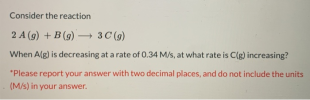
Consider the reaction 2 A (9) + B(g) + 3C(9) When A(g) is decreasing at a rate of 0.34 M/s, at what rate is C(g) increasing? *Please report your answer with two decimal places, and do not include the units (M/s) in your answer.
reaction rates
Consider the reaction 2 A (9) + B(g) + 3C(9) When A(g) is decreasing at a rate of 0.34 M/s, at what rate is C(g) increasing? *Please report your answer with two decimal places, and do not include the units (M/s) in your answer.
Consider the reaction below. At equilibrium, the concentration of A is 0.0242 M and the concentration...
Consider the reaction below. At equilibrium, the concentration of A is 0.0242 M and the concentration of B is 0.0767 M. If the equilibrium constant is Kc=0.0266, what is the equilibrium concentration of C? 3A(g)⇌3B(g)+2C(g) Round the answer to three significant figures.
 Seat # Ver. K J. Quest. 6 (9 pts). The following initial rates were obtained for the reaction -120 kJ Δ Η 2C 2A +B [B] (M) 0.30 0.60 [A] (M) 0.20 Rate (M/s) 0.127 0.40 1.02 0.254 0.509 0.60 0.20 0.40 0.30 a. Determine the rate law for the reaction. b. Calculate the rate when B 0.40 M and A 0.65 M. a. With the aid of the rate law, propose a plausible two-step mechanism for the reaction. Label...
 The rate constant for the following elementary reaction is 3.9 times 10^9 M^-2 s^-1 at 25 degree C: 2A(g)+B(g) rightarrow 2C(g) What is the rate constant for the reverse reaction at the same temperature?
 1) Given the reaction 2A(2) B) + C(O) a) Express the rate of reaction in terms of the change in concentration in terms of the change in concentration of each of the reactants and products. b) When [C] is increasing at 2.0 mol/L s, how fast is [A] decreasing?
 At high temperatures, A(s) decomposes to B(s) and C(g): 2A(s) 3B(s) + C(g) When the rate of formation of B(s) is 8,952 M/s, the rate of decomposition of A(s) is M/s. (Answer should be in 3 significant figures. Do not add unit in the answer.)
 [A] (2) Consider this reaction: 2A + 2B → 2C+D (2.5 pts) [B] Initial Rate(M/s) (a) Write the rate law for this reaction 0.400 0.0100 5.90 x 10⁻⁶ (6) Calculate the rate constant. Include Units. 0.400 0.0400 9.44 x 10⁵ (c) Is the reaction in an elementary reaction? Explain 0.400 0.0800 3.78 x 10⁻⁴ your answer in a sentence. 0.800 0.0600 2.12 x 10⁻⁴ (3) Here is a reaction: A products (1.5 pt) 0.800 0.0400 9.44 x 10⁻⁵ (3a) How...
 28. For the reaction 2 SO2(g) + O2(g) → 2 S03(), a. Determine the expression for the rate of the reaction with respect to each of the reactants and products. b. When SO3 is increasing at a rate of 0.0071 M/s, how fast is 02 decreasing? How fast is SO2 A decreasing?
 reaction rates
Consider the reaction 2 A (9) + B(g) + 3C(9) When A(g) is decreasing at a rate of 0.34 M/s, at what rate is C(g) increasing? *Please report your answer with two decimal places, and do not include the units (M/s) in your answer.
reaction rates
Consider the reaction 2 A (9) + B(g) + 3C(9) When A(g) is decreasing at a rate of 0.34 M/s, at what rate is C(g) increasing? *Please report your answer with two decimal places, and do not include the units (M/s) in your answer.
Most questions answered within 3 hours.
-
Where is the error in this code sequence?
String s1 = "Hello";
String s2 = "ello";...
asked 10 months ago -
Financial data for Joel de Paris, Inc., for last year
follow:
Joel de Paris, Inc.
Balance...
asked 10 months ago -
Consider this reaction:
Al2(SO4)3 (aq)+ BaCl3
(aq) Al2Cl6 (aq)- +
3BaSO4(s) . What is the...
asked 10 months ago -
Suppose that Savneet is considering increasing her
recent random sample from 20 car rentals to 40...
asked 10 months ago -
Trucks arrive at an unloading terminal at an average rate of 120
per hour.
Trucks arrive...
asked 10 months ago -
Why are methanol and ethanol completely soluble in water while
octanol is not very little soluble....
asked 10 months ago -
A facilities manager at a university reads in a research report
that the mean amount of...
asked 10 months ago -
When the CuSO4 is rehydrated by adding water to the anhydrous
compound, is this an endothermic...
asked 10 months ago -
A ray of sunlight is passing from diamond into crown glass; the
angle of incidence is...
asked 10 months ago -
A block of mass 0.249 kg is placed on top of a light, vertical
spring of...
asked 10 months ago -
how do the kidneys compensate in the presences of acidosis
a) trigger hyperventilate
b) reserve acid...
asked 10 months ago -
Question 501 pts
The rental rate of capital to the firm increases. Which of the
following...
asked 10 months ago