A company purchases a fixed asset for $100 with $50 equity and $50 debt. Assume depreciation...
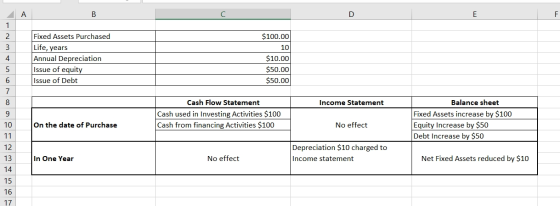
A company purchases a fixed asset for $100 with $50 equity and $50 debt. Assume depreciation is linear over the 10-year life of the asset and that the annual interest rate on the debt is 5%. a. Describe the effects on the 3 financial statements at the date of purchase
b. Describe the effects on the 3 financial statements in one year
Homework Answers
Hope this will help, please do comment if you need any further explanation. Your feedback would be highly appreciated.
Add Answer to:
A company purchases a fixed asset for $100 with $50 equity and
$50 debt. Assume depreciation...
Problem no 1: An asset is purchased for $10, 000 with 50% equity and 50% debt....
 Problem no 1: An asset is purchased for $10, 000 with 50% equity and 50% debt. The custom debt financing details are shown in the "principle" and "interest " columns. The company has elected to apply straight-line depreciation assuming no salvage value at the end of a 10-year life. Annual gross income is $8,000 and annual expenses plus upgrade expenses are $5,000. Both income and costs are subject to an inflation rate of 5%. The corporate combined federal and state...
2. A company using straight-line depreciation purchases an asset for $6,000 and is depreciating this asset...
 2. A company using straight-line depreciation purchases an asset for $6,000 and is depreciating this asset to zero over its three year tax life. The company's tax rate is 30%, if the company ends the project after two years and sells this equipment for $500, what will be the after-tax cash flow from the sale of this asset? (ANSWER $950) Then How to calculate book value?
A company purchases an asset with a 5-year depreciable life for $75,00 with no expected salvage...
A company purchases an asset with a 5-year depreciable life for $75,00 with no expected salvage value. The company uses straight line depreciation for financial statements and uses double-declining for tax accounting. Assume a tax rate of 34%. What is the value of the company's deferred tax account at the end of the third year? Enter your answer as a whole number with no commas and no dollar sign.
Company A purchases Company B. This is a 100% equity purchase which means that Company A...
Company A purchases Company B. This is a 100% equity purchase which means that Company A acquires all of the Company B assets and assumes the liabilities of Company B. Calculate the Price that Company A paid for Company B in the acquisition. Round to the nearest whole dollar and do not include the dollar sign ($). Assume the current market value of tangible physical assets is $1,492,000 (determined by Company A as at the acquisition date) the current market...
Company A purchases Company B. This is a 100% equity purchase which means that Company A...
Company A purchases Company B. This is a 100% equity purchase which means that Company A acquires all of the Company B assets and assumes the liabilities of Company B. Calculate the Price that Company A paid for Company B in the acquisition. Round to the nearest whole dollar and do not include the dollar sign ($). Assume the current market value of tangible physical assets is $1,492,000 (determined by Company A as at the acquisition date) the current market...
Company A purchases Company B. This is a 100% equity purchase which means that Company A...
 Company A purchases Company B. This is a 100% equity purchase which means that Company A acquires all of the Company B assets and assumes the liabilities of Company B. Calculate the Price that Company A paid for Company B in the acquisition. Round to the nearest whole dollar and do not include the dollar sign ($). Assume • the current market value of tangible physical assets is $864,000 (determined by Company A as at the acquisition date) the current...
Recording Purchase of Equipment through Debt and Equity On January 1, 2020, Sidelines Company purchases equipment...
 Recording Purchase of Equipment through Debt and Equity On January 1, 2020, Sidelines Company purchases equipment with an estimated 6-year useful life by making a $5,600 cash payment and issuing a noninterset-bearing note for $19,200 due in two years. The fair value of the the equipment is unknown. An 11% annual interest rate is typical of this transaction. The company uses the effective interest method to amortize interest expense and the straight-line method to estimate depreciation expense. a. Prepare the...
Depreciation by Two Methods; Sale of Fixed Asset New tire retreading equipment, acquired at a cost...
 Depreciation by Two Methods; Sale of Fixed Asset New tire retreading equipment, acquired at a cost of $140,000 at the beginning of a fiscal year, has an estimated useful life of four years and an estimated residual value of $10,000. The manager requested information regarding the effect of alternative methods on the amount of depreciation expense each year. On the basis of the data presented to the manager, the double-declining-balance method was selected In the first week of the fourth...
Assume you have a $500,000,000 portfolio: 50% equity with a beta of 1.2, and 50% fixed...
Assume you have a $500,000,000 portfolio: 50% equity with a beta of 1.2, and 50% fixed income, corporate bonds, average credit quality of BBB, duration of 5. You wish to design a portfolio: 75% equity asset allocation, beta 1.6, fixed income 25% asset allocation, duration 3. The available futures are: equity index 2,000, multiplier 250, fixed income Tbond $100,000 par, 97 price, 2 duration. The simulation is that in one day the market appreciates by 1.5% and the interest rates...
Assume you have a $500,000,000 portfolio: 50% equity with a beta of 1.2, and 50% fixed...
Assume you have a $500,000,000 portfolio: 50% equity with a beta of 1.2, and 50% fixed income, corporate bonds, average credit quality of BBB, duration of 5. You wish to design a portfolio: 75% equity asset allocation, beta 1.6, fixed income 25% asset allocation, duration 3. The available futures are: equity index 2,000, multiplier 250, fixed income T-bond $100,000 par, 97 price, 2 duration. The simulation is that in one day the market appreciates by 1.5% and the interest rates...
 Problem no 1: An asset is purchased for $10, 000 with 50% equity and 50% debt. The custom debt financing details are shown in the "principle" and "interest " columns. The company has elected to apply straight-line depreciation assuming no salvage value at the end of a 10-year life. Annual gross income is $8,000 and annual expenses plus upgrade expenses are $5,000. Both income and costs are subject to an inflation rate of 5%. The corporate combined federal and state...
 2. A company using straight-line depreciation purchases an asset for $6,000 and is depreciating this asset to zero over its three year tax life. The company's tax rate is 30%, if the company ends the project after two years and sells this equipment for $500, what will be the after-tax cash flow from the sale of this asset? (ANSWER $950) Then How to calculate book value?
 Company A purchases Company B. This is a 100% equity purchase which means that Company A acquires all of the Company B assets and assumes the liabilities of Company B. Calculate the Price that Company A paid for Company B in the acquisition. Round to the nearest whole dollar and do not include the dollar sign ($). Assume • the current market value of tangible physical assets is $864,000 (determined by Company A as at the acquisition date) the current...
 Recording Purchase of Equipment through Debt and Equity On January 1, 2020, Sidelines Company purchases equipment with an estimated 6-year useful life by making a $5,600 cash payment and issuing a noninterset-bearing note for $19,200 due in two years. The fair value of the the equipment is unknown. An 11% annual interest rate is typical of this transaction. The company uses the effective interest method to amortize interest expense and the straight-line method to estimate depreciation expense. a. Prepare the...
 Depreciation by Two Methods; Sale of Fixed Asset New tire retreading equipment, acquired at a cost of $140,000 at the beginning of a fiscal year, has an estimated useful life of four years and an estimated residual value of $10,000. The manager requested information regarding the effect of alternative methods on the amount of depreciation expense each year. On the basis of the data presented to the manager, the double-declining-balance method was selected In the first week of the fourth...
Most questions answered within 3 hours.
-
Where is the error in this code sequence?
String s1 = "Hello";
String s2 = "ello";...
asked 11 months ago -
Financial data for Joel de Paris, Inc., for last year
follow:
Joel de Paris, Inc.
Balance...
asked 11 months ago -
Consider this reaction:
Al2(SO4)3 (aq)+ BaCl3
(aq) Al2Cl6 (aq)- +
3BaSO4(s) . What is the...
asked 11 months ago -
Suppose that Savneet is considering increasing her
recent random sample from 20 car rentals to 40...
asked 11 months ago -
Trucks arrive at an unloading terminal at an average rate of 120
per hour.
Trucks arrive...
asked 11 months ago -
Why are methanol and ethanol completely soluble in water while
octanol is not very little soluble....
asked 11 months ago -
A facilities manager at a university reads in a research report
that the mean amount of...
asked 11 months ago -
When the CuSO4 is rehydrated by adding water to the anhydrous
compound, is this an endothermic...
asked 11 months ago -
A ray of sunlight is passing from diamond into crown glass; the
angle of incidence is...
asked 11 months ago -
A block of mass 0.249 kg is placed on top of a light, vertical
spring of...
asked 11 months ago -
how do the kidneys compensate in the presences of acidosis
a) trigger hyperventilate
b) reserve acid...
asked 11 months ago -
Question 501 pts
The rental rate of capital to the firm increases. Which of the
following...
asked 11 months ago