When discussing a supply curve, it is conventional to denote the supply function are Qs =...
When discussing a supply curve, it is conventional to denote the supply function are Qs = f(P). What does this mean in terms of the causal relationship between the quantity supplied and the price of the good? Explain how this relationship between price and quantity supplied can be explained through the profit maximizing behavior of the firm producing the good.
Homework Answers
Supply in economics refers the quantity of goods which a producer will sell at different levels of price. As the price of the goods increase, the supply increases. This is because the price is a factor of how much profits a firm can make. If the price which is accepted by the general public increases, each firm would try to increase the production. This is done so as to maximize returns.
The following is a diagram of the supply curve:-
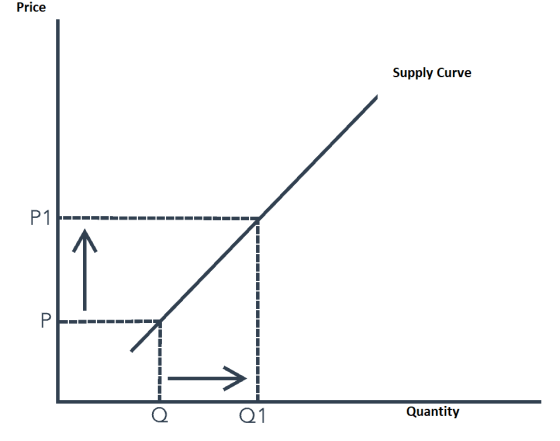
It is clear from the diagram that as the price increases from P to P1, the quantity of goods supplied also increase from Q to Q1 respectively this clearly illustrates the fact that Quantity Supplied is a function directly related to price. That is as the price of goods increases the supply side also sees an increase respectively.
In numerical Terms it can be expressed as Qs = f(p) or Quantity supplied is a function of price. Further, any firm which wants to maximize must remember this rule. It clearly states that if a firm wants to maximize its profit margins, then it has to sell the highest possible quantity at the highest possible price point respectively.
The direct relationship can be explained in terms of profits which a firm makes. As the quantity supplied of the product increases with price, the profits rise.
Add Answer to:
When discussing a supply curve, it is conventional to denote the
supply function are Qs =...
Q2. Consider the general supply function: Qs = 1,000 + 20 P - 9 PI +25...
Q2. Consider the general supply function: Qs = 1,000 + 20 P - 9 PI +25 F Qs = quantity supplied P = price of the commodity PI = price of a key input in the production process F = number of firms producing the commodity b. Derive the equation for the supply function when PI = $480 and F = 60. (1 point) c. Sketch a graph of the supply function in part b. At what price does the...
Use the following general linear supply function: Qs = 40 + 6P - 8PI + 10F...
Use the following general linear supply function: Qs = 40 + 6P - 8PI + 10F where Qs is the quantity supplied of the good, P is the price of the good, PI is the price of an input, and F is the number of firms producing the good. If PI = $20, F = 60, and the demand function is Qd = 600 - 6p the equilibrium price and quantity are, respectively,
Suppose the supply curve for apples is given by QS = 2P, where QS is the...
Suppose the supply curve for apples is given by QS = 2P, where QS is the quantity offered for sale when the prices is P. Also, suppose the demand curve for apples is given by QD = 182 − 4P I, where QD is the quantity of apples demanded when the price is P and the level of income is I. a) Find the equilibrium P and Q when I = 6. b) Find price-elasticity of demand at the equilibrium...
4. Suppose the supply curve for apples is given by QS -2P, where QS is the...
 4. Suppose the supply curve for apples is given by QS -2P, where QS is the quantity offered for sale when the prices is P. Also, suppose the demand curve for apples is given by QD- 182-4PI, where QD is the quantity of apples demanded when the price is P and the level of income is erw a) Find the equilibrium P and Q when I -6 b) Find price-elasticity of demand at the equilibrium when 6, and give an...
--The SR Market Supply Curve As long as P ≥ AVC, each firm will produce its...
--The SR Market Supply Curve As long as P ≥ AVC, each firm will produce its profit-maximizing quantity, where MR = MC. At each price, the market quantity supplied is the sum of quantities supplied by all firms. Explain and give an example
The general demand and supply functions for good A are QD-2, 800-6P 0.5M-10PB Qs 40 4P...
 The general demand and supply functions for good A are QD-2, 800-6P 0.5M-10PB Qs 40 4P - 8P1+6F where QD is the quantity demanded of good A, Qs is the quantity supplied of good A, P is the price of good A, M is the averaged income level of consumers, Pb is the price of a related good B, Pr is the price of an input, and F is the number of firms producing good A (a) Is good A...
Question #2 Consider the general demand function and the supply function for Dates (Tamr) in (tons)...
 Question #2 Consider the general demand function and the supply function for Dates (Tamr) in (tons) below: la = 60 - 2P + 0.01M+ 0.5P, +6P Is = 600 + 10P Id=quantity demanded of dates in ton. M=income P=price of dates in Saudi Riyal Pr=price of related good(chocolates) Pe= expected price of dates. Is=quantity supplied of dates 1- Define the relationship between the price of dates and quantity demanded as well as the price and the quantity supplied? Is it...
For Question 1-8, consider a competitive market for a good where the demand curve is determined...
For Question 1-8, consider a competitive market for a good where the demand curve is determined by the demand function: P=5-QD and the supply curve is determined by the supply function: P=QS. Where P stands for Price, QD is quantity demanded and QS is quantity supplied. What is the equilibrium price level for the good in the competitive market?
Suppose that the supply of barley is given by the supply function : Qs= 500+5p+2r where...
Suppose that the supply of barley is given by the supply function : Qs= 500+5p+2r where Qs is the quantity of barley supplied, P is the price of barley, and r is total rainfall in inches. Suppose that the demand function for barley is given by: Qd= 700-8p d) now assume that consumer preferences have changed, and the new demand curve for barley is Qd= 700-6p after a large increase in rainfall, will the equilibrium quantity be higher or lower...
Consider the general supply function: Qs=1,000+20P-9P1+25F Qs=Quantity supplied P=price of commodity P1=price of a key input...
Consider the general supply function: Qs=1,000+20P-9P1+25F Qs=Quantity supplied P=price of commodity P1=price of a key input in the production process F=number of firms producing the commodity What is the value of the coefficient of the price of the commodity? Does it have the theoretically correct algebraic sign? Why?
 4. Suppose the supply curve for apples is given by QS -2P, where QS is the quantity offered for sale when the prices is P. Also, suppose the demand curve for apples is given by QD- 182-4PI, where QD is the quantity of apples demanded when the price is P and the level of income is erw a) Find the equilibrium P and Q when I -6 b) Find price-elasticity of demand at the equilibrium when 6, and give an...
 The general demand and supply functions for good A are QD-2, 800-6P 0.5M-10PB Qs 40 4P - 8P1+6F where QD is the quantity demanded of good A, Qs is the quantity supplied of good A, P is the price of good A, M is the averaged income level of consumers, Pb is the price of a related good B, Pr is the price of an input, and F is the number of firms producing good A (a) Is good A...
 Question #2 Consider the general demand function and the supply function for Dates (Tamr) in (tons) below: la = 60 - 2P + 0.01M+ 0.5P, +6P Is = 600 + 10P Id=quantity demanded of dates in ton. M=income P=price of dates in Saudi Riyal Pr=price of related good(chocolates) Pe= expected price of dates. Is=quantity supplied of dates 1- Define the relationship between the price of dates and quantity demanded as well as the price and the quantity supplied? Is it...
Most questions answered within 3 hours.
-
Where is the error in this code sequence?
String s1 = "Hello";
String s2 = "ello";...
asked 10 months ago -
Financial data for Joel de Paris, Inc., for last year
follow:
Joel de Paris, Inc.
Balance...
asked 10 months ago -
Consider this reaction:
Al2(SO4)3 (aq)+ BaCl3
(aq) Al2Cl6 (aq)- +
3BaSO4(s) . What is the...
asked 10 months ago -
Suppose that Savneet is considering increasing her
recent random sample from 20 car rentals to 40...
asked 10 months ago -
Trucks arrive at an unloading terminal at an average rate of 120
per hour.
Trucks arrive...
asked 10 months ago -
Why are methanol and ethanol completely soluble in water while
octanol is not very little soluble....
asked 10 months ago -
A facilities manager at a university reads in a research report
that the mean amount of...
asked 10 months ago -
When the CuSO4 is rehydrated by adding water to the anhydrous
compound, is this an endothermic...
asked 10 months ago -
A ray of sunlight is passing from diamond into crown glass; the
angle of incidence is...
asked 10 months ago -
A block of mass 0.249 kg is placed on top of a light, vertical
spring of...
asked 10 months ago -
how do the kidneys compensate in the presences of acidosis
a) trigger hyperventilate
b) reserve acid...
asked 10 months ago -
Question 501 pts
The rental rate of capital to the firm increases. Which of the
following...
asked 10 months ago