I have already posted this before and I am looking at different answer. using C outputs...
I have already posted this before and I am looking at different
answer. using C
outputs and comments will be appreciated.
QUESTION: Write a function to check if a machine uses little endian
or big endian notation.The basic structure of the program is
givenbelow.
You are expected to write the function checkEndianess(), complete
the main function implementation to print the value returned by the
function and print if the machine is “Little Endian” or “Big
Endian”, compile and run the program. The function checkEndianess()
should return the following values: •0if the architecture is
"Little Endian" •1if the architecture is "Big Endian".
KEY POINTS:
1.Make sure to call the function name correctly (same function name
as given in this document) in the main program.
2.Comment out all non-C statements.
3.Follow all instructions mentioned above.
We will check your function by calling the function in the
following main function.
#include<stdio.h>
int main()
{int check; // Variable: "check" will hold the value returned by
the function
//Call the function to check the Endianness here
// This is where your function will be called to return
endianness
check = checkEndianess ();
// TODO for TAs and Students who will use this function to check
the student function
// TODO Write the code to check the value returned by the
function
// TODO print if the system uses little Endian or big Endian
notation
return(0);
}
/* Function "checkEndianess" checks the Endianness of the machine
on which this program is executed. The function should return 0 if
the architecture is "Little Endian" and return 1 if the
architecture is "Big Endian". */
int checkEndianess ()
{
}
Please note that if you implement the function checkEndianess in a
separate file other than the file containing the main function, you
need to declare this function as an extern in the file containing
the main function.
Homework Answers
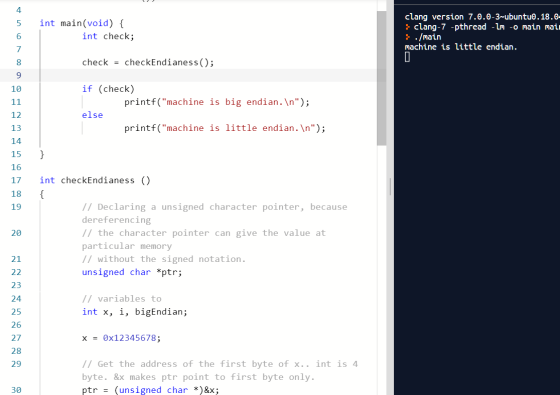
#include <stdio.h>

int checkEndianess ();

int main(void) {
        int check;

        check = checkEndianess();

        if (check)
                printf("machine is big endian.\n");
        else
                printf("machine is little endian.\n");

}

int checkEndianess ()
{
        // Declaring a unsigned character pointer, because dereferencing
        // the character pointer can give the value at particular memory
        // without the signed notation.
        unsigned char *ptr;

        // variables to
        int x, i, bigEndian;

        x = 0x12345678;

        // Get the address of the first byte of x.. int is 4 byte. &x makes ptr point to first byte only.
        ptr = (unsigned char *)&x;

        /*
        The Big Endian machine stores the Lowest byte of the numbers on the higher memory locations, and highest byte on the lower memory locations..
        So if 0x12345678 need to be stored in big endian machine starting from address 100, then
        location 100 contains: 12
        location 101 contains: 34
        location 102 contains: 56
        location 103 contains: 78
        */
        // x >> 24, Shifts the bytes to left side on user input integer.
        // So we basically compare the value of first memory location with the
        // value of left 8 bits of the x.
        // similarly for other bytes.

        bigEndian = (*ptr == (unsigned char)(0xff & (x >> 24))) &&
        (*(ptr + 1) == (unsigned char)(0xff & (x >> 16))) &&
        (*(ptr + 2) == (unsigned char)(0xff & (x >> 8))) &&
        (*(ptr + 3) == (unsigned char)(0xff & x));

        return bigEndian;
}
**************************************************

Thanks for your question. We try our best to help you with detailed answers, But in any case, if you need any modification or have a query/issue with respect to above answer, Please ask that in the comment section. We will surely try to address your query ASAP and resolve the issue.
Please consider providing a thumbs up to this question if it helps you. by Doing that, You will help other students, who are facing similar issue.
Add Answer to:
I have already posted this before and I am looking at different
answer. using C
outputs...
Using C programming...
Write a text file contains a square matrix of integer numbers. The file contains an integer number indicating the identical number of rows and columns followed by the data itself (that number cannot be larger than 100). For example, a file containing a 3x3 matrix would contain 3 followed by 9 other integer numbers. The program will call one function to determine if all the numbers on the main diagonal are the same.The function is called checkdiag (int checkdiag (int matrix[][100], int...
Write a C++ program that will count the number of words and vowels in a sentence....
Write a C++ program that will count the number of words and vowels in a sentence. Create a bool function called isVowel that accepts a character as a parameter and returns a true if it’s a vowel (aeiou) and false otherwise. Create an int function named countVowels that will accept a string variable as a parameter and will return the number of vowels in it. Call the isVowel function as part of this process. Write an int function named countWords...
My module page is correct but I don't believe I am using the main() function properly....
My module page is correct but I don't believe I am using the main() function properly. One of my .py files is supposed to contain my definitions, which is the module file. My second .py file is supposed to properly call a main function that does what my program asks it to: First name, last name, age, and respond based off of input. For some reason I am struggling with using the main() function so that my program works. Any...
Using C programming
Write another function called checkdiag2 (int checkdiag2 (int matrix[][100], int size)) that will return 1 if all the numbers on the antidiagonal are the same and 0 otherwise.Rewrite your main program to use 2D dynamic allocation instead for your array. Your array will have rows and columns depending of the first integer read from the file.Call your function from the main program. A typical report would look like The matrix is 8x8 and all the numbers on the antidiagonal are the same.Check your...
C++ 3. Write a program that reads integers from a file, sums the values and calculates...
 C++
3. Write a program that reads integers from a file, sums the values and calculates the average. a. Write a value-returning function that opens an input file named in File txt. You may "hard-code" the file name, i.e., you do not need to ask the user for the file name. The function should check the file state of the input file and return a value indicating success or failure. Main should check the returned value and if the file...
C++
3. Write a program that reads integers from a file, sums the values and calculates the average. a. Write a value-returning function that opens an input file named in File txt. You may "hard-code" the file name, i.e., you do not need to ask the user for the file name. The function should check the file state of the input file and return a value indicating success or failure. Main should check the returned value and if the file...
Write a program that allows the user to enter an unsigned integer (the maximum value of...
Write a program that allows the user to enter an unsigned integer (the maximum value of an unsigned 4-byte int is 232 = 4,294,967,296) and reverses its format (from little to big endian, or vice versa). Print out the user-entered number in hexadecimal and binary, reverse the endianness, and print the reverse in hexadecimal and binary. Integers in most machine architectures are represented in little endian format: the least significant byte is stored in the smallest address; for instance, the...
Using C Write a function that takes two ints and returns the minimum (smallest) of those...
Using C Write a function that takes two ints and returns the minimum (smallest) of those two ints. Include a function prototype. In main, call the function with two int inputs of your choice and print the returned value to the output window. The function should not print, just return the smallest number (int). If the numbers are the same, the minimum is just the number. Please use notes to explain, thanks!
In c++ programming, can you please edit this program to meet these requirements: The program that...
 In
c++ programming, can you please edit this program to meet these
requirements:
The program that needs editing:
#include <iostream>
#include <fstream>
#include <iomanip>
using namespace std;
int cal_avg(char* filenumbers, int n){
int a = 0;
int number[100];
ifstream filein(filenumbers);
if (!filein) {
cout << "Please enter a a correct file to read in the
numbers from";
}
while (!filein.eof()) {
filein >> number[a];
a++;
}
int total = number[0];
for (a = 0; a < n; a++) {...
In
c++ programming, can you please edit this program to meet these
requirements:
The program that needs editing:
#include <iostream>
#include <fstream>
#include <iomanip>
using namespace std;
int cal_avg(char* filenumbers, int n){
int a = 0;
int number[100];
ifstream filein(filenumbers);
if (!filein) {
cout << "Please enter a a correct file to read in the
numbers from";
}
while (!filein.eof()) {
filein >> number[a];
a++;
}
int total = number[0];
for (a = 0; a < n; a++) {...
It is a C++ program by using inheritance and vectors My professor said that all the files should be separate. like File.cpp, File.h, Text.cpp,Text.h,Main.cpp I already have these files File.cpp #inclu...
 It is a C++ program by using
inheritance and vectors
My professor said that all the files should be separate. like
File.cpp, File.h, Text.cpp,Text.h,Main.cpp
I already have these files
File.cpp
#include "File.h"
// Constructor of File that takes File name and type as
arguments
File::File(string type, string name) {
this->type = type;
this->name = name;
}
//returns the type.
string File::getType() {
return type;
}
//returns the name of file.
string File::getName() {
return name;
}
File.h
#ifndef __FILE_H__
#define...
It is a C++ program by using
inheritance and vectors
My professor said that all the files should be separate. like
File.cpp, File.h, Text.cpp,Text.h,Main.cpp
I already have these files
File.cpp
#include "File.h"
// Constructor of File that takes File name and type as
arguments
File::File(string type, string name) {
this->type = type;
this->name = name;
}
//returns the type.
string File::getType() {
return type;
}
//returns the name of file.
string File::getName() {
return name;
}
File.h
#ifndef __FILE_H__
#define...
This lab is to give you more experience with C++ Searching and Sorting Arrays Given a...
This lab is to give you more experience with C++ Searching and Sorting Arrays Given a file with data for names and marks you will read them into two arrays You will then display the data, do a linear search and report if found, sort the data, do a binary search. Be sure to test for found and not found in your main program. Read Data Write a function that reads in data from a file using the prototype below....
 C++
3. Write a program that reads integers from a file, sums the values and calculates the average. a. Write a value-returning function that opens an input file named in File txt. You may "hard-code" the file name, i.e., you do not need to ask the user for the file name. The function should check the file state of the input file and return a value indicating success or failure. Main should check the returned value and if the file...
C++
3. Write a program that reads integers from a file, sums the values and calculates the average. a. Write a value-returning function that opens an input file named in File txt. You may "hard-code" the file name, i.e., you do not need to ask the user for the file name. The function should check the file state of the input file and return a value indicating success or failure. Main should check the returned value and if the file...
 In
c++ programming, can you please edit this program to meet these
requirements:
The program that needs editing:
#include <iostream>
#include <fstream>
#include <iomanip>
using namespace std;
int cal_avg(char* filenumbers, int n){
int a = 0;
int number[100];
ifstream filein(filenumbers);
if (!filein) {
cout << "Please enter a a correct file to read in the
numbers from";
}
while (!filein.eof()) {
filein >> number[a];
a++;
}
int total = number[0];
for (a = 0; a < n; a++) {...
In
c++ programming, can you please edit this program to meet these
requirements:
The program that needs editing:
#include <iostream>
#include <fstream>
#include <iomanip>
using namespace std;
int cal_avg(char* filenumbers, int n){
int a = 0;
int number[100];
ifstream filein(filenumbers);
if (!filein) {
cout << "Please enter a a correct file to read in the
numbers from";
}
while (!filein.eof()) {
filein >> number[a];
a++;
}
int total = number[0];
for (a = 0; a < n; a++) {...
 It is a C++ program by using
inheritance and vectors
My professor said that all the files should be separate. like
File.cpp, File.h, Text.cpp,Text.h,Main.cpp
I already have these files
File.cpp
#include "File.h"
// Constructor of File that takes File name and type as
arguments
File::File(string type, string name) {
this->type = type;
this->name = name;
}
//returns the type.
string File::getType() {
return type;
}
//returns the name of file.
string File::getName() {
return name;
}
File.h
#ifndef __FILE_H__
#define...
It is a C++ program by using
inheritance and vectors
My professor said that all the files should be separate. like
File.cpp, File.h, Text.cpp,Text.h,Main.cpp
I already have these files
File.cpp
#include "File.h"
// Constructor of File that takes File name and type as
arguments
File::File(string type, string name) {
this->type = type;
this->name = name;
}
//returns the type.
string File::getType() {
return type;
}
//returns the name of file.
string File::getName() {
return name;
}
File.h
#ifndef __FILE_H__
#define...
Most questions answered within 3 hours.
-
Where is the error in this code sequence?
String s1 = "Hello";
String s2 = "ello";...
asked 10 months ago -
Financial data for Joel de Paris, Inc., for last year
follow:
Joel de Paris, Inc.
Balance...
asked 10 months ago -
Consider this reaction:
Al2(SO4)3 (aq)+ BaCl3
(aq) Al2Cl6 (aq)- +
3BaSO4(s) . What is the...
asked 10 months ago -
Suppose that Savneet is considering increasing her
recent random sample from 20 car rentals to 40...
asked 10 months ago -
Trucks arrive at an unloading terminal at an average rate of 120
per hour.
Trucks arrive...
asked 10 months ago -
Why are methanol and ethanol completely soluble in water while
octanol is not very little soluble....
asked 10 months ago -
A facilities manager at a university reads in a research report
that the mean amount of...
asked 10 months ago -
When the CuSO4 is rehydrated by adding water to the anhydrous
compound, is this an endothermic...
asked 10 months ago -
A ray of sunlight is passing from diamond into crown glass; the
angle of incidence is...
asked 10 months ago -
A block of mass 0.249 kg is placed on top of a light, vertical
spring of...
asked 10 months ago -
how do the kidneys compensate in the presences of acidosis
a) trigger hyperventilate
b) reserve acid...
asked 10 months ago -
Question 501 pts
The rental rate of capital to the firm increases. Which of the
following...
asked 10 months ago