Question: 3-methyl-1-hexene is reacted with HCl. Select ALL statements below that are true for this reaction....
Question: 3-methyl-1-hexene is reacted with HCl. Select ALL statements below that are true for this reaction.
-Reaction is stereoselective
-Reaction involves carbocation intermediate
-A 1,2-shift is expected in reaction mechanism
-Reaction is regioselective
Homework Answers
Answer :
 Mechanism of reaction is shown
in the image attached:
Mechanism of reaction is shown
in the image attached:
In the mechanism , there is formation of carbocation intermediate takes place and there is 1,2 shift also takes place to give more stable intermediate . In the last , there are formation of 2 product takes place which are constitutional isomers. So, reaction is regioselective as well .
So, statement 2 , 3 and 4th are true .
Add Answer to:
Question: 3-methyl-1-hexene is reacted with HCl. Select ALL
statements below that are true for this reaction....
Question 10 1 pts Please consider the following reaction. The major product, represented in the box...
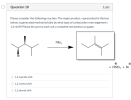 Question 10 1 pts Please consider the following reaction. The major product, represented in the box below, is generated mechanistically by what type of carbocation rearrangement/ 1,2-shift? Please be sure to work out a complete mechanism on paper. NEt Br HNEt Br 1,2-hydride shift O1,2-methyl shift 1,2-phenyl shift
QUESTION 2 1. Which one of the following statements is true? (HX is either HCl or HBr) Alkynes undergo electrop...
 QUESTION 2 1. Which one of the following statements is true? (HX is either HCl or HBr) Alkynes undergo electrophilic substitution reactions with HX to give halogenated alkenes. Adding an excess of HX to an alkyne gftens times will stop the reaction at the alkene step instead of forming the halogenated alkane. When adding one mole of HX to an alkyne, regioselective Markovnikov addition is observed for the alkene product typically exhibiting trans stereochemistry When adding one mole of HX...
Question 2 2 pts Select letter(s) corresponding to the MAJOR expected product(s) of the reaction shown...
 Question 2 2 pts Select letter(s) corresponding to the MAJOR expected product(s) of the reaction shown below to ya baad a (A) (B) (C) ady (E) (D) Question 3 2 pts 1-hexene is reacted with H2SO, and water in a hydration reaction. Select ALL statements below DELL
Part 1What is the major product of the following reaction? a. 2-ethyl-1-pentene b.(E)-4-methyl-3-hexene c.(E)-3-methyl-2-hexene d. (Z)-3-methyl-2-hexene...
 Part 1What is the major product of the following reaction?
a.
2-ethyl-1-pentene
b.(E)-4-methyl-3-hexene
c.(E)-3-methyl-2-hexene
d.
(Z)-3-methyl-2-hexene
Part 2
What alkyl chloride gives the following as the only product upon
treatment with a strong base?
a.
b.
c.
d.
Part 3
Give the major product for the following E1 reaction.
a.
b.
c.
d.
e.
CH3 CH3CO Br CH3
Part 1What is the major product of the following reaction?
a.
2-ethyl-1-pentene
b.(E)-4-methyl-3-hexene
c.(E)-3-methyl-2-hexene
d.
(Z)-3-methyl-2-hexene
Part 2
What alkyl chloride gives the following as the only product upon
treatment with a strong base?
a.
b.
c.
d.
Part 3
Give the major product for the following E1 reaction.
a.
b.
c.
d.
e.
CH3 CH3CO Br CH3
A student was planning to synthesize 2-chloro-3-methylbutane from 3-methyl-2-butanol using concentrated HCl, similar to the reaction...
A student was planning to synthesize 2-chloro-3-methylbutane from 3-methyl-2-butanol using concentrated HCl, similar to the reaction you did. When the experiment was carried out, the product isolated was 2-chloro-2-methylbutane. Explain these results by showing a plausible mechanism for the formation of 2-chloro-2-methylbutane under these reaction conditions. (Hint: it is an SN1 reaction, but think about what can happen to the carbocation intermediate that we learned about in lecture to cause that product to form.)
3. Additional question. Propose a mechanism for the following reaction. You don't have to draw all...
 3. Additional question. Propose a mechanism for the following reaction. You don't have to draw all resonance forms, but some important resonance forms should be shown. Hints: the mechanism involves two sequential carbocation rearrangements and a spirocyclic carbocation intermediate. H2SO4 heat (rac) OH
3. Give the structures of the two products for addition reaction of HCl to 3-methyl-1-pentene (1...
 3. Give the structures of the two products for addition reaction of HCl to 3-methyl-1-pentene (1 point). Point out which one is the major product, and explain why! (Hint: don t forget carbocation rearrangement)
Bonus 3. Give the structures of the two products for addition reaction of HCl to 3-methyl-1-pentene...
 Bonus 3. Give the structures of the two products for addition reaction of HCl to 3-methyl-1-pentene (1 point). Point out which one is the major product, and explain why! (Hint: dont forget carbocation rearrangement) 4. The transformation of the alkyl chloride shown below into the alcohol can be accomplished in two steps. Show the synthetic scheme to finish the conversion. (1 point) Он Br
+ R products CI HO For the reaction shown above, which of the statements below are...
 + R products CI HO For the reaction shown above, which of the statements below are true? (Think about the reaction mechanism.) The reaction will be an SN2 mechanism. The product of the reaction will be a carboxxylic acid, RCO2H. Water will act as the electrophile. This will be a one-step reaction with no intermediate. This reaction will proceed via the "up-down-out" mechanism. The reaction will be rapid at room temperature. The intermediate will be a carbocation. There will be...
In the reaction of HCl with 3-methylbut-1-ene, two products are isolated as follows. СІ HCI CI...
 In the reaction of HCl with 3-methylbut-1-ene, two products are isolated as follows. СІ HCI CI In an effort to explain the product distribution in this reaction, the following structural rearrangement has been proposed as reactive intermediates. What type of structural rearrangement is shown here? a. Two resonance forms b. A "Keto-enol tautomerism" C. A Carbocation shift d. A "1,2-Hydride shift"
 Question 10 1 pts Please consider the following reaction. The major product, represented in the box below, is generated mechanistically by what type of carbocation rearrangement/ 1,2-shift? Please be sure to work out a complete mechanism on paper. NEt Br HNEt Br 1,2-hydride shift O1,2-methyl shift 1,2-phenyl shift
 QUESTION 2 1. Which one of the following statements is true? (HX is either HCl or HBr) Alkynes undergo electrophilic substitution reactions with HX to give halogenated alkenes. Adding an excess of HX to an alkyne gftens times will stop the reaction at the alkene step instead of forming the halogenated alkane. When adding one mole of HX to an alkyne, regioselective Markovnikov addition is observed for the alkene product typically exhibiting trans stereochemistry When adding one mole of HX...
 Question 2 2 pts Select letter(s) corresponding to the MAJOR expected product(s) of the reaction shown below to ya baad a (A) (B) (C) ady (E) (D) Question 3 2 pts 1-hexene is reacted with H2SO, and water in a hydration reaction. Select ALL statements below DELL
 Part 1What is the major product of the following reaction?
a.
2-ethyl-1-pentene
b.(E)-4-methyl-3-hexene
c.(E)-3-methyl-2-hexene
d.
(Z)-3-methyl-2-hexene
Part 2
What alkyl chloride gives the following as the only product upon
treatment with a strong base?
a.
b.
c.
d.
Part 3
Give the major product for the following E1 reaction.
a.
b.
c.
d.
e.
CH3 CH3CO Br CH3
Part 1What is the major product of the following reaction?
a.
2-ethyl-1-pentene
b.(E)-4-methyl-3-hexene
c.(E)-3-methyl-2-hexene
d.
(Z)-3-methyl-2-hexene
Part 2
What alkyl chloride gives the following as the only product upon
treatment with a strong base?
a.
b.
c.
d.
Part 3
Give the major product for the following E1 reaction.
a.
b.
c.
d.
e.
CH3 CH3CO Br CH3
 3. Additional question. Propose a mechanism for the following reaction. You don't have to draw all resonance forms, but some important resonance forms should be shown. Hints: the mechanism involves two sequential carbocation rearrangements and a spirocyclic carbocation intermediate. H2SO4 heat (rac) OH
 3. Give the structures of the two products for addition reaction of HCl to 3-methyl-1-pentene (1 point). Point out which one is the major product, and explain why! (Hint: don t forget carbocation rearrangement)
 Bonus 3. Give the structures of the two products for addition reaction of HCl to 3-methyl-1-pentene (1 point). Point out which one is the major product, and explain why! (Hint: dont forget carbocation rearrangement) 4. The transformation of the alkyl chloride shown below into the alcohol can be accomplished in two steps. Show the synthetic scheme to finish the conversion. (1 point) Он Br
 + R products CI HO For the reaction shown above, which of the statements below are true? (Think about the reaction mechanism.) The reaction will be an SN2 mechanism. The product of the reaction will be a carboxxylic acid, RCO2H. Water will act as the electrophile. This will be a one-step reaction with no intermediate. This reaction will proceed via the "up-down-out" mechanism. The reaction will be rapid at room temperature. The intermediate will be a carbocation. There will be...
 In the reaction of HCl with 3-methylbut-1-ene, two products are isolated as follows. СІ HCI CI In an effort to explain the product distribution in this reaction, the following structural rearrangement has been proposed as reactive intermediates. What type of structural rearrangement is shown here? a. Two resonance forms b. A "Keto-enol tautomerism" C. A Carbocation shift d. A "1,2-Hydride shift"
Most questions answered within 3 hours.
-
Where is the error in this code sequence?
String s1 = "Hello";
String s2 = "ello";...
asked 10 months ago -
Financial data for Joel de Paris, Inc., for last year
follow:
Joel de Paris, Inc.
Balance...
asked 10 months ago -
Consider this reaction:
Al2(SO4)3 (aq)+ BaCl3
(aq) Al2Cl6 (aq)- +
3BaSO4(s) . What is the...
asked 10 months ago -
Suppose that Savneet is considering increasing her
recent random sample from 20 car rentals to 40...
asked 10 months ago -
Trucks arrive at an unloading terminal at an average rate of 120
per hour.
Trucks arrive...
asked 10 months ago -
Why are methanol and ethanol completely soluble in water while
octanol is not very little soluble....
asked 10 months ago -
A facilities manager at a university reads in a research report
that the mean amount of...
asked 10 months ago -
When the CuSO4 is rehydrated by adding water to the anhydrous
compound, is this an endothermic...
asked 10 months ago -
A ray of sunlight is passing from diamond into crown glass; the
angle of incidence is...
asked 10 months ago -
A block of mass 0.249 kg is placed on top of a light, vertical
spring of...
asked 10 months ago -
how do the kidneys compensate in the presences of acidosis
a) trigger hyperventilate
b) reserve acid...
asked 10 months ago -
Question 501 pts
The rental rate of capital to the firm increases. Which of the
following...
asked 10 months ago