A 7320 kg space probe, moving nose-first toward Jupiter at 187 m/s relative to the Sun,...
A 7320 kg space probe, moving nose-first toward Jupiter at 187 m/s relative to the Sun, fires its rocket engine, ejecting 150 kg of exhaust at a speed of 217 m/s relative to the space probe. What is the final velocity of the probe?
Homework Answers

Add Answer to:
A 7320 kg space probe, moving nose-first toward Jupiter at 187
m/s relative to the Sun,...
A rocket in deep space moving with velocity of 300 m/s has an initial mass of...
A rocket in deep space moving with velocity of 300 m/s has an initial mass of 5000 kg, of which 2000 kg are fuel. If it is ejecting gasses at a rate of 5 kg/s at a speed of 200 m/s relative to the rocket, then after 200 second of motion, its speed is
A shuttlecraft is initially moving at 96.0 m/s as it travels in deep space. The mass...
 A shuttlecraft is initially moving at 96.0 m/s as it travels in
deep space. The mass of the shuttle given its current fuel level is
approximately 6.41 ✕ 106 kg. When the
shuttle fires its rockets to move faster, the speed of the exhaust
leaving the rockets is 2900 m/s. What is the mass of the fuel
necessary to get the shuttlecraft up to a final speed of 130 m/s?
A shuttlecraft is initially moving at 96.0 m/s as...
A shuttlecraft is initially moving at 96.0 m/s as it travels in
deep space. The mass of the shuttle given its current fuel level is
approximately 6.41 ✕ 106 kg. When the
shuttle fires its rockets to move faster, the speed of the exhaust
leaving the rockets is 2900 m/s. What is the mass of the fuel
necessary to get the shuttlecraft up to a final speed of 130 m/s?
A shuttlecraft is initially moving at 96.0 m/s as...
(a) Imagine that a space probe could be fired as a projectile from the Earth's surface...
(a) Imagine that a space probe could be fired as a projectile from the Earth's surface with an initial speed of 4.98 104 m/s relative to the Sun. What would its speed be when it is very far from the Earth (in m/s)? Ignore atmospheric friction, the effects of other planets, and the rotation of the Earth. (Consider the mass of the Sun in your calculations.) (b) What If? The speed provided in part (a) is very difficult to achieve...
A spaceship with a mass of 5.50 104 kg is traveling at 6.16 103 m/s relative...
 A spaceship with a mass of 5.50
104 kg is traveling at 6.16
103 m/s relative to a space station. What mass will the
ship have after it fires its engines in order to reach a speed of
7.78
103 m/s? Assume an exhaust velocity of 4.69
103 m/s.
A spaceship with a mass of 5.50
104 kg is traveling at 6.16
103 m/s relative to a space station. What mass will the
ship have after it fires its engines in order to reach a speed of
7.78
103 m/s? Assume an exhaust velocity of 4.69
103 m/s.
A rocket that is in deep space and initially at rest relative to an inertial reference...
A rocket that is in deep space and initially at rest relative to an inertial reference frame has a mass of 2.80 105 kg, of which 1.92 105 kg is fuel. The rocket engine is then fired for 250 s while fuel is consumed at the rate of 480 kg/s. The speed of the exhaust product relative to the rocket is 3.21 km/s. (a) What is the rocket's thrust? N (b) What is the mass of the rocket after the...
7. A space probe (mass=4.85 x 10 kg) is drifting directly toward the moon in the...
 7. A space probe (mass=4.85 x 10 kg) is drifting directly toward the moon in the +x direction) at a speed of 3.23 x 10 m/s. To correct its speed before going into orbit, a thruster rocket is fired in the -x direction; the magnitude of the force is 5.63 x 10' N. The speed after the thruster is fired is 2.87 x 10' m/s. a. Find the probe's momentum before the thruster is fired, as well as its momentum...
Suppose a 3950-kg space probe expels 3300 kg of its mass at a constant rate with an exhaust speed of 1.85 × 10³ m/s. sho...
Suppose a 3950-kg space probe expels 3300 kg of its mass at a constant rate with an exhaust speed of 1.85 × 10³ m/s. show answer No Attempt Calculate the increase in speed, in meters per second, of the space probe. You may assume the gravitational force is negligible at the probe’s location. Δv =
5. Rocket guidance A space probe with mass 5180 kg is traveling beyond Saturn with a...
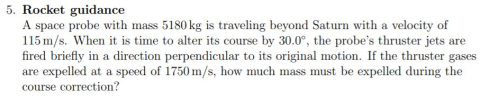 5. Rocket guidance A space probe with mass 5180 kg is traveling beyond Saturn with a velocity of 115 m/s. When it is time to alter its course by 30.0°, the probe's thruster jets are fired briefly in a direction perpendicular to its original motion. If the thruster gases are expelled at a speed of 1750 m/s, how much mass must be expelled during the course correction?
Far in space, where gravity is negligible, a 440 kg rocket traveling at 75 m/s fires itsengines. Figure P9.26 shows the...
 Far in space, where gravity is negligible, a 440 kg rocket
traveling at 75 m/s fires itsengines. Figure P9.26 shows the thrust
force as a function of time,with the horizontal axis in 11
sincrements. The mass lost by the rocket during these 33 s is
negligible.
Figure P9.26
(a) What impulse does the engine impart to
therocket?
N·s
(b) At what time does the rocket reach its maximum speed?
s
What is the maximum speed?
m/s
Far in space, where gravity is negligible, a 440 kg rocket
traveling at 75 m/s fires itsengines. Figure P9.26 shows the thrust
force as a function of time,with the horizontal axis in 11
sincrements. The mass lost by the rocket during these 33 s is
negligible.
Figure P9.26
(a) What impulse does the engine impart to
therocket?
N·s
(b) At what time does the rocket reach its maximum speed?
s
What is the maximum speed?
m/s
A 2690 kg unmanned space probe is moving in a straight line at a constant speed...
A 2690 kg unmanned space probe is moving in a straight line at a constant speed of 198 m/s. Control rockets on the space probe execute a burn in which a thrust of 4520 N acts for 62.5 s. (a) What is the change in the magnitude of the probe's linear momentum if the thrust is directed in the forward direction, so as to slow the probe? (b) What is the change in kinetic energy under the same condition? Assume...
 A shuttlecraft is initially moving at 96.0 m/s as it travels in
deep space. The mass of the shuttle given its current fuel level is
approximately 6.41 ✕ 106 kg. When the
shuttle fires its rockets to move faster, the speed of the exhaust
leaving the rockets is 2900 m/s. What is the mass of the fuel
necessary to get the shuttlecraft up to a final speed of 130 m/s?
A shuttlecraft is initially moving at 96.0 m/s as...
A shuttlecraft is initially moving at 96.0 m/s as it travels in
deep space. The mass of the shuttle given its current fuel level is
approximately 6.41 ✕ 106 kg. When the
shuttle fires its rockets to move faster, the speed of the exhaust
leaving the rockets is 2900 m/s. What is the mass of the fuel
necessary to get the shuttlecraft up to a final speed of 130 m/s?
A shuttlecraft is initially moving at 96.0 m/s as...
 A spaceship with a mass of 5.50
104 kg is traveling at 6.16
103 m/s relative to a space station. What mass will the
ship have after it fires its engines in order to reach a speed of
7.78
103 m/s? Assume an exhaust velocity of 4.69
103 m/s.
A spaceship with a mass of 5.50
104 kg is traveling at 6.16
103 m/s relative to a space station. What mass will the
ship have after it fires its engines in order to reach a speed of
7.78
103 m/s? Assume an exhaust velocity of 4.69
103 m/s.
 7. A space probe (mass=4.85 x 10 kg) is drifting directly toward the moon in the +x direction) at a speed of 3.23 x 10 m/s. To correct its speed before going into orbit, a thruster rocket is fired in the -x direction; the magnitude of the force is 5.63 x 10' N. The speed after the thruster is fired is 2.87 x 10' m/s. a. Find the probe's momentum before the thruster is fired, as well as its momentum...
 5. Rocket guidance A space probe with mass 5180 kg is traveling beyond Saturn with a velocity of 115 m/s. When it is time to alter its course by 30.0°, the probe's thruster jets are fired briefly in a direction perpendicular to its original motion. If the thruster gases are expelled at a speed of 1750 m/s, how much mass must be expelled during the course correction?
 Far in space, where gravity is negligible, a 440 kg rocket
traveling at 75 m/s fires itsengines. Figure P9.26 shows the thrust
force as a function of time,with the horizontal axis in 11
sincrements. The mass lost by the rocket during these 33 s is
negligible.
Figure P9.26
(a) What impulse does the engine impart to
therocket?
N·s
(b) At what time does the rocket reach its maximum speed?
s
What is the maximum speed?
m/s
Far in space, where gravity is negligible, a 440 kg rocket
traveling at 75 m/s fires itsengines. Figure P9.26 shows the thrust
force as a function of time,with the horizontal axis in 11
sincrements. The mass lost by the rocket during these 33 s is
negligible.
Figure P9.26
(a) What impulse does the engine impart to
therocket?
N·s
(b) At what time does the rocket reach its maximum speed?
s
What is the maximum speed?
m/s
Most questions answered within 3 hours.
-
Where is the error in this code sequence?
String s1 = "Hello";
String s2 = "ello";...
asked 10 months ago -
Financial data for Joel de Paris, Inc., for last year
follow:
Joel de Paris, Inc.
Balance...
asked 10 months ago -
Consider this reaction:
Al2(SO4)3 (aq)+ BaCl3
(aq) Al2Cl6 (aq)- +
3BaSO4(s) . What is the...
asked 10 months ago -
Suppose that Savneet is considering increasing her
recent random sample from 20 car rentals to 40...
asked 10 months ago -
Trucks arrive at an unloading terminal at an average rate of 120
per hour.
Trucks arrive...
asked 10 months ago -
Why are methanol and ethanol completely soluble in water while
octanol is not very little soluble....
asked 10 months ago -
A facilities manager at a university reads in a research report
that the mean amount of...
asked 10 months ago -
When the CuSO4 is rehydrated by adding water to the anhydrous
compound, is this an endothermic...
asked 10 months ago -
A ray of sunlight is passing from diamond into crown glass; the
angle of incidence is...
asked 10 months ago -
A block of mass 0.249 kg is placed on top of a light, vertical
spring of...
asked 10 months ago -
how do the kidneys compensate in the presences of acidosis
a) trigger hyperventilate
b) reserve acid...
asked 10 months ago -
Question 501 pts
The rental rate of capital to the firm increases. Which of the
following...
asked 10 months ago