Show (graph) and explain how Christmas effects bond prices and money market interest rates.
Show (graph) and explain how Christmas effects bond prices and money market interest rates.
Homework Answers
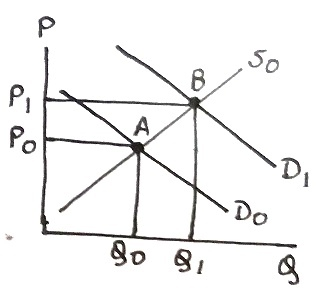
During Christmas, investors are in a bullish sentiment and therefore invest more in bonds. Demand for bonds rises, shifting bond demand curve rightward, increasing both price and quantity of bonds.
Since bond price and interest rate are inversely related, higher bond price decreases interest rate.
In following graph, D0 and S0 are initial demand and supply curves of bonds, intersecting at point A with initial price P0 and quantity Q0. As bond demand rises, D0 shifts right to D1, intersecting S0 at point B with higher price P1 and higher quantity Q1.
Add Answer to:
Show (graph) and explain how Christmas effects
bond prices and money market interest rates.
MTv1 4. Discuss how contractionary monetary policy impacts the equilibrium interest rate using the bond market to motivate the change in the interest rate. Explain using the Bond market graph and...
 MTv1 4. Discuss how contractionary monetary policy impacts the equilibrium interest rate using the bond market to motivate the change in the interest rate. Explain using the Bond market graph and the Bond pricing formula. Clearly label the graph Soond Dbond 5. In our Chapter 4 Money Market, the demand for money is given by M-SY (03-i), where $Ys 100 and the supply of money is $20. Find the equilibrium interest rate Show calculation
MTv1 4. Discuss how contractionary monetary...
MTv1 4. Discuss how contractionary monetary policy impacts the equilibrium interest rate using the bond market to motivate the change in the interest rate. Explain using the Bond market graph and the Bond pricing formula. Clearly label the graph Soond Dbond 5. In our Chapter 4 Money Market, the demand for money is given by M-SY (03-i), where $Ys 100 and the supply of money is $20. Find the equilibrium interest rate Show calculation
MTv1 4. Discuss how contractionary monetary...
Draw the money market graph, label the money demand and supply and show and explain what...
Draw the money market graph, label the money demand and supply and show and explain what happens to interest rates and money with federal reserve open market operations.
The figure to the right depicts the bond market. Show what will happen to interest rates...
 The figure to the right depicts the bond market. Show what will happen to interest rates if prices in the bond market become more volatile. 1. Using the line drawing tool, show the effect of this shock on the bond market. Properly label your line, 2. Using the point drawing tool, indicate the new equilibrium bond price and quantity. Label the point 2. Carefully follow the instructions above, and only draw the required objects. The effect of this shock will...
Money and the Money Market Using the money market graph, show the effects of an increase...
Money and the Money Market Using the money market graph, show the effects of an increase in the price level. Please describe the changes beside your graph. (5 marks) In an economy for the month of June 2019, individuals and businesses held $35 billion in currency, there was $246 billion in personal chequable deposits and $325 billion in non-personal chequable deposits; non-chequable personal deposits were $164 billion and non-chequable business deposits were $39 billion, and term deposits totaled $314 billion....
5. Using a supply and demand graph of the market for money, show the effects on...
 5. Using a supply and demand graph of the market for money, show the effects on the nominal interest rate if the Fed takes the following monetary policy actions: (LO2, LO3) a. The Fed lowers the discount rate and increases dis- count lending. b. The Fed increases the reserve requirements for com- mercial banks. c. The Fed conducts open market sales of government bonds to the public. d. The Fed decreases the reserve requirements for como mercial banks.
Explain the effect of interest rates on bond pricing and how maturity length and higher and...
Explain the effect of interest rates on bond pricing and how maturity length and higher and lower coupon rates can affect bond prices when interests go up and down in the economy.
Use the graph to illustrate the effects of inflation on the money market. The interest rate...
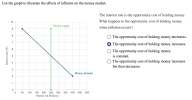 Use the graph to illustrate the effects of inflation on the money market. The interest rate is the opportunity cost of holding money. What happens to the opportunity cost of holding money 10 Money supply when inflation occurs? 8 The opportunity cost of holding money decreases. 7 The opportunity cost of holding money increases 6 The opportunity cost of holding money is constant 5 The opportunity cost of holding money increases 4 but then decreases. Money demand 2 1 250...
3. Assume that the money market is initially in equilibrium and that the money supply is then increased. Explain th...
 3. Assume that the money market is initially in equilibrium and that the money supply is then increased. Explain the adjustments toward a new equilibrium interest rate. Will bond prices be higher at the new equilibrium rate of interest? What effects would you expect that interest-rate change to have on the levels of output, employment, and prices? Answer the same questions for a decrease in the money supply 4. How is the chairperson of the Federal Reserve Board selected? Describe...
The following graph shows the money market in a hypothetical economy.
 The following graph shows the money market in a hypothetical economy. The central bank in this economy is called the Fed. Assume that the Fed fixes the quantity of money supplied. Suppose the price level decreases from 90 to 75. Shift the appropriate curve on the graph to show the impact of a decrease in the overall price level on the market for money. After the decrease in the price level, the quantity of money demanded at the initial interest rate of 9%...
1) Please explain why bond prices are subject to changes in interest rates. 2) Describe the...
1) Please explain why bond prices are subject to changes in interest rates. 2) Describe the characteristics of a bond and provide an example of a firm or government entity that has recently issued (sold) these securities.
 MTv1 4. Discuss how contractionary monetary policy impacts the equilibrium interest rate using the bond market to motivate the change in the interest rate. Explain using the Bond market graph and the Bond pricing formula. Clearly label the graph Soond Dbond 5. In our Chapter 4 Money Market, the demand for money is given by M-SY (03-i), where $Ys 100 and the supply of money is $20. Find the equilibrium interest rate Show calculation
MTv1 4. Discuss how contractionary monetary...
MTv1 4. Discuss how contractionary monetary policy impacts the equilibrium interest rate using the bond market to motivate the change in the interest rate. Explain using the Bond market graph and the Bond pricing formula. Clearly label the graph Soond Dbond 5. In our Chapter 4 Money Market, the demand for money is given by M-SY (03-i), where $Ys 100 and the supply of money is $20. Find the equilibrium interest rate Show calculation
MTv1 4. Discuss how contractionary monetary...
 The figure to the right depicts the bond market. Show what will happen to interest rates if prices in the bond market become more volatile. 1. Using the line drawing tool, show the effect of this shock on the bond market. Properly label your line, 2. Using the point drawing tool, indicate the new equilibrium bond price and quantity. Label the point 2. Carefully follow the instructions above, and only draw the required objects. The effect of this shock will...
 5. Using a supply and demand graph of the market for money, show the effects on the nominal interest rate if the Fed takes the following monetary policy actions: (LO2, LO3) a. The Fed lowers the discount rate and increases dis- count lending. b. The Fed increases the reserve requirements for com- mercial banks. c. The Fed conducts open market sales of government bonds to the public. d. The Fed decreases the reserve requirements for como mercial banks.
 Use the graph to illustrate the effects of inflation on the money market. The interest rate is the opportunity cost of holding money. What happens to the opportunity cost of holding money 10 Money supply when inflation occurs? 8 The opportunity cost of holding money decreases. 7 The opportunity cost of holding money increases 6 The opportunity cost of holding money is constant 5 The opportunity cost of holding money increases 4 but then decreases. Money demand 2 1 250...
 3. Assume that the money market is initially in equilibrium and that the money supply is then increased. Explain the adjustments toward a new equilibrium interest rate. Will bond prices be higher at the new equilibrium rate of interest? What effects would you expect that interest-rate change to have on the levels of output, employment, and prices? Answer the same questions for a decrease in the money supply 4. How is the chairperson of the Federal Reserve Board selected? Describe...
Most questions answered within 3 hours.
-
Where is the error in this code sequence?
String s1 = "Hello";
String s2 = "ello";...
asked 10 months ago -
Financial data for Joel de Paris, Inc., for last year
follow:
Joel de Paris, Inc.
Balance...
asked 10 months ago -
Consider this reaction:
Al2(SO4)3 (aq)+ BaCl3
(aq) Al2Cl6 (aq)- +
3BaSO4(s) . What is the...
asked 10 months ago -
Suppose that Savneet is considering increasing her
recent random sample from 20 car rentals to 40...
asked 10 months ago -
Trucks arrive at an unloading terminal at an average rate of 120
per hour.
Trucks arrive...
asked 10 months ago -
Why are methanol and ethanol completely soluble in water while
octanol is not very little soluble....
asked 10 months ago -
A facilities manager at a university reads in a research report
that the mean amount of...
asked 10 months ago -
When the CuSO4 is rehydrated by adding water to the anhydrous
compound, is this an endothermic...
asked 10 months ago -
A ray of sunlight is passing from diamond into crown glass; the
angle of incidence is...
asked 10 months ago -
A block of mass 0.249 kg is placed on top of a light, vertical
spring of...
asked 10 months ago -
how do the kidneys compensate in the presences of acidosis
a) trigger hyperventilate
b) reserve acid...
asked 10 months ago -
Question 501 pts
The rental rate of capital to the firm increases. Which of the
following...
asked 10 months ago