Consider a risky asset with return expressed by Return =0.5 with probability p and Return of...
Consider a risky asset with return expressed by
Return =0.5 with probability p
and Return of 0.05 with probability1−p
It has a utility function U(WT)=ln(WT), where WT is the final value from investing wealth W.
a) Find the Certainty Equivalent of the investment for such
utility as a function of probability p and invested wealth W. How
does it depend on p? Comment on your result.
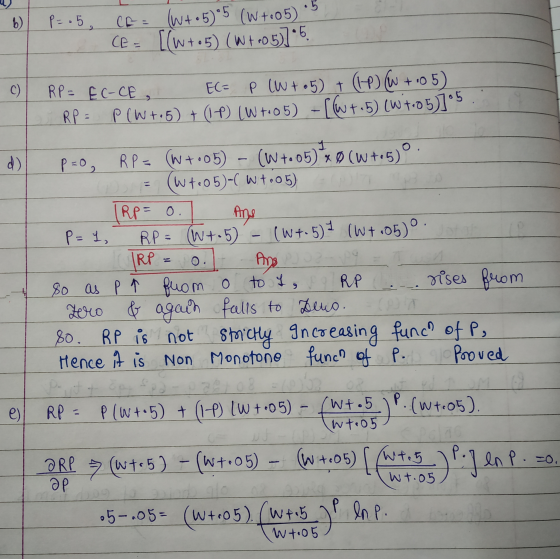
b) Compute the Certainty Equivalent for a probability p=50%
c) Compute the Risk Premium for a probability p=50%
d) What is the risk premium if p=0? And if p=1? Comment on your
results, and show how the risk premium is a non-monotonic function
of probability p.
e) Find the probability p that maximises the risk premium (for this
it may be useful to know that logb(x)=ln(x)/ln(b)
Homework Answers
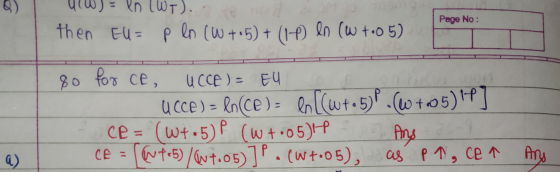
As p rises, Probability of good return rises, so CE , (Minimum amount of wealth, which if provided with certainty,providing same EU as that of the gamble,) will rise naturally
Add Answer to:
Consider a risky asset with return expressed by
Return =0.5 with probability p
and Return of...
A person with the following utility function, u(x) = ln(x) faces a world where with probability...
 A person with the following utility function, u(x) = ln(x) faces a world where with probability 0.1 will suffer of identity theft which will reduce their wealth from $250000 to $100000. This means that we can write: E{u(.)] = 0.91n(x) +0.1ln(y) where x would be the wealth under no identity theft and y the wealth under identity theft. This means that the marginal utilities are: MU 0.9, MUy = 0.1 Using this information answer the following questions 1) What is...
Consider the utility function u(x) = ax + b e^cx where a, b, c are positive...
Consider the utility function u(x) = ax + b e^cx where a, b, c are positive scalars. (a) Compute the coefficient of absolute risk aversion. (b) Describe the risk attitude represented by u(x) and how it changes as x increases. (c) Write down the equations to determine the certainty equivalent and the risk premium of a gamble X for an individual with initial wealth w > 0. (d) What is the sign of the risk premium? How does the risk...
1. a. Two investors, A and B, are evaluating the same investment opportunity, which has an expected value of £100. The u...
1. a. Two investors, A and B, are evaluating the same investment opportunity, which has an expected value of £100. The utility functions of A and B are ln(x) and x2, respectively. Which investor has a certainty equivalent higher than 100? Which investor requires the higher risk premium? b. (i) Describe suitable measures of risk for ‘loss-aversion’ and ‘risk aversion’. (ii) Concisely define the term ‘risk neutral’ with respect to a utility function u (w), where w is the realisation...
My von Neumann Morgenstern utility function is U (W) = 32 + (9/5)w1/2 for wealth w....
 My von Neumann Morgenstern utility function is U (W) = 32 + (9/5)w1/2 for wealth w. I face a gamble that pays 1 with probability %, and 4 with probability %. Calculate my certainty equivalent for this gamble: CE=_ . Calculate my risk premium p for this gamble p=
Suppose there are two assets, one is risk-free and one is risky. The risk-free asset has a sure r...
 Suppose there are two assets, one is risk-free and one is risky. The risk-free asset has a sure rate of return rj, the risky asset has a random rate of return r. Suppose the utility function of an investor is U(x) =--. The initial wealth is wo, the dollar amount invested in the risky asset is θ. r is normally distributed with mean μ and variance σ2. Based on the maximum utility framework, find the optimal investment strategy 6. (25...
Exercise 2. Suppose that there is one risk free asset with return rf and one risky...
 Exercise 2. Suppose that there is one risk free asset with return rf and one risky asset with normally distributed returns, r ~ N(u,02). Show that the CARA utility u(r) = -e-Ar gives the same optimal allocation of wealth to the risky asset as the mean-variance utility function we used in class. That is, show that E[r] – rf OCARA = AO2 Hint: Use the fact that if a random variable x is distributed normally with mean Mx and variance...
A firm is considering two projects, A and B, with the probability distributions of profits presented...
A firm is considering two projects, A and B, with the probability distributions of profits presented in the first three columns of Table 1. Denote the profit of project A as random variable X, and its distribution functions as F(x). Denote the profit of Project B, as random variable Y, distribution function G(y). Table 1. Column 1 Column 2 X Column 3 Y Profits ($1,000s) Project A Probability (%) Project B Probability (%) $ 20 10 10 40 15 15...
1. Suppose that an individual has a wealth of $50,000 and the utility of U(W) =...
 1. Suppose that an individual has a wealth of $50,000 and the utility of U(W) = VW. This individual has the option of investing all wealth in risky stock, which is worth $100 per share, which will be worth $105 per share in a good state with probability 1/2 and $95 per share in a bad state with probability 1/2. Assume, the interest rate is zero. (a) Find the expected value and the expected utility of investing all wealth in...
A person with the following utility function, u(x) In(x) faces a world where with probability 0.1...
 A person with the following utility function, u(x) In(x) faces a world where with probability 0.1 will suffer of identity theft which will reduce their wealth from $250000 to $100000. This means that we can write: Eu(.0.91n(x)+0.1n(y) where would be the wealth under no identity theft and y the wealth under identity theft This means that the marginal utilities are: MU0.9 MUy = 0.1 Using this information answer the following questions 1) What is this persons attitude towards risk? explain...
Suppose there are two assets, one is risk-free and one is risky. The risk-free asset has...
 Suppose there are two assets, one is risk-free and one is risky. The risk-free asset has a sure rate of return rj, the risky asset has a random rate of return r. Suppose the utility function of an investor is U(x) =--. The initial wealth is wo, the dollar amount invested in the risky asset is θ. r is normally distributed with mean μ and variance σ2. Based on the maximum utility framework, find the optimal investment strategy 6. (25...
 A person with the following utility function, u(x) = ln(x) faces a world where with probability 0.1 will suffer of identity theft which will reduce their wealth from $250000 to $100000. This means that we can write: E{u(.)] = 0.91n(x) +0.1ln(y) where x would be the wealth under no identity theft and y the wealth under identity theft. This means that the marginal utilities are: MU 0.9, MUy = 0.1 Using this information answer the following questions 1) What is...
 My von Neumann Morgenstern utility function is U (W) = 32 + (9/5)w1/2 for wealth w. I face a gamble that pays 1 with probability %, and 4 with probability %. Calculate my certainty equivalent for this gamble: CE=_ . Calculate my risk premium p for this gamble p=
 Suppose there are two assets, one is risk-free and one is risky. The risk-free asset has a sure rate of return rj, the risky asset has a random rate of return r. Suppose the utility function of an investor is U(x) =--. The initial wealth is wo, the dollar amount invested in the risky asset is θ. r is normally distributed with mean μ and variance σ2. Based on the maximum utility framework, find the optimal investment strategy 6. (25...
 Exercise 2. Suppose that there is one risk free asset with return rf and one risky asset with normally distributed returns, r ~ N(u,02). Show that the CARA utility u(r) = -e-Ar gives the same optimal allocation of wealth to the risky asset as the mean-variance utility function we used in class. That is, show that E[r] – rf OCARA = AO2 Hint: Use the fact that if a random variable x is distributed normally with mean Mx and variance...
 1. Suppose that an individual has a wealth of $50,000 and the utility of U(W) = VW. This individual has the option of investing all wealth in risky stock, which is worth $100 per share, which will be worth $105 per share in a good state with probability 1/2 and $95 per share in a bad state with probability 1/2. Assume, the interest rate is zero. (a) Find the expected value and the expected utility of investing all wealth in...
 A person with the following utility function, u(x) In(x) faces a world where with probability 0.1 will suffer of identity theft which will reduce their wealth from $250000 to $100000. This means that we can write: Eu(.0.91n(x)+0.1n(y) where would be the wealth under no identity theft and y the wealth under identity theft This means that the marginal utilities are: MU0.9 MUy = 0.1 Using this information answer the following questions 1) What is this persons attitude towards risk? explain...
 Suppose there are two assets, one is risk-free and one is risky. The risk-free asset has a sure rate of return rj, the risky asset has a random rate of return r. Suppose the utility function of an investor is U(x) =--. The initial wealth is wo, the dollar amount invested in the risky asset is θ. r is normally distributed with mean μ and variance σ2. Based on the maximum utility framework, find the optimal investment strategy 6. (25...
Most questions answered within 3 hours.
-
Where is the error in this code sequence?
String s1 = "Hello";
String s2 = "ello";...
asked 10 months ago -
Financial data for Joel de Paris, Inc., for last year
follow:
Joel de Paris, Inc.
Balance...
asked 10 months ago -
Consider this reaction:
Al2(SO4)3 (aq)+ BaCl3
(aq) Al2Cl6 (aq)- +
3BaSO4(s) . What is the...
asked 10 months ago -
Suppose that Savneet is considering increasing her
recent random sample from 20 car rentals to 40...
asked 10 months ago -
Trucks arrive at an unloading terminal at an average rate of 120
per hour.
Trucks arrive...
asked 10 months ago -
Why are methanol and ethanol completely soluble in water while
octanol is not very little soluble....
asked 10 months ago -
A facilities manager at a university reads in a research report
that the mean amount of...
asked 10 months ago -
When the CuSO4 is rehydrated by adding water to the anhydrous
compound, is this an endothermic...
asked 10 months ago -
A ray of sunlight is passing from diamond into crown glass; the
angle of incidence is...
asked 10 months ago -
A block of mass 0.249 kg is placed on top of a light, vertical
spring of...
asked 10 months ago -
how do the kidneys compensate in the presences of acidosis
a) trigger hyperventilate
b) reserve acid...
asked 10 months ago -
Question 501 pts
The rental rate of capital to the firm increases. Which of the
following...
asked 10 months ago