An O star has a temperature of 20,000 K and a radius 10 x that of...
An O star has a temperature of 20,000 K and a radius 10 x that of the Sun. How much more luminous is the O star than the Sun? At what distance would the O star have to be placed to appear to be the same brightness as the Sun. Express your answer in AU and light-years.
Homework Answers
Luminosity is the total amount of energy emitted by a star per unit time. So this is basically the power output of the star.
So for a star with Temperature T=20000°K and radius R=10×695510Km=6.95×10⁹ m, the power output is given by the Stefan-Boltzmann law which is expressed below

Where  is the Stefan-Boltzmann constant=5.7×10⁻⁸
Wm-2 K-4
is the Stefan-Boltzmann constant=5.7×10⁻⁸
Wm-2 K-4
A= surface area of star=4πR2 4× 3.14 ×(6.95×109 )2 =6.06×10²⁰ m2

So the luminosity=5.52×1030 Watt.
Now we determine the power per unit area of this star so that we can compare it with the power per unit area of sun to calculate at what distance the star should be to appear as bright as the sun.
The power per unit area of the star=(5.52×1030 )÷(6..06×1020 )..............(power/area of star)
Therefore power per unit area of the star=9.1×10⁹ W/m2
We know the power per unit area (solar insolation) received at earth is 1370Watt/m2 .
This is a measure of the brightness of the sun.
now we need to determine how far the star has to be from earth to appear as bright as sun(i e.1370W/m^2)
The solar insolation is a function of inverse of area of the surface on which the insolation is measured. That means it is a function of inverse square of distance of that surface from the sun. By same logic,the farther we go from the star, the dimmer it appears. So we can write the following relation
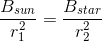
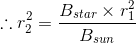
Where Bsun is the brightness of sun, Bstar is the brightness of the star,r1 and r2 are the distances from earth to the sun and star respectively
We already know
 ,
,
 and
and 
So now let's just plug in the values n


Inlightyears, this distance is about 0.0405 lightyears.
So this star needs to at a distance of 2577.27AU or 0.0405 lightyears to appear as bright as sun.
Add Answer to:
An O star has a temperature of 20,000 K and a radius 10 x that
of...
Imagine we find a star that has the same radius as the Sun, but its temperature...
Imagine we find a star that has the same radius as the Sun, but its temperature is 9.6 times greater. That star should be _____ times as luminous as the Sun. Suppose we find a planet with an orbital period of 200 days around a star with the same mass as the Sun, but only 75 percent as luminous. What is the planet’s semi-major axis, in AU?
The brightest star in the northern celestial hemisphere has a surface temperature of about 4300 K...
The brightest star in the northern celestial hemisphere has a surface temperature of about 4300 K and it is 170 times more luminous than the Sun. Calculate the radius of the star in units of the radius of the solar radius (round the result to the nearest integer) In the calculation, you may assume that the Sun has a radius of 7E8 meters and a luminosity of 3.8E26 watts.
5. The HR Diagram. Suppose we consider a main sequence “O star” much more massive than...
5. The HR Diagram. Suppose we consider a main sequence “O star” much more massive than the sun. According to the formulae shown in lecture: a. What is the luminosity of a main-sequence O star (in solar units, Lsun) of mass 100 solar masses? b. If the sun were a 100 solar mass main-sequence O star, how much brighter would it appear from the earth? c. What is the hydrogen fusing lifetime of this star in years? d. If the...
A certain bright star has a temperature of 10,600 K, and is believed to have a...
A certain bright star has a temperature of 10,600 K, and is believed to have a radius of order 70 times the radius of the Sun. At what orbital radius would a planet have a flux of radiation comparable to that on our Earth – ie – habitable like the Earth? At this stellar temperature, what colour does the star have?
Problem 22.52-Copy Part A ReviewI Constants Periodic Table Using the inverse square law for light from...
 Problem 22.52-Copy Part A ReviewI Constants Periodic Table Using the inverse square law for light from Mathematical Insight 15.1 in the textbook, determine the apparent brightness of the Sun in our sky. Express your answer to two significant figures and include the appropriate units. According to Olbers' paradox, the entire sky would be as bright as the surface of a typical star if the universe were infinite in space, unchanging in time, and the same everywhere. However, conditions would not...
Now suppose youhave two stars, with one them 2times more luminous than the other. From Earth...
Now suppose youhave two stars, with one them 2times more luminous than the other. From Earth you see that they both appear to have exactly the same apparent brightness or intensity. How much farther away is the bright star compared to the fainter one?
If one star has a temperature of 5100 K and another star has a temperature of...
If one star has a temperature of 5100 K and another star has a temperature of 7709 K, how much more energy per second will the hotter star radiate from each square meter of its surface?
Planet X has 20 times the mass of the earth and 3 times the earth's radius....
 Planet X has 20 times the mass of the earth and 3 times the earth's radius. It orbits star Y at a distance of 8 AU, where 1 AU is the earth-sun distance. Star Y has twice the mass of our sun. (a) What is the orbital period of Planet X in years? (b) An astronaut has an earth weight of 120 lbs. What is her weight on the surface of planet X?
choose correct answer. no explanation needed QUESTION 10 How do astrophysicists account for neutrino emission from...
 choose correct answer. no explanation needed
QUESTION 10 How do astrophysicists account for neutrino emission from the Sun? Solar flares create neutrinos with very energetic magnetic fields. Convection releases neutrinos, which random walk through the radiation zone. Fission in the Sun's core creates neutrinos when protons turn into neutrons. The annihilation of positrons and electrons in the core produces neutrinos. Fusion in the Sun's core creates neutrinos when protons turn into neutrons, QUESTION 11 How does the interstellar medium impact...
choose correct answer. no explanation needed
QUESTION 10 How do astrophysicists account for neutrino emission from the Sun? Solar flares create neutrinos with very energetic magnetic fields. Convection releases neutrinos, which random walk through the radiation zone. Fission in the Sun's core creates neutrinos when protons turn into neutrons. The annihilation of positrons and electrons in the core produces neutrinos. Fusion in the Sun's core creates neutrinos when protons turn into neutrons, QUESTION 11 How does the interstellar medium impact...
What is the reason for two stars to have the same brightness but one being 100...
What is the reason for two stars to have the same brightness but one being 100 times more luminous than the other? One of them is 100 times more distant One of them is 10 times more distant One of them is 1000 times more distant One of them is 4π times more distant The Brightness scale like the inverse of the square of the distance (1/R2) T F What is parallax? The distance of a star A method to...
 Problem 22.52-Copy Part A ReviewI Constants Periodic Table Using the inverse square law for light from Mathematical Insight 15.1 in the textbook, determine the apparent brightness of the Sun in our sky. Express your answer to two significant figures and include the appropriate units. According to Olbers' paradox, the entire sky would be as bright as the surface of a typical star if the universe were infinite in space, unchanging in time, and the same everywhere. However, conditions would not...
 Planet X has 20 times the mass of the earth and 3 times the earth's radius. It orbits star Y at a distance of 8 AU, where 1 AU is the earth-sun distance. Star Y has twice the mass of our sun. (a) What is the orbital period of Planet X in years? (b) An astronaut has an earth weight of 120 lbs. What is her weight on the surface of planet X?
 choose correct answer. no explanation needed
QUESTION 10 How do astrophysicists account for neutrino emission from the Sun? Solar flares create neutrinos with very energetic magnetic fields. Convection releases neutrinos, which random walk through the radiation zone. Fission in the Sun's core creates neutrinos when protons turn into neutrons. The annihilation of positrons and electrons in the core produces neutrinos. Fusion in the Sun's core creates neutrinos when protons turn into neutrons, QUESTION 11 How does the interstellar medium impact...
choose correct answer. no explanation needed
QUESTION 10 How do astrophysicists account for neutrino emission from the Sun? Solar flares create neutrinos with very energetic magnetic fields. Convection releases neutrinos, which random walk through the radiation zone. Fission in the Sun's core creates neutrinos when protons turn into neutrons. The annihilation of positrons and electrons in the core produces neutrinos. Fusion in the Sun's core creates neutrinos when protons turn into neutrons, QUESTION 11 How does the interstellar medium impact...
Most questions answered within 3 hours.
-
Where is the error in this code sequence?
String s1 = "Hello";
String s2 = "ello";...
asked 11 months ago -
Financial data for Joel de Paris, Inc., for last year
follow:
Joel de Paris, Inc.
Balance...
asked 11 months ago -
Consider this reaction:
Al2(SO4)3 (aq)+ BaCl3
(aq) Al2Cl6 (aq)- +
3BaSO4(s) . What is the...
asked 11 months ago -
Suppose that Savneet is considering increasing her
recent random sample from 20 car rentals to 40...
asked 11 months ago -
Trucks arrive at an unloading terminal at an average rate of 120
per hour.
Trucks arrive...
asked 11 months ago -
Why are methanol and ethanol completely soluble in water while
octanol is not very little soluble....
asked 11 months ago -
A facilities manager at a university reads in a research report
that the mean amount of...
asked 11 months ago -
When the CuSO4 is rehydrated by adding water to the anhydrous
compound, is this an endothermic...
asked 11 months ago -
A ray of sunlight is passing from diamond into crown glass; the
angle of incidence is...
asked 11 months ago -
A block of mass 0.249 kg is placed on top of a light, vertical
spring of...
asked 11 months ago -
how do the kidneys compensate in the presences of acidosis
a) trigger hyperventilate
b) reserve acid...
asked 11 months ago -
Question 501 pts
The rental rate of capital to the firm increases. Which of the
following...
asked 11 months ago