You observe a rocket moving toward you. Compared to its length when it was at rest...
You observe a rocket moving toward you. Compared to its length when it was at rest on the ground, you will measure its length to be shorter, longer, or the same. Explain please!
Homework Answers
The incoming rocket will appear to have shorter length, due to the effect of LENGTH CONTRACTION.
Length Contraction is independent of direction of moving object, i.e. rocket length will again appear shorter, when rocket will move away from observer.
*LENGTH CONTRACTION : It is the phenomenon due to which moving object length will appear shorter, as compared to original length when ojbect is in rest.
The phenomenon of Length contraction takes place only along the motion direction.
Length Contraction ,
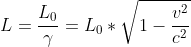
here,
L0 = Original length
v = speed of an object
c = speed of light
 = lorentz
factor
= lorentz
factor
Add Answer to:
You observe a rocket moving toward you. Compared to its length
when it was at rest...
Relative Math Your friend flies from Los Angeles to New York. He determines the distance using the tried-and-true d vt....
 Relative Math Your friend flies from Los Angeles to New York. He determines the distance using the tried-and-true d vt. You and your assistants on the ground surveying equipment. also measure the distance, using meter sticks and a. Who, if anyone, measures the proper length? b. Who, if anyone, measures the shorter distance? A rocket travels at speed 0.5c relative to the earth. a. The rocket shoots a bullet in the forward direction at speed 0.5c relative to the rocket....
You observe a lead brick with a rest mass of 16 kg. What is its apparent...
You observe a lead brick with a rest mass of 16 kg. What is its apparent mass if it is moving away from you at 0.85c? The speed of light is 3 × 10⁸ m/s. Answer in units of kg. (part 2 of 2) What is its apparent mass if you are moving toward it at −0.85c? Answer in units of kg.
Three space ships are seen flying past your classroom on a space station. When moving, Ship...
Three space ships are seen flying past your classroom on a space station. When moving, Ship 1 is measured to be only 60% of its length compared to when it is at rest at the space station. Ship 2 is moving away from the space station at 0.5c and Ship 3 is moving toward the space station (in the opposite direction as Ship 2) at 0.75c After 5 hours pass on your watch, how much time do you measure to...
A rocket speeding by the Earth is known, when at rest, to be roughly cylindrical with...
A rocket speeding by the Earth is known, when at rest, to be roughly cylindrical with a radius of 14 m and a length of 140 m. When speeding by, its volume is measured to be 3.83 × 10⁴ m3. What is its speed? Insufficient information is given. 0.896c 0.774c. 0.678c
lllllllllllllll esc Problem 3 A sound source is moving toward you such that the frequency you...
 lllllllllllllll esc Problem 3 A sound source is moving toward you such that the frequency you observe is 5.0% greater than the frequency at the source. Assume that you are at rest. Calculate the speed of the source in km/h. (Take the speed of sound to be 340 m/s.)
03.4 When walking on a moving sidewalk in the same direction the sidewalk is moving, you...
 03.4 When walking on a moving sidewalk in the same direction the sidewalk is moving, you take 24 s to go the length of the sidewalk. When walking on the sidewalk in the opposite direction to its motion, you take 36 s to return to your starting point. Your walking speed on fixed ground is 1.5 m/s. How long is the moving sidewalk and how fast is it moving?
4) Suppose you observe a star that is three times as hot as the sun, but...
4) Suppose you observe a star that is three times as hot as the sun, but also three smaller in radius than the sun. a) What is the wavelength at which its spectrum peaks? Is that wavelength shorter or longer than that of the sun? b) How much more (or less) power (ie., luminosity or energy per time) is it emitting in total, compared to the sun?
when is the force of an oscilating spring positvie? a. when its moving toward equil. point...
when is the force of an oscilating spring positvie? a. when its moving toward equil. point b. when its moving away from equil. point c. its always positive d. its always negative
a rocket is dropped out of a window and pointed sideways toward another building. a time...
a rocket is dropped out of a window and pointed sideways toward another building. a time “tau” after it is dropped, its motor fires, giving it an acceleration of 2g in the horizontal direction (its vertical acceleration is still g downward) in terms of tau, g, and d what are the position and velocity of the rocket when the motor fires ? in terms of tau, g, and d, how long in total is the rocket in the air before...
you observe an object that is moving along level ground purely with translational kinetic energy. later,...
you observe an object that is moving along level ground purely with translational kinetic energy. later, you see that the object has gained some rotational kinetic energy but the total mechanical energy of the object has not changed not has ita potential energy. What has happened to the linear velocity of the object from when you first observed it to when you look at it again? a. the linear velocity stays the same b. there is no way to tell...
 Relative Math Your friend flies from Los Angeles to New York. He determines the distance using the tried-and-true d vt. You and your assistants on the ground surveying equipment. also measure the distance, using meter sticks and a. Who, if anyone, measures the proper length? b. Who, if anyone, measures the shorter distance? A rocket travels at speed 0.5c relative to the earth. a. The rocket shoots a bullet in the forward direction at speed 0.5c relative to the rocket....
 lllllllllllllll esc Problem 3 A sound source is moving toward you such that the frequency you observe is 5.0% greater than the frequency at the source. Assume that you are at rest. Calculate the speed of the source in km/h. (Take the speed of sound to be 340 m/s.)
 03.4 When walking on a moving sidewalk in the same direction the sidewalk is moving, you take 24 s to go the length of the sidewalk. When walking on the sidewalk in the opposite direction to its motion, you take 36 s to return to your starting point. Your walking speed on fixed ground is 1.5 m/s. How long is the moving sidewalk and how fast is it moving?
Most questions answered within 3 hours.
-
Where is the error in this code sequence?
String s1 = "Hello";
String s2 = "ello";...
asked 10 months ago -
Financial data for Joel de Paris, Inc., for last year
follow:
Joel de Paris, Inc.
Balance...
asked 10 months ago -
Consider this reaction:
Al2(SO4)3 (aq)+ BaCl3
(aq) Al2Cl6 (aq)- +
3BaSO4(s) . What is the...
asked 10 months ago -
Suppose that Savneet is considering increasing her
recent random sample from 20 car rentals to 40...
asked 10 months ago -
Trucks arrive at an unloading terminal at an average rate of 120
per hour.
Trucks arrive...
asked 10 months ago -
Why are methanol and ethanol completely soluble in water while
octanol is not very little soluble....
asked 10 months ago -
A facilities manager at a university reads in a research report
that the mean amount of...
asked 10 months ago -
When the CuSO4 is rehydrated by adding water to the anhydrous
compound, is this an endothermic...
asked 10 months ago -
A ray of sunlight is passing from diamond into crown glass; the
angle of incidence is...
asked 10 months ago -
A block of mass 0.249 kg is placed on top of a light, vertical
spring of...
asked 10 months ago -
how do the kidneys compensate in the presences of acidosis
a) trigger hyperventilate
b) reserve acid...
asked 10 months ago -
Question 501 pts
The rental rate of capital to the firm increases. Which of the
following...
asked 10 months ago