Find a) overall run time T(n) and b) worst case run timeO(N) of this recursive function....
Find a) overall run time T(n) and b) worst case run timeO(N) of this recursive function.
int mystery (int n)
{
if (n<= 1)
{return 1
}
else
{
return mystery(n-1) + mystery(n-2);
}
}
Homework Answers
a)
recurrence relation
overall runtime is T(n)
T(n) = T(n-1) + T(n-2) + O(1)

b)
worst-case running time is O(2^n)

Explanation:
----------------
T(n)
= T(n-1) + T(n-2) + 1
<= 2T(n-1) + 1
= 2(2T(n-2) + 1) + 1
= 2(2(2T(n-3) + 1) + 1) + 1
= 2^3T(n-3) + 2^2 + 2^1 + 1
= 2^nT(1) + 2^n-1 + ... + 1
= 2^n + 2^n-1 + ... + 1
= 2^(n+1) - 1
so, T(n) = O(2^n)

hence, worst-case running time is O(2^n)
Add Answer to:
Find a) overall run time T(n) and b) worst case run timeO(N) of
this recursive function....
*Program is in C* Write a recursive function to compute a^b for integers a and b....
 *Program is in C*
Write a recursive function to compute a^b for integers a and b. For the recursive use the following equality a^b = a^b - 1 * a and a^0 = 1. What does the following recursive function do? int mystery(int a, int b) {if (b == 1) return (a); else return (a + mystery(a, b - 1));}
*Program is in C*
Write a recursive function to compute a^b for integers a and b. For the recursive use the following equality a^b = a^b - 1 * a and a^0 = 1. What does the following recursive function do? int mystery(int a, int b) {if (b == 1) return (a); else return (a + mystery(a, b - 1));}
For each of the following recursive methods available on the class handout, derive a worst-case recurrence...
For each of the following recursive methods available on the class handout, derive a worst-case recurrence relation along with initial condition(s) and solve the relation to analyze the time complexity of the method. The time complexity must be given in a big-O notation. 1. digitSum(int n) - summing the digits of integer: int digitSum(int n) { if (n < 10) return n; return (digitSum(n/10) + n%10); } 2. void reverseA(int l, int r) - reversing array: void...
FOR ALGORITHM A WORST CASE TIME COMPLEXITY IS DESCRIBED BY RECURRENCE FORMULA T(n)= n/ T (n...
 FOR ALGORITHM A WORST CASE TIME COMPLEXITY IS DESCRIBED BY RECURRENCE FORMULA T(n)= n/ T (n )thi T (c)=1 if c < 100 FOR ALGORITHM B WORST TIME COMPLEXITY IS DESCRIBED BY RECURRENCE FORMULA T(n) = 2T (2/2) + n/logn ; (c) = 1 fc 2100 WHICH ALGORITHM IS ASYMPTOTICALLY FASTER? WHY?
The code for a recursive function 'mystery' appears below. Assume we passed the following array as...
The code for a recursive function 'mystery' appears below. Assume we passed the following array as x[]: int x[] = { 10, 20, 25, 25 }; How would we call mystery() so the return value is 1? int mystery(const int x[], int n, int mysteryValue) { int count = 0; if (n <= 0) return 0; else { if (x[n - 1] == mysteryValue) count = 1; return mystery(x, n - 1, mysteryValue) + count; } } 1mystery(x, 4, 0)...
For the following code, figure out the recurrences (base case and recursive step), calculate the running...
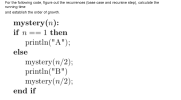 For the following code, figure out the recurrences (base case and recursive step), calculate the running time and establish the order of growth. mystery(n): if n == 1 then println("A"); else mystery(n/2); println("B") mystery(n/2); end if
I can not get this recursive binary search to wok for an edge case and it...
I can not get this recursive binary search to wok for an edge case and it works but not for all, If you could look at it and try to find what is wrong to make this work for all edge cases. //Write a function that will return true if an element k is found in an array of integers A and false otherwise. The input to your //function is the array, its length 0 < n <= 10000, and...
CHALLENGE ACTIVITY 6.4.2: Recursive function: Writing the recursive case. Write code to complete factorial_str()'s recursive case....
 CHALLENGE ACTIVITY 6.4.2: Recursive function: Writing the recursive case. Write code to complete factorial_str()'s recursive case. Sample output with input: 5 5! = 5 * 4 * 3 * 2 * 1 = 120 1 test passed 4 6 All tests 1 passed 8 9 1 def factorial_str(fact_counter, fact_value): 2 output_string = 3 if fact_counter == 0: # Base case: 0! = 1 5 output_string += '1' elif fact counter == 1: # Base case: print 1 and result 7...
C++: Find Time Analysis Worst case O() of each member function with explanation: 1) /** insert function: parameters:...
C++: Find Time Analysis Worst case O() of each member function with explanation: 1) /** insert function: parameters: obj Description: inserts new elements into the correct position in the sorted array, sliding elements over the position to right, as needed **/ template <typename Object> SortedArray::void insert(const Object &obj) { if (theSize >= theCapacity) { cout << "Error: there is no enough memory space. " << endl; return; } else { for (int i = ((2 * theSize) + 1); (i...
Find the worst case runtime f(n) for the following algorithms. Specify the number of operations executed...
 Find the worst case runtime f(n) for the following
algorithms.
Specify the number of operations executed for an input size n,
for the worst case run time as a function of n.
Circle statement(s) and draw a line to the right
side specifying the number of operations.
If statement(s) are a part of an iteration of n, specify the
total number of iterations as a function of n.
Algorithm-01 int sum = 0; int j = 1; while ( <=...
Find the worst case runtime f(n) for the following
algorithms.
Specify the number of operations executed for an input size n,
for the worst case run time as a function of n.
Circle statement(s) and draw a line to the right
side specifying the number of operations.
If statement(s) are a part of an iteration of n, specify the
total number of iterations as a function of n.
Algorithm-01 int sum = 0; int j = 1; while ( <=...
PROBLEM: Write a recursive method named SumEvens that takes an integer X and returns the sum...
PROBLEM: Write a recursive method named SumEvens that takes an integer X and returns the sum of even digits in X. Please comment on every line of code. EXISTING CODE: int numTwos(int n) { int right = n % 10; int remain = n / 10; if(n==0) { return 0 ; } else if(right ==2) { //rightmost digit is 2 return 1 + numTwos(remain); else { return 0 + numTwos(remain); } } int SumDigits(int X) { if (X == 0)...
 *Program is in C*
Write a recursive function to compute a^b for integers a and b. For the recursive use the following equality a^b = a^b - 1 * a and a^0 = 1. What does the following recursive function do? int mystery(int a, int b) {if (b == 1) return (a); else return (a + mystery(a, b - 1));}
*Program is in C*
Write a recursive function to compute a^b for integers a and b. For the recursive use the following equality a^b = a^b - 1 * a and a^0 = 1. What does the following recursive function do? int mystery(int a, int b) {if (b == 1) return (a); else return (a + mystery(a, b - 1));}
 FOR ALGORITHM A WORST CASE TIME COMPLEXITY IS DESCRIBED BY RECURRENCE FORMULA T(n)= n/ T (n )thi T (c)=1 if c < 100 FOR ALGORITHM B WORST TIME COMPLEXITY IS DESCRIBED BY RECURRENCE FORMULA T(n) = 2T (2/2) + n/logn ; (c) = 1 fc 2100 WHICH ALGORITHM IS ASYMPTOTICALLY FASTER? WHY?
 For the following code, figure out the recurrences (base case and recursive step), calculate the running time and establish the order of growth. mystery(n): if n == 1 then println("A"); else mystery(n/2); println("B") mystery(n/2); end if
 CHALLENGE ACTIVITY 6.4.2: Recursive function: Writing the recursive case. Write code to complete factorial_str()'s recursive case. Sample output with input: 5 5! = 5 * 4 * 3 * 2 * 1 = 120 1 test passed 4 6 All tests 1 passed 8 9 1 def factorial_str(fact_counter, fact_value): 2 output_string = 3 if fact_counter == 0: # Base case: 0! = 1 5 output_string += '1' elif fact counter == 1: # Base case: print 1 and result 7...
 Find the worst case runtime f(n) for the following
algorithms.
Specify the number of operations executed for an input size n,
for the worst case run time as a function of n.
Circle statement(s) and draw a line to the right
side specifying the number of operations.
If statement(s) are a part of an iteration of n, specify the
total number of iterations as a function of n.
Algorithm-01 int sum = 0; int j = 1; while ( <=...
Find the worst case runtime f(n) for the following
algorithms.
Specify the number of operations executed for an input size n,
for the worst case run time as a function of n.
Circle statement(s) and draw a line to the right
side specifying the number of operations.
If statement(s) are a part of an iteration of n, specify the
total number of iterations as a function of n.
Algorithm-01 int sum = 0; int j = 1; while ( <=...
Most questions answered within 3 hours.
-
Where is the error in this code sequence?
String s1 = "Hello";
String s2 = "ello";...
asked 10 months ago -
Financial data for Joel de Paris, Inc., for last year
follow:
Joel de Paris, Inc.
Balance...
asked 10 months ago -
Consider this reaction:
Al2(SO4)3 (aq)+ BaCl3
(aq) Al2Cl6 (aq)- +
3BaSO4(s) . What is the...
asked 10 months ago -
Suppose that Savneet is considering increasing her
recent random sample from 20 car rentals to 40...
asked 10 months ago -
Trucks arrive at an unloading terminal at an average rate of 120
per hour.
Trucks arrive...
asked 10 months ago -
Why are methanol and ethanol completely soluble in water while
octanol is not very little soluble....
asked 10 months ago -
A facilities manager at a university reads in a research report
that the mean amount of...
asked 10 months ago -
When the CuSO4 is rehydrated by adding water to the anhydrous
compound, is this an endothermic...
asked 10 months ago -
A ray of sunlight is passing from diamond into crown glass; the
angle of incidence is...
asked 10 months ago -
A block of mass 0.249 kg is placed on top of a light, vertical
spring of...
asked 10 months ago -
how do the kidneys compensate in the presences of acidosis
a) trigger hyperventilate
b) reserve acid...
asked 10 months ago -
Question 501 pts
The rental rate of capital to the firm increases. Which of the
following...
asked 10 months ago