if a substance in the blood does not become part of the filtrate what happens to...
Homework Answers
In the glomerular capillaries depending on the electric charge and molecular size,the substances are filtered,preferably small sized and positively charges substances are easily filtered across (since the glomerulus is negatively charged),the unfiltered substances exit the glomerulus via the efferent artery which then supplies blood to the Renal tubules where some substances like vasopressin (the ADH hormone) are secreted into the tubules and the ones that are neither filtered in the glomerulus nor secreted into the tubules are returned back to the systemic circulation via the Renal vein.
The substances that are not filtered or secreted are the ones that are essential for the body and are not to be excreted,like Albumin,globulins, complement proteins etc and are kept in the blood.
Add Answer to:
if
a substance in the blood does not become part of the filtrate what
happens to...
Glomerular Filtration 1. Blood entering the glomerulus contains blood cells, proteins, glucose, amino acids, salts, urea....
 Glomerular Filtration 1. Blood entering the glomerulus contains blood cells, proteins, glucose, amino acids, salts, urea. wall and enter the filtrate. acids, salts, urea, and water to exit the blood and 2. Blood pressure causes small molecules of glucose, amino enter the glomerular capsule. The fluid in the glomerular capsule is called the filtrate. become part of the filtrate. 3. In the list that follows, draw an arrow from left to right for the small molecules that leave the glomerulus...
How does GFR change when blood flow changes in each of the following: 1) increased blood...
How does GFR change when blood flow changes in each of the following: 1) increased blood flow into afferent arteriole/glomerulus with normal output from efferent arteriole/glomerulus 2) normal blood flow into afferent arteriole/glomerulus with decreased output from efferent arteriole/glomerulus 3) decreased input and decreased output
Under what conditions will the flow through a cvergent-divergent nozzle become choked? What happens to the...
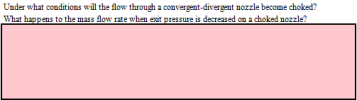 Under what conditions will the flow through a cvergent-divergent nozzle become choked? What happens to the mass flow rate when exit pressure is decreased on a choked nozzle?
To what can we best compare blood filtrate as it enters the extracellular spaces of organs...
 To what can we best compare blood filtrate as it enters the extracellular spaces of organs and tissues? Select one: O A. Serum B. Plasma O C. Lymph OD. Blood O E. Interstitial fluid
Check Your REV 1 Fill in the blanks: The pressure in the glomerulus that tends to...
 Check Your REV 1 Fill in the blanks: The pressure in the glomerulus that tends to favor filtration is known as the , and the two pressures that oppose filtration are the and the 2 The overall force that drives glomerular filtration is known as the a. glomerular osmotic pressure. b. capsular hydrostatic pressure. C. glomerular filtration pressure. d. net filtration pressure. 3 Fill in the blanks: The rate of filtrate formation is known as the and averages about 4...
what happens if theres more Cd8 cells than Cd4 cells found in sheeps blood? does that...
what happens if theres more Cd8 cells than Cd4 cells found in sheeps blood? does that mean the sheep is sick?
1. What substance is in the little spiny lines connecting skin epithelial cells? 2. What structure...
1. What substance is in the little spiny lines connecting skin epithelial cells? 2. What structure waves back and forth to move substances along the epithelial surface? 3. What kind of filaments do microvilli contain? 4. What type of gland secretes substances right into the blood?
what happens to the conductivity of a substance if you increase the temperature of the solution....
what happens to the conductivity of a substance if you increase the temperature of the solution. Explain what happens on a molecular level during this temperature increase.
what happens to the concentration of H positive in the blood during acidosis and how are...
what happens to the concentration of H positive in the blood during acidosis and how are they buffered
1. How does one enantiomer become another? 2. What does the energy of the conformations of...
1. How does one enantiomer become another? 2. What does the energy of the conformations of a molecule depend on? 3. When the C2-C3 bond is rotated in the anti butane conformation how many eclipsed interactions are observed? 4. What happens in the folded conformation of cyclobutane compared to the flat? 5. How is the interconversion of cyclohexane chairs achieved? PLEASE, ANSWER ALL THE QUESTIONS AND DON'T WRITE IT ON A PAPER. ANSWERS MUST BE SIMPLE AND SHORT. THANKS!
 Glomerular Filtration 1. Blood entering the glomerulus contains blood cells, proteins, glucose, amino acids, salts, urea. wall and enter the filtrate. acids, salts, urea, and water to exit the blood and 2. Blood pressure causes small molecules of glucose, amino enter the glomerular capsule. The fluid in the glomerular capsule is called the filtrate. become part of the filtrate. 3. In the list that follows, draw an arrow from left to right for the small molecules that leave the glomerulus...
 Under what conditions will the flow through a cvergent-divergent nozzle become choked? What happens to the mass flow rate when exit pressure is decreased on a choked nozzle?
 To what can we best compare blood filtrate as it enters the extracellular spaces of organs and tissues? Select one: O A. Serum B. Plasma O C. Lymph OD. Blood O E. Interstitial fluid
 Check Your REV 1 Fill in the blanks: The pressure in the glomerulus that tends to favor filtration is known as the , and the two pressures that oppose filtration are the and the 2 The overall force that drives glomerular filtration is known as the a. glomerular osmotic pressure. b. capsular hydrostatic pressure. C. glomerular filtration pressure. d. net filtration pressure. 3 Fill in the blanks: The rate of filtrate formation is known as the and averages about 4...
Most questions answered within 3 hours.
-
Where is the error in this code sequence?
String s1 = "Hello";
String s2 = "ello";...
asked 10 months ago -
Financial data for Joel de Paris, Inc., for last year
follow:
Joel de Paris, Inc.
Balance...
asked 10 months ago -
Consider this reaction:
Al2(SO4)3 (aq)+ BaCl3
(aq) Al2Cl6 (aq)- +
3BaSO4(s) . What is the...
asked 10 months ago -
Suppose that Savneet is considering increasing her
recent random sample from 20 car rentals to 40...
asked 10 months ago -
Trucks arrive at an unloading terminal at an average rate of 120
per hour.
Trucks arrive...
asked 10 months ago -
Why are methanol and ethanol completely soluble in water while
octanol is not very little soluble....
asked 10 months ago -
A facilities manager at a university reads in a research report
that the mean amount of...
asked 10 months ago -
When the CuSO4 is rehydrated by adding water to the anhydrous
compound, is this an endothermic...
asked 10 months ago -
A ray of sunlight is passing from diamond into crown glass; the
angle of incidence is...
asked 10 months ago -
A block of mass 0.249 kg is placed on top of a light, vertical
spring of...
asked 10 months ago -
how do the kidneys compensate in the presences of acidosis
a) trigger hyperventilate
b) reserve acid...
asked 10 months ago -
Question 501 pts
The rental rate of capital to the firm increases. Which of the
following...
asked 10 months ago