We have seen that in general with volume, number of particles, and other parameters that determine...
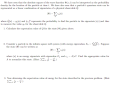
We have seen that in general with volume, number of particles, and other parameters that determine the positions of the energy levels held fixed, 1 Ω dΩ dU = 1 kBT . Suppose that U = CT, where C is the heat capacity of the system. Find Ω(U).
Homework Answers
given
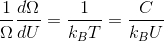
where I have used
T = U/C
Therefore
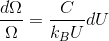
Integrate both sides
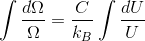
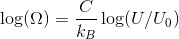
or

which is the answer
Add Answer to:
We have seen that in general with volume, number of particles,
and other parameters that determine...
(80 pts) Entropy of the ideal gas: Consider a monatomic gas of identical non-interacting particles of...
 (80 pts) Entropy of the ideal gas: Consider a monatomic gas of identical non-interacting particles of mass m. The kinetic energy of each particle is given in terms of its momentum p by Ekinp2/(2m). For a given total energy U, volume V and total particle number N (with N » 1) calculate the entropy S(U, V,N)-klog Ω(U, V,N), where Ω(U, V,N) counts the number of different microscopic configurations for given N, U and V. To get a finite number for...
Consider a system of distinguishable particles having only three energy levels (0, 1 and 2) equally...
Consider a system of distinguishable particles having only three energy levels (0, 1 and 2) equally separated by an energy , delta e, which is equal to the value of kT at 25 K. Calculate at 25 K: (a) the ratios of populations n1/n0 and n2/n0 (b) the molecular partition function, q (c) the molar internal energy, E = U - U(0), in J/mol (d) the molar entropy, S, in J/(K mol) (e) the molar constant volume heat capacity, Cv,...
In class we looked at the example of the potential energy step seen below (where E...
 In class we looked at the example of the potential energy step seen below (where E > U_0). We wrote down the wave functions in complex exponential form as seen below: psi _0 (x) = A' e^i K_0 x + B' e^-i K_0 x x < 0 psi _1 (x) = C' e^i K_1 x + D' e^-i K_1 x x > 0 a) Assume the particles are incident on the barrier from the left, which coefficient can be set...
The amount of heat needed to raise the temperature of 1 mole of a substance by...
The amount of heat needed to raise the temperature of 1 mole of a substance by one Celsius degree (or, equivalently, one kelvin) is called the molar heat capacity of the system, denoted by the letter C. If a small amount of heat dQ is put into n moles of a substance, and the resulting change in temperature for the system is dT, then C=1ndQdT. This is the definition of molar heat capacity--the amount of heat Q added per infinitesimal...
please solve 2 problems restriction on the total number of particles 4. For photons, there is no (a) Find out the numbe...
 please solve 2 problems
restriction on the total number of particles 4. For photons, there is no (a) Find out the number of photons per quantum state 8T V 2 dv 4 (b) Find out the partition function, Z. cf. g(v)dv 15 e 1 In z n (1 e hulkT) for a (c) Calculate the internal energy, U single oscillator (d) Calculate the pressure, P. 4. For solids Einstein the vibrational levels given energy are as € (j+h, j 0,1,2,....
please solve 2 problems
restriction on the total number of particles 4. For photons, there is no (a) Find out the number of photons per quantum state 8T V 2 dv 4 (b) Find out the partition function, Z. cf. g(v)dv 15 e 1 In z n (1 e hulkT) for a (c) Calculate the internal energy, U single oscillator (d) Calculate the pressure, P. 4. For solids Einstein the vibrational levels given energy are as € (j+h, j 0,1,2,....
Please answer the question in full and show all work. We have seen that the absolute...
 Please answer the question in full and show all work.
We have seen that the absolute square of the wave function VI,t) can be interpreted as the probability density for the location of the particle at time t. We have also seen that a particle's quantum state can be represented as a linear combination of eigenstates of a physical observable Q: V) SIT) where Q n ) = qn|n) and represents the probability to find the particle in the eigenstate...
Please answer the question in full and show all work.
We have seen that the absolute square of the wave function VI,t) can be interpreted as the probability density for the location of the particle at time t. We have also seen that a particle's quantum state can be represented as a linear combination of eigenstates of a physical observable Q: V) SIT) where Q n ) = qn|n) and represents the probability to find the particle in the eigenstate...
Answer a total of any THREE out of the four questions. Put the solution to each problem in a separate blue book and put the number of the problem and your name on the front of each book. If you su...
 Answer a total of any THREE out of the four questions. Put the solution to each problem in a separate blue book and put the number of the problem and your name on the front of each book. If you submit solutions to more than three problems, only the first three problems as listed on the exam will be graded. Some possibly useful information: Sterling's asymptotic series: N In N-N + 1 ln(2nN] In N! N → oo, as 2...
We have seen that the Carnot cycle can be used to determine the maximum efficiency of...
We have seen that the Carnot cycle can be used to determine the maximum efficiency of a heat engine. The efficiency is defined as the sum of all of the work during the cycle divided by the amount of heat exchanged during the expansion process: efficiency=?1 +?2 +?3 +?3 /?1 Theoretically, the efficiency of the engine can be determined with the hot and cold temperature of the cycle. efficiency = ?h − ?c/ ?h In this problem, we will calculate...
Ch 19 HW Relationships between Molar Heat Capacities 9 of 23 Constants The amount of heat needed to raise the temperatu...
 Ch 19 HW Relationships between Molar Heat Capacities 9 of 23 Constants The amount of heat needed to raise the temperature of 1 mole of a substance by one Celsius degree (or, equivalently, one kelvin) is called the molar heat capacity of the system, denoted by the letter C. If a small amount of heat dQ is put into n moles of a substance, and the resulting change in temperature for the system is dT, then Part A Consider an...
need help with thermodynamics A system consists of N weakly interacting particles, each of which can...
 need help with thermodynamics
A system consists of N weakly interacting particles, each of which can be in either of two states with respective energies e and 2. where e1 2 1. Without explicit calculation, make a qualitative plot of the mean energy U the entropy S of the system as a function of its temperature T. What is in the limit of very low and very high temperatures? What is S in the limit of very low and very...
need help with thermodynamics
A system consists of N weakly interacting particles, each of which can be in either of two states with respective energies e and 2. where e1 2 1. Without explicit calculation, make a qualitative plot of the mean energy U the entropy S of the system as a function of its temperature T. What is in the limit of very low and very high temperatures? What is S in the limit of very low and very...
 (80 pts) Entropy of the ideal gas: Consider a monatomic gas of identical non-interacting particles of mass m. The kinetic energy of each particle is given in terms of its momentum p by Ekinp2/(2m). For a given total energy U, volume V and total particle number N (with N » 1) calculate the entropy S(U, V,N)-klog Ω(U, V,N), where Ω(U, V,N) counts the number of different microscopic configurations for given N, U and V. To get a finite number for...
 In class we looked at the example of the potential energy step seen below (where E > U_0). We wrote down the wave functions in complex exponential form as seen below: psi _0 (x) = A' e^i K_0 x + B' e^-i K_0 x x < 0 psi _1 (x) = C' e^i K_1 x + D' e^-i K_1 x x > 0 a) Assume the particles are incident on the barrier from the left, which coefficient can be set...
 please solve 2 problems
restriction on the total number of particles 4. For photons, there is no (a) Find out the number of photons per quantum state 8T V 2 dv 4 (b) Find out the partition function, Z. cf. g(v)dv 15 e 1 In z n (1 e hulkT) for a (c) Calculate the internal energy, U single oscillator (d) Calculate the pressure, P. 4. For solids Einstein the vibrational levels given energy are as € (j+h, j 0,1,2,....
please solve 2 problems
restriction on the total number of particles 4. For photons, there is no (a) Find out the number of photons per quantum state 8T V 2 dv 4 (b) Find out the partition function, Z. cf. g(v)dv 15 e 1 In z n (1 e hulkT) for a (c) Calculate the internal energy, U single oscillator (d) Calculate the pressure, P. 4. For solids Einstein the vibrational levels given energy are as € (j+h, j 0,1,2,....
 Please answer the question in full and show all work.
We have seen that the absolute square of the wave function VI,t) can be interpreted as the probability density for the location of the particle at time t. We have also seen that a particle's quantum state can be represented as a linear combination of eigenstates of a physical observable Q: V) SIT) where Q n ) = qn|n) and represents the probability to find the particle in the eigenstate...
Please answer the question in full and show all work.
We have seen that the absolute square of the wave function VI,t) can be interpreted as the probability density for the location of the particle at time t. We have also seen that a particle's quantum state can be represented as a linear combination of eigenstates of a physical observable Q: V) SIT) where Q n ) = qn|n) and represents the probability to find the particle in the eigenstate...
 Answer a total of any THREE out of the four questions. Put the solution to each problem in a separate blue book and put the number of the problem and your name on the front of each book. If you submit solutions to more than three problems, only the first three problems as listed on the exam will be graded. Some possibly useful information: Sterling's asymptotic series: N In N-N + 1 ln(2nN] In N! N → oo, as 2...
 Ch 19 HW Relationships between Molar Heat Capacities 9 of 23 Constants The amount of heat needed to raise the temperature of 1 mole of a substance by one Celsius degree (or, equivalently, one kelvin) is called the molar heat capacity of the system, denoted by the letter C. If a small amount of heat dQ is put into n moles of a substance, and the resulting change in temperature for the system is dT, then Part A Consider an...
 need help with thermodynamics
A system consists of N weakly interacting particles, each of which can be in either of two states with respective energies e and 2. where e1 2 1. Without explicit calculation, make a qualitative plot of the mean energy U the entropy S of the system as a function of its temperature T. What is in the limit of very low and very high temperatures? What is S in the limit of very low and very...
need help with thermodynamics
A system consists of N weakly interacting particles, each of which can be in either of two states with respective energies e and 2. where e1 2 1. Without explicit calculation, make a qualitative plot of the mean energy U the entropy S of the system as a function of its temperature T. What is in the limit of very low and very high temperatures? What is S in the limit of very low and very...
Most questions answered within 3 hours.
-
Where is the error in this code sequence?
String s1 = "Hello";
String s2 = "ello";...
asked 10 months ago -
Financial data for Joel de Paris, Inc., for last year
follow:
Joel de Paris, Inc.
Balance...
asked 10 months ago -
Consider this reaction:
Al2(SO4)3 (aq)+ BaCl3
(aq) Al2Cl6 (aq)- +
3BaSO4(s) . What is the...
asked 10 months ago -
Suppose that Savneet is considering increasing her
recent random sample from 20 car rentals to 40...
asked 10 months ago -
Trucks arrive at an unloading terminal at an average rate of 120
per hour.
Trucks arrive...
asked 10 months ago -
Why are methanol and ethanol completely soluble in water while
octanol is not very little soluble....
asked 10 months ago -
A facilities manager at a university reads in a research report
that the mean amount of...
asked 10 months ago -
When the CuSO4 is rehydrated by adding water to the anhydrous
compound, is this an endothermic...
asked 10 months ago -
A ray of sunlight is passing from diamond into crown glass; the
angle of incidence is...
asked 10 months ago -
A block of mass 0.249 kg is placed on top of a light, vertical
spring of...
asked 10 months ago -
how do the kidneys compensate in the presences of acidosis
a) trigger hyperventilate
b) reserve acid...
asked 10 months ago -
Question 501 pts
The rental rate of capital to the firm increases. Which of the
following...
asked 10 months ago