how did the optical rotation of sucrose changes atls the concentration increased and was there a...
Homework Answers
- Optical rotation is the extent (measured in degrees) to which a solution of a molecule will rotate plane-polarized light, as measured by a polarimeter. Optical rotation is dependent on concentration, path length, temperature, and the wavelength of light used, as well as the solvent.
-
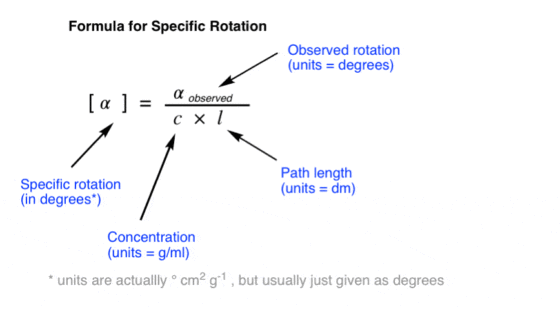
The specific rotation of a molecule is the rotation in degrees observed upon passing polarized light through a path length of 1 decimetre (dm) at a concentration of 1 g/mL.
To convert an observed rotation to specific rotation, divide the observed rotation by the concentration in g/mL and the path length in decimeters (dm).
Add Answer to:
how
did the optical rotation of sucrose changes atls the concentration
increased and was there a...
Which of these is a comparatively insignificant factor affecting the magnitude of specific optical rotation? concentration...
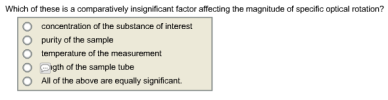 Which of these is a comparatively insignificant factor affecting the magnitude of specific optical rotation? concentration of the substance of interest purity of the sample temperature of the measurementgth of the sample tube All of the above are equally significant.
a)The optical rotation of a sample of 2-butanol is measured to be αobs = -0.35º. The...
a)The optical rotation of a sample of 2-butanol is measured to be αobs = -0.35º. The specific rotation for pure (+)-2-butanol is [α]D = 13.52° ml/g dm. If the cell path length was 0.6 dm and the concentration of 2-butanol in the sample was 0.15 g/ml, calculate the specific rotation and the percentage of the (+) and (-) isomers in your sample. b)You have a sample that you know is composed of 21% R isomer and 79% S isomer. What...
repared a limonene sample with a concentration of 0.044 g/mL and measured an optical rotation of a=8.78 degrees usi...
 repared a limonene sample with a concentration of 0.044 g/mL and measured an optical rotation of a=8.78 degrees using a 20 cm polarimeter tube. Calculate the specific rotation () of the students limonene sample and write your answer in the box. (review Example 1 in the procedure for how to do this) 6. If a mixture of (R) and (S)-Limonene Acid gives a %ee of 80.35% favoring the R enantiomer, use this to calculate the ratio of R to S...
Based on the optical rotation or specific rotation, how can you tell if the (R)-enantiomer is...
Based on the optical rotation or specific rotation, how can you tell if the (R)-enantiomer is in excess as opposed to the (S)-enantiomer being in excess?
Invertase (sucrase is the other name) is the enzyme hydrolyzing sucrose into glucose and fructose. (a)...
Invertase (sucrase is the other name) is the enzyme hydrolyzing sucrose into glucose and fructose. (a) Describe how you can measure the rate of the reaction catalyzed by invertase by change in optical rotation of the reaction solution. Provide the formula for calculation of the rate (in uM/min) from the change of optical rotation that your high-school educated laboratory technician can use. (b) Can you guess why the enzyme gets the name invertase? The specific rotation (see #1 for definition)...
11 degrees at 10cm rotation of sucrose is 1 C=.171 Tength of the light path, and...
 11 degrees at 10cm
rotation of sucrose is 1
C=.171
Tength of the light path, and the wavelength of the A standard formula is used to convert observed into "specific rotations" Tal a physical property tl be found in tables of physical properties of chemical compounds. al- 0 - measured rotation in angular degrees c = concentration in grams per milliliter of solution = cell length in decimeters D = wavelength of light, usually the D* line of a sodium...
11 degrees at 10cm
rotation of sucrose is 1
C=.171
Tength of the light path, and the wavelength of the A standard formula is used to convert observed into "specific rotations" Tal a physical property tl be found in tables of physical properties of chemical compounds. al- 0 - measured rotation in angular degrees c = concentration in grams per milliliter of solution = cell length in decimeters D = wavelength of light, usually the D* line of a sodium...
How was optical rotation different from other physical properties 4. Describe the physical properties (color and s...
 How was optical rotation different from other physical
properties
4. Describe the physical properties (color and state) of L-(+)-tartaric acid, trans-1,2- diaminocyclohexane, and your diastereomeric salt mixture. How is optical rotation different from other physical properties?
How was optical rotation different from other physical
properties
4. Describe the physical properties (color and state) of L-(+)-tartaric acid, trans-1,2- diaminocyclohexane, and your diastereomeric salt mixture. How is optical rotation different from other physical properties?
11. Enantiopurity - How pure a substance is in one enantiomer over the other is expressed...
 11. Enantiopurity - How pure a substance is in one enantiomer over the other is expressed as a % enantiomeric excess. Consider the following theoretical scenario: CH2OH CH2OH optical rotation: +100° optical rotation: -100° % composition % enantiomeric excess observed rotation In the lab, a polarimeter can give you optical purity (% enantiomeric excess) by comparing against a pure enantiomeric standard: Optical purity = specific rotation of sample - X 100 specific rotation of pure enantiomer Page 2 A mixture...
1. For bench stepping, when did you detect changes in heart rate and / or arterial...
1. For bench stepping, when did you detect changes in heart rate and / or arterial pressure relative to rest? Explain what most likely caused these cardiovascular changes. 2.For postural changes, when did you detect changes in heart rate and / or arterial pressure relative to rest (sitting)? Explain what most likely caused these cardiovascular changes. 3. How do your hematocrit values compare to typical percentages for RBCs and plasma? How do your hemoglobin values compare to typical values? What...
Experimental sucrose solution (final concentration) 30% 15% Amount of 30% stock sucrose solution needed 5 mL...
 Experimental sucrose solution (final concentration) 30% 15% Amount of 30% stock sucrose solution needed 5 mL 2.5 mL 0.5 mL Amount of water needed O mL 2.5 mL 4.5 mL 3% 12. Make an additional 200 mL of 15% sucrose solution in Beaker 1 by mixing the 30% stock solution with water. Use the following dilution equation to solve for the necessary amount of stock solution MV, = M2V2 Where: • V1 = Needed volume of stock solution M =...
 Which of these is a comparatively insignificant factor affecting the magnitude of specific optical rotation? concentration of the substance of interest purity of the sample temperature of the measurementgth of the sample tube All of the above are equally significant.
 repared a limonene sample with a concentration of 0.044 g/mL and measured an optical rotation of a=8.78 degrees using a 20 cm polarimeter tube. Calculate the specific rotation () of the students limonene sample and write your answer in the box. (review Example 1 in the procedure for how to do this) 6. If a mixture of (R) and (S)-Limonene Acid gives a %ee of 80.35% favoring the R enantiomer, use this to calculate the ratio of R to S...
 11 degrees at 10cm
rotation of sucrose is 1
C=.171
Tength of the light path, and the wavelength of the A standard formula is used to convert observed into "specific rotations" Tal a physical property tl be found in tables of physical properties of chemical compounds. al- 0 - measured rotation in angular degrees c = concentration in grams per milliliter of solution = cell length in decimeters D = wavelength of light, usually the D* line of a sodium...
11 degrees at 10cm
rotation of sucrose is 1
C=.171
Tength of the light path, and the wavelength of the A standard formula is used to convert observed into "specific rotations" Tal a physical property tl be found in tables of physical properties of chemical compounds. al- 0 - measured rotation in angular degrees c = concentration in grams per milliliter of solution = cell length in decimeters D = wavelength of light, usually the D* line of a sodium...
 How was optical rotation different from other physical
properties
4. Describe the physical properties (color and state) of L-(+)-tartaric acid, trans-1,2- diaminocyclohexane, and your diastereomeric salt mixture. How is optical rotation different from other physical properties?
How was optical rotation different from other physical
properties
4. Describe the physical properties (color and state) of L-(+)-tartaric acid, trans-1,2- diaminocyclohexane, and your diastereomeric salt mixture. How is optical rotation different from other physical properties?
 11. Enantiopurity - How pure a substance is in one enantiomer over the other is expressed as a % enantiomeric excess. Consider the following theoretical scenario: CH2OH CH2OH optical rotation: +100° optical rotation: -100° % composition % enantiomeric excess observed rotation In the lab, a polarimeter can give you optical purity (% enantiomeric excess) by comparing against a pure enantiomeric standard: Optical purity = specific rotation of sample - X 100 specific rotation of pure enantiomer Page 2 A mixture...
 Experimental sucrose solution (final concentration) 30% 15% Amount of 30% stock sucrose solution needed 5 mL 2.5 mL 0.5 mL Amount of water needed O mL 2.5 mL 4.5 mL 3% 12. Make an additional 200 mL of 15% sucrose solution in Beaker 1 by mixing the 30% stock solution with water. Use the following dilution equation to solve for the necessary amount of stock solution MV, = M2V2 Where: • V1 = Needed volume of stock solution M =...
Most questions answered within 3 hours.
-
Where is the error in this code sequence?
String s1 = "Hello";
String s2 = "ello";...
asked 10 months ago -
Financial data for Joel de Paris, Inc., for last year
follow:
Joel de Paris, Inc.
Balance...
asked 10 months ago -
Consider this reaction:
Al2(SO4)3 (aq)+ BaCl3
(aq) Al2Cl6 (aq)- +
3BaSO4(s) . What is the...
asked 10 months ago -
Suppose that Savneet is considering increasing her
recent random sample from 20 car rentals to 40...
asked 10 months ago -
Trucks arrive at an unloading terminal at an average rate of 120
per hour.
Trucks arrive...
asked 10 months ago -
Why are methanol and ethanol completely soluble in water while
octanol is not very little soluble....
asked 10 months ago -
A facilities manager at a university reads in a research report
that the mean amount of...
asked 10 months ago -
When the CuSO4 is rehydrated by adding water to the anhydrous
compound, is this an endothermic...
asked 10 months ago -
A ray of sunlight is passing from diamond into crown glass; the
angle of incidence is...
asked 10 months ago -
A block of mass 0.249 kg is placed on top of a light, vertical
spring of...
asked 10 months ago -
how do the kidneys compensate in the presences of acidosis
a) trigger hyperventilate
b) reserve acid...
asked 10 months ago -
Question 501 pts
The rental rate of capital to the firm increases. Which of the
following...
asked 10 months ago