The amount of money in an account earning compound interest is modelled by the equation: P(n)...
The amount of money in an account earning compound
interest is modelled by the equation:
P(n) = Arn – 1 where P(n) is the amount in the account at year n, A
is the amount invested, and r = 1 + i,
and i expressed as a percent is the effective rate of interest. If
a man invests $1500 in year 1, and earns
4% interest, how much money will he have in year 30?
a. $4677.98 c. $6482.91
b. $5059.70 d. $4865.10
Homework Answers
| P(n) =A*(1+i)^n |
| Here, |
| A =$1,500 |
| I =4% and 1+I =1+0.4 =1.04 |
| n =30 |
| $1,500*(1.04)^30 |
| $1,500*3.2434 =$4,865.10 |
| So Option D is the answer |
Add Answer to:
The amount of money in an account earning compound
interest is modelled by the equation:
P(n)...
1. Calculate the compound amount when S1500 is deposited in an account earning an annual interest...
 1. Calculate the compound amount when S1500 is deposited in an account earning an annual interest rate of 5%, compounded monthly, for 18 months. 2, How much money should be invested in an account that earns 6% annual interest, com- pounded monthly, in order to have $15, 000 in 5 years? 3. How much interest is earned on a $2000 deposit for 2 years at a 0.12% monthly interest rate. compounded daily?
The principal represents an amount of money deposited in a savings account subject to compound interest...
 The principal represents an amount of money deposited in a savings account subject to compound interest at the given rate. Find how much money will be in the account after the given number of years (Assume 360 days in a year.), and how much interest was earned. Int A P A = Pert n nt 1 + 38) Principal: $10,000 Rate: 5% Compounded: semiannually Time: 5 years A) amount in account: $11,314.08; interest earned: $1314.08 B) amount in account: $12,762.82;...
1) The amount of money earned by an investment of principal P with an (annual) interest...
1) The amount of money earned by an investment of principal P with an (annual) interest rate of r with interest compute continuously is given by P ert where t is the investment in years. In the following, all amounts are invested in accounts where interest is compounded continuously. (a) (15 pts) Assume that Alice invests $50000 at an interest rate of 5%. Create a table that lists her income for t = 1, 2, . . . 5 (b)...
How much money(USD) do you have to invest if it earns continuous compound interest and the investment is continuously pa...
How much money(USD) do you have to invest if it earns continuous compound interest and the investment is continuously paid out to your bank account at a rate of $100,000 per year, and after 100 years the money is all used up? Interest rate is 'r', where r is whichever number leads to the smallest amount of money needed to be invested. What is the equation needed to find this answer, rather than a specific numerical answer.
An account earns compound interest of an unknown annual effective interest rate ?. The money doubles...
An account earns compound interest of an unknown annual effective interest rate ?. The money doubles in nine year, find ?.
The principal represents an amount of money deposited in a savings account subject to compound interest...
 The principal represents an amount of money deposited in a savings account subject to compound interest at the given rate. Find how much money will be in the account after the given number of years (Assume 360 days in a year.), and how much interest was earned. 5) 1.9tA= Pert Y= (1. :) - 1 Principal: $3500 Rate: 4.5% Compounded: monthly Time: 4 years amount in account: $4865.38; interest earned: $673.82 amount in account: $4188.85; interest earned: $688.85 amount in...
14.Compound Interest hank account pays compound interest, it pays interest not only on the principal amount...
 14.Compound Interest hank account pays compound interest, it pays interest not only on the principal amount that was deposited into the account, but also on the interest that has accumulated over time. Suppose you want to deposit some money into a savings account, and let the account earn compound interest for a certain number of years. The formula for calculating the balance of the account afer a specified namber of years is The terms in the formula are A is...
1. Suppose $26002600 is invested annually into an annuity that earns 55% interest. If P dollars...
1. Suppose $26002600 is invested annually into an annuity that earns 55% interest. If P dollars are invested annually at an interest rate of r, the value of the annuity after n years is given by the following equation. Upper W equals Upper P left bracket StartFraction left parenthesis 1 plus r right parenthesis Superscript n Baseline minus 1 Over r EndFraction right bracketW=P(1+r)n−1r How much is the annuity worth after 5 years? 2. Suppose that $90,000 is invested at...
differential It is assumed that the bank account with annual compound interest rate i contains TL...
 differential
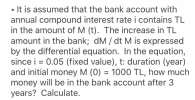
It is assumed that the bank account with annual compound interest rate i contains TL in the amount of M (t). The increase in TL amount in the bank; dM / dt M is expressed by the differential equation. In the equation, since i = 0.05 (fixed value), t: duration (year) and initial money M (0) = 1000 TL, how much money will be in the bank account after 3 years? Calculate.
differential
It is assumed that the bank account with annual compound interest rate i contains TL in the amount of M (t). The increase in TL amount in the bank; dM / dt M is expressed by the differential equation. In the equation, since i = 0.05 (fixed value), t: duration (year) and initial money M (0) = 1000 TL, how much money will be in the bank account after 3 years? Calculate.
Suppose you have a certain amount of money in a savings account that earns compound monthly...
Suppose you have a certain amount of money in a savings account that earns compound monthly interest, and you want to calculate the amount that you will have after a specific number of months. The formula is as follows: f = p * (1 + i)^t • f is the future value of the account after the specified time period. • p is the present value of the account. • i is the monthly interest rate. • t is the...
 1. Calculate the compound amount when S1500 is deposited in an account earning an annual interest rate of 5%, compounded monthly, for 18 months. 2, How much money should be invested in an account that earns 6% annual interest, com- pounded monthly, in order to have $15, 000 in 5 years? 3. How much interest is earned on a $2000 deposit for 2 years at a 0.12% monthly interest rate. compounded daily?
 The principal represents an amount of money deposited in a savings account subject to compound interest at the given rate. Find how much money will be in the account after the given number of years (Assume 360 days in a year.), and how much interest was earned. Int A P A = Pert n nt 1 + 38) Principal: $10,000 Rate: 5% Compounded: semiannually Time: 5 years A) amount in account: $11,314.08; interest earned: $1314.08 B) amount in account: $12,762.82;...
 The principal represents an amount of money deposited in a savings account subject to compound interest at the given rate. Find how much money will be in the account after the given number of years (Assume 360 days in a year.), and how much interest was earned. 5) 1.9tA= Pert Y= (1. :) - 1 Principal: $3500 Rate: 4.5% Compounded: monthly Time: 4 years amount in account: $4865.38; interest earned: $673.82 amount in account: $4188.85; interest earned: $688.85 amount in...
 14.Compound Interest hank account pays compound interest, it pays interest not only on the principal amount that was deposited into the account, but also on the interest that has accumulated over time. Suppose you want to deposit some money into a savings account, and let the account earn compound interest for a certain number of years. The formula for calculating the balance of the account afer a specified namber of years is The terms in the formula are A is...
 differential
It is assumed that the bank account with annual compound interest rate i contains TL in the amount of M (t). The increase in TL amount in the bank; dM / dt M is expressed by the differential equation. In the equation, since i = 0.05 (fixed value), t: duration (year) and initial money M (0) = 1000 TL, how much money will be in the bank account after 3 years? Calculate.
differential
It is assumed that the bank account with annual compound interest rate i contains TL in the amount of M (t). The increase in TL amount in the bank; dM / dt M is expressed by the differential equation. In the equation, since i = 0.05 (fixed value), t: duration (year) and initial money M (0) = 1000 TL, how much money will be in the bank account after 3 years? Calculate.
Most questions answered within 3 hours.
-
Where is the error in this code sequence?
String s1 = "Hello";
String s2 = "ello";...
asked 11 months ago -
Financial data for Joel de Paris, Inc., for last year
follow:
Joel de Paris, Inc.
Balance...
asked 11 months ago -
Consider this reaction:
Al2(SO4)3 (aq)+ BaCl3
(aq) Al2Cl6 (aq)- +
3BaSO4(s) . What is the...
asked 11 months ago -
Suppose that Savneet is considering increasing her
recent random sample from 20 car rentals to 40...
asked 11 months ago -
Trucks arrive at an unloading terminal at an average rate of 120
per hour.
Trucks arrive...
asked 11 months ago -
Why are methanol and ethanol completely soluble in water while
octanol is not very little soluble....
asked 11 months ago -
A facilities manager at a university reads in a research report
that the mean amount of...
asked 11 months ago -
When the CuSO4 is rehydrated by adding water to the anhydrous
compound, is this an endothermic...
asked 11 months ago -
A ray of sunlight is passing from diamond into crown glass; the
angle of incidence is...
asked 11 months ago -
A block of mass 0.249 kg is placed on top of a light, vertical
spring of...
asked 11 months ago -
how do the kidneys compensate in the presences of acidosis
a) trigger hyperventilate
b) reserve acid...
asked 11 months ago -
Question 501 pts
The rental rate of capital to the firm increases. Which of the
following...
asked 11 months ago