1- We looked at NaCl before it dissolved and after it dissolved. Now,1- draw a picture...
1- We looked at NaCl before it dissolved and after it dissolved. Now,1- draw a picture of NaCl while it dissolves. Make sure to include both NaCl and H2O.
2- describe the sequence of events that happens when solid NaCl dissolves in water.
3- How is energy transferred between the system and the surroundings during this process?
Homework Answers
Ans 1
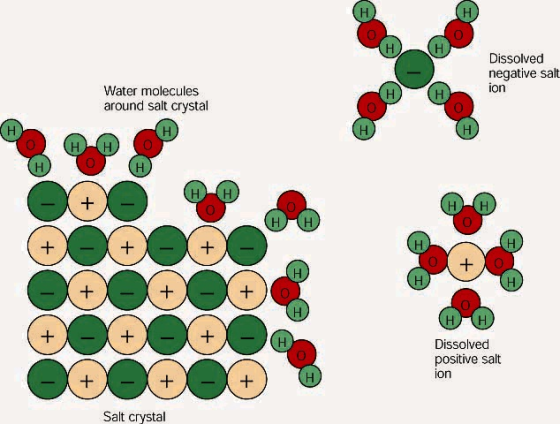
This figure shows how NaCl dissolves in water. Here in the left side salt crystal is shown which is dissolving and in the right side dissolved particles are shown.
Ans 2:
When NaCl crystals are dipped in water, cleavage of ionic bond takes place which is compensated by the surrounding water molecules. After the cleavage Na+ and Cl- ions are formed. Since we know that water molecules are polar in nature in which oxygen is more electronegative in nature than hydrogen. Hence water molecules forms a layer around the ions and energy is released known as hydration enthalpy which compensated the lattice energy of the NaCl molecules. In this way NaCl is dissolved in water.
Ans 3:
During the cleavage of ionic bond energy is transferred from surrounding to system as energy is needed for the cleavage of ionic bond. After this water molecules form layers around the ions in which energy is released. This energy is transferred from system to the surrounding.
Add Answer to:
1- We looked at NaCl before it dissolved and after it dissolved.
Now,1- draw a picture...
I need help with 11 and 12 please. Data Table Mixture NaCl (s) + H2O (1)...
 I need help with 11 and 12 please.
Data Table Mixture NaCl (s) + H2O (1) T (initial) T, (final) AT (T-T) -.20 25.00 24.80 NaNO, (s) + H2O (1) 24.99 24.11 -.88 NaCH,COO + H2O (1) 24.99 25.91 .82 Use your experimental data to answer the following questions: 7. Calculate AT (AT = T2-T) for each mixture and record the results in the data table. 8. An exothermic process releases heat (warms up), and an endothermic process absorbs heat...
I need help with 11 and 12 please.
Data Table Mixture NaCl (s) + H2O (1) T (initial) T, (final) AT (T-T) -.20 25.00 24.80 NaNO, (s) + H2O (1) 24.99 24.11 -.88 NaCH,COO + H2O (1) 24.99 25.91 .82 Use your experimental data to answer the following questions: 7. Calculate AT (AT = T2-T) for each mixture and record the results in the data table. 8. An exothermic process releases heat (warms up), and an endothermic process absorbs heat...
26. In case study 1 we looked at pneumonia caused by the Gram-positive bacteria Streptococcus pneumoniae...
 26. In case study 1 we looked at pneumonia caused by the Gram-positive bacteria Streptococcus pneumoniae and the yeast Candida albicans. A. Draw picture of each cell. A complete answer will include the major internal and external structures with special attention to features that are used to characterize these cells (8pts). B. Indicate an antibiotic that could be used to selectively target each of these organisms and describe its mode of action (2.5pts). 27. You decide you would like to...
How Do I solve question 8, 10 and 13? Activity #1: Dissolution of ammonium nitrate in...
 How Do I solve question 8, 10 and 13?
Activity #1: Dissolution of ammonium nitrate in water Fill a 100 ml beaker half-full with water. Place your hand on the outside of the beaker to gauge the temperature Add a large scoop of ammonium nitrate to the beaker and stir. Feel the temperature of the beaker as the ammonium nitrate dissolves. 1. Write the molecular and total ionic equations for the dissolution of ammonium nitrate. MOLECULAR EQUATION: NH4NO3 +H20) NH4OH...
How Do I solve question 8, 10 and 13?
Activity #1: Dissolution of ammonium nitrate in water Fill a 100 ml beaker half-full with water. Place your hand on the outside of the beaker to gauge the temperature Add a large scoop of ammonium nitrate to the beaker and stir. Feel the temperature of the beaker as the ammonium nitrate dissolves. 1. Write the molecular and total ionic equations for the dissolution of ammonium nitrate. MOLECULAR EQUATION: NH4NO3 +H20) NH4OH...
Draw the pathway for a threat conditioning 1. What happens before conditioning? 1. Draw where the...
 Draw the pathway for a threat conditioning 1. What happens before conditioning? 1. Draw where the tone and visual stimulus connect in the pathway 2. What happens with conditioning? I. Draw the outcome of repeated pairings of the unconditioned stimulus and the conditioned stimulus 2. Make sure you include how long-term potentiation works (describe what changes are happening at the synapse) Draw the associated output pathway in this circuit (assuming the pairing of the image and tone lead you to...
I dont need help with test tube 2, only one im having trouble with it. I...
 I
dont need help with test tube 2, only one im having trouble with
it. I dont under really what to do for the optional part.
Test Tube 1: Draw an energy diagram of the process and label the energy changes including the enthalpy of solution. -5.anL of d;Stile water nCl2 .5 cacle in AX 27Cterf 26 2 5 min 23'c terr 20 23 As you draw the energy diagram, consider the entire solvation process as a series of steps....
I
dont need help with test tube 2, only one im having trouble with
it. I dont under really what to do for the optional part.
Test Tube 1: Draw an energy diagram of the process and label the energy changes including the enthalpy of solution. -5.anL of d;Stile water nCl2 .5 cacle in AX 27Cterf 26 2 5 min 23'c terr 20 23 As you draw the energy diagram, consider the entire solvation process as a series of steps....
Hand In Problem 2 A solid globe of mass M and radius R can rotate about...
 Hand In Problem 2 A solid globe of mass M and radius R can rotate about its axis. A block of mass m is attached by a massless-string/pulley system as shown. As the block falls it causes the globe to spin. If the block starts at rest, at what speed does the block hit the ground after it falls a distance h? ' State your answer in terms of the given variables: M, R, m, h and g. Solve this...
Thermodynamics example information to help solve each question CALCULATIONS Question 1. Write the complete exp...
 Thermodynamics
example information to help solve each question
CALCULATIONS Question 1. Write the complete expression for the free energy change of the L = V equilibrium reaction for pure water (equation 2) at 100 bars and 300-C using the following data: Gy = -210330 joules/mole GL = -210330 joules/mole Recall that the right side (water vapor) of the reaction is the product side and left side (water liquid) of the reaction is the reactant side, Recall that we always calculate...
Thermodynamics
example information to help solve each question
CALCULATIONS Question 1. Write the complete expression for the free energy change of the L = V equilibrium reaction for pure water (equation 2) at 100 bars and 300-C using the following data: Gy = -210330 joules/mole GL = -210330 joules/mole Recall that the right side (water vapor) of the reaction is the product side and left side (water liquid) of the reaction is the reactant side, Recall that we always calculate...
e. [1 pt] Now suppose we see that the particle is moving in a straight line,...
 e. [1 pt] Now suppose we see that the particle is moving in a straight line, as shown in Figure 1. Find vq in terms of vx and physical constants. Can this be observed in a lab? (Recall that Eouoc2, nothing can travel faster than the speed of light, and that it costs an infinite amount of energy to accelerate something with nonzero mass up to the speed of light, c 3 x 10⁸ m/s 109 miles per hour.) 0...
1 picture- problem 2 other pictures- phase diagrams for problem 1. Draw a phase diagram for...
 1 picture- problem
2 other pictures- phase diagrams for problem
1. Draw a phase diagram for a binary eutectic alloy with solid solubility, naming and describing the significance of the main features. The binary alloy system of metals A and B contains two intermediate (intermetallic) phases A B and AB2 of narrow composition range, each of which forms by a peritectic reaction A cutectic point also exists, at 85at% B. The melting point of A is higher than that of...
1 picture- problem
2 other pictures- phase diagrams for problem
1. Draw a phase diagram for a binary eutectic alloy with solid solubility, naming and describing the significance of the main features. The binary alloy system of metals A and B contains two intermediate (intermetallic) phases A B and AB2 of narrow composition range, each of which forms by a peritectic reaction A cutectic point also exists, at 85at% B. The melting point of A is higher than that of...
10. When sodium chloride dissolves in water, the ions dissociate: NaCl (s) = Na+ (aq) +...
 10. When sodium chloride
dissolves in water, the ions dissociate: NaCl (s) = Na+
(aq) + Cl- (aq)
Write ionic equations, similar to the one above, that describe
how NaNO3 and NaCH3CO2 each
dissociate as they dissolve in water. Include heat as a reactant or
product in each equation.
Here is what I answered:
NaNO3 (s) = Na+ +
NO3- + heat
NaC2H3O2 + Heat =
Na+ +
C2H3O2-(ag)
Lab data table attached to determine where to place heat.
AGO no...
10. When sodium chloride
dissolves in water, the ions dissociate: NaCl (s) = Na+
(aq) + Cl- (aq)
Write ionic equations, similar to the one above, that describe
how NaNO3 and NaCH3CO2 each
dissociate as they dissolve in water. Include heat as a reactant or
product in each equation.
Here is what I answered:
NaNO3 (s) = Na+ +
NO3- + heat
NaC2H3O2 + Heat =
Na+ +
C2H3O2-(ag)
Lab data table attached to determine where to place heat.
AGO no...
 I need help with 11 and 12 please.
Data Table Mixture NaCl (s) + H2O (1) T (initial) T, (final) AT (T-T) -.20 25.00 24.80 NaNO, (s) + H2O (1) 24.99 24.11 -.88 NaCH,COO + H2O (1) 24.99 25.91 .82 Use your experimental data to answer the following questions: 7. Calculate AT (AT = T2-T) for each mixture and record the results in the data table. 8. An exothermic process releases heat (warms up), and an endothermic process absorbs heat...
I need help with 11 and 12 please.
Data Table Mixture NaCl (s) + H2O (1) T (initial) T, (final) AT (T-T) -.20 25.00 24.80 NaNO, (s) + H2O (1) 24.99 24.11 -.88 NaCH,COO + H2O (1) 24.99 25.91 .82 Use your experimental data to answer the following questions: 7. Calculate AT (AT = T2-T) for each mixture and record the results in the data table. 8. An exothermic process releases heat (warms up), and an endothermic process absorbs heat...
 26. In case study 1 we looked at pneumonia caused by the Gram-positive bacteria Streptococcus pneumoniae and the yeast Candida albicans. A. Draw picture of each cell. A complete answer will include the major internal and external structures with special attention to features that are used to characterize these cells (8pts). B. Indicate an antibiotic that could be used to selectively target each of these organisms and describe its mode of action (2.5pts). 27. You decide you would like to...
 How Do I solve question 8, 10 and 13?
Activity #1: Dissolution of ammonium nitrate in water Fill a 100 ml beaker half-full with water. Place your hand on the outside of the beaker to gauge the temperature Add a large scoop of ammonium nitrate to the beaker and stir. Feel the temperature of the beaker as the ammonium nitrate dissolves. 1. Write the molecular and total ionic equations for the dissolution of ammonium nitrate. MOLECULAR EQUATION: NH4NO3 +H20) NH4OH...
How Do I solve question 8, 10 and 13?
Activity #1: Dissolution of ammonium nitrate in water Fill a 100 ml beaker half-full with water. Place your hand on the outside of the beaker to gauge the temperature Add a large scoop of ammonium nitrate to the beaker and stir. Feel the temperature of the beaker as the ammonium nitrate dissolves. 1. Write the molecular and total ionic equations for the dissolution of ammonium nitrate. MOLECULAR EQUATION: NH4NO3 +H20) NH4OH...
 Draw the pathway for a threat conditioning 1. What happens before conditioning? 1. Draw where the tone and visual stimulus connect in the pathway 2. What happens with conditioning? I. Draw the outcome of repeated pairings of the unconditioned stimulus and the conditioned stimulus 2. Make sure you include how long-term potentiation works (describe what changes are happening at the synapse) Draw the associated output pathway in this circuit (assuming the pairing of the image and tone lead you to...
 I
dont need help with test tube 2, only one im having trouble with
it. I dont under really what to do for the optional part.
Test Tube 1: Draw an energy diagram of the process and label the energy changes including the enthalpy of solution. -5.anL of d;Stile water nCl2 .5 cacle in AX 27Cterf 26 2 5 min 23'c terr 20 23 As you draw the energy diagram, consider the entire solvation process as a series of steps....
I
dont need help with test tube 2, only one im having trouble with
it. I dont under really what to do for the optional part.
Test Tube 1: Draw an energy diagram of the process and label the energy changes including the enthalpy of solution. -5.anL of d;Stile water nCl2 .5 cacle in AX 27Cterf 26 2 5 min 23'c terr 20 23 As you draw the energy diagram, consider the entire solvation process as a series of steps....
 Hand In Problem 2 A solid globe of mass M and radius R can rotate about its axis. A block of mass m is attached by a massless-string/pulley system as shown. As the block falls it causes the globe to spin. If the block starts at rest, at what speed does the block hit the ground after it falls a distance h? ' State your answer in terms of the given variables: M, R, m, h and g. Solve this...
 Thermodynamics
example information to help solve each question
CALCULATIONS Question 1. Write the complete expression for the free energy change of the L = V equilibrium reaction for pure water (equation 2) at 100 bars and 300-C using the following data: Gy = -210330 joules/mole GL = -210330 joules/mole Recall that the right side (water vapor) of the reaction is the product side and left side (water liquid) of the reaction is the reactant side, Recall that we always calculate...
Thermodynamics
example information to help solve each question
CALCULATIONS Question 1. Write the complete expression for the free energy change of the L = V equilibrium reaction for pure water (equation 2) at 100 bars and 300-C using the following data: Gy = -210330 joules/mole GL = -210330 joules/mole Recall that the right side (water vapor) of the reaction is the product side and left side (water liquid) of the reaction is the reactant side, Recall that we always calculate...
 e. [1 pt] Now suppose we see that the particle is moving in a straight line, as shown in Figure 1. Find vq in terms of vx and physical constants. Can this be observed in a lab? (Recall that Eouoc2, nothing can travel faster than the speed of light, and that it costs an infinite amount of energy to accelerate something with nonzero mass up to the speed of light, c 3 x 10⁸ m/s 109 miles per hour.) 0...
 1 picture- problem
2 other pictures- phase diagrams for problem
1. Draw a phase diagram for a binary eutectic alloy with solid solubility, naming and describing the significance of the main features. The binary alloy system of metals A and B contains two intermediate (intermetallic) phases A B and AB2 of narrow composition range, each of which forms by a peritectic reaction A cutectic point also exists, at 85at% B. The melting point of A is higher than that of...
1 picture- problem
2 other pictures- phase diagrams for problem
1. Draw a phase diagram for a binary eutectic alloy with solid solubility, naming and describing the significance of the main features. The binary alloy system of metals A and B contains two intermediate (intermetallic) phases A B and AB2 of narrow composition range, each of which forms by a peritectic reaction A cutectic point also exists, at 85at% B. The melting point of A is higher than that of...
 10. When sodium chloride
dissolves in water, the ions dissociate: NaCl (s) = Na+
(aq) + Cl- (aq)
Write ionic equations, similar to the one above, that describe
how NaNO3 and NaCH3CO2 each
dissociate as they dissolve in water. Include heat as a reactant or
product in each equation.
Here is what I answered:
NaNO3 (s) = Na+ +
NO3- + heat
NaC2H3O2 + Heat =
Na+ +
C2H3O2-(ag)
Lab data table attached to determine where to place heat.
AGO no...
10. When sodium chloride
dissolves in water, the ions dissociate: NaCl (s) = Na+
(aq) + Cl- (aq)
Write ionic equations, similar to the one above, that describe
how NaNO3 and NaCH3CO2 each
dissociate as they dissolve in water. Include heat as a reactant or
product in each equation.
Here is what I answered:
NaNO3 (s) = Na+ +
NO3- + heat
NaC2H3O2 + Heat =
Na+ +
C2H3O2-(ag)
Lab data table attached to determine where to place heat.
AGO no...
Most questions answered within 3 hours.
-
Where is the error in this code sequence?
String s1 = "Hello";
String s2 = "ello";...
asked 10 months ago -
Financial data for Joel de Paris, Inc., for last year
follow:
Joel de Paris, Inc.
Balance...
asked 10 months ago -
Consider this reaction:
Al2(SO4)3 (aq)+ BaCl3
(aq) Al2Cl6 (aq)- +
3BaSO4(s) . What is the...
asked 10 months ago -
Suppose that Savneet is considering increasing her
recent random sample from 20 car rentals to 40...
asked 10 months ago -
Trucks arrive at an unloading terminal at an average rate of 120
per hour.
Trucks arrive...
asked 10 months ago -
Why are methanol and ethanol completely soluble in water while
octanol is not very little soluble....
asked 10 months ago -
A facilities manager at a university reads in a research report
that the mean amount of...
asked 10 months ago -
When the CuSO4 is rehydrated by adding water to the anhydrous
compound, is this an endothermic...
asked 10 months ago -
A ray of sunlight is passing from diamond into crown glass; the
angle of incidence is...
asked 10 months ago -
A block of mass 0.249 kg is placed on top of a light, vertical
spring of...
asked 10 months ago -
how do the kidneys compensate in the presences of acidosis
a) trigger hyperventilate
b) reserve acid...
asked 10 months ago -
Question 501 pts
The rental rate of capital to the firm increases. Which of the
following...
asked 10 months ago