. The ion below most likely to undergo hydrolysis is: SO4-2 B) I-1 C) NO3-1 D)...
. The ion below most likely to undergo hydrolysis is:
- SO4-2 B) I-1 C) NO3-1 D) Cl-1 E) F-1
Homework Answers
Among all the four ions F-1 will undergo hydrolysis to produce Hydrofluoric acid and hydroxide. So the option (E) is correct
SO4-2 is fairly weak acid than water so it will not undergo hydrolysis.
Add Answer to:
. The ion below most likely to undergo hydrolysis is:
SO4-2 B)
I-1 C)
NO3-1 D)...
Which alky halide would you expect to undergo SN1 hydrolysis most rapidly? (A) (CH3)3C-I (B)...
Which alky halide would you expect to undergo SN1 hydrolysis most rapidly? (A) (CH3)3C-I (B) (CH3)3C-Br (C) (CH3)3C-Cl (D) (CH3)3C-F
When salts dissolve in water, they dissociate into cations and anions which may undergo hydrolysis with...
When salts dissolve in water, they dissociate into cations and anions which may undergo hydrolysis with water. In general, metal ions undergo hydrolysis to produce hydronium ion when the metal is a transition metal with a 2+ charge or higher, or a non-transition metal with a 3+ charge or higher. Which of the following salts should produce an acidic solution when dissolved in water? Select all that apply. There may be more than one correct answer. A. MgCl2 ...
What is the formula of the sulfate ion? A. SO4- B. SO3- C. SO42- D. SO32-...
What is the formula of the sulfate ion? A. SO4- B. SO3- C. SO42- D. SO32- E. SO22-
1) match the compounds on the left to the compound on the right most likely to...
 1) match the compounds on the left to the compound on the
right most likely to have the same electrical conductivity per
mole.
2) estimate the crystal field stabilization energy for the
octahedral ion tris(ethylenediamine)nickel(II), if the wavelength
of maximum absorption for the ion id 893 nm. ______ kJ mol^-1
[Co(NH3)5Cl]I2 C12H22011 NH4[Mn(CN)51 CuSO4 [Fe(CO)] Cu(NO3)2 [Pt(en)3](NO3)4 Fe(NO3)3 K3[PdF61 Fe2(SO4)3
1) match the compounds on the left to the compound on the
right most likely to have the same electrical conductivity per
mole.
2) estimate the crystal field stabilization energy for the
octahedral ion tris(ethylenediamine)nickel(II), if the wavelength
of maximum absorption for the ion id 893 nm. ______ kJ mol^-1
[Co(NH3)5Cl]I2 C12H22011 NH4[Mn(CN)51 CuSO4 [Fe(CO)] Cu(NO3)2 [Pt(en)3](NO3)4 Fe(NO3)3 K3[PdF61 Fe2(SO4)3
6. The most common ion of bromine has a charge of A. +2 В. +1 C....
 6. The most common ion of bromine has a charge of A. +2 В. +1 C. -1 D. -2 E. bromine only forms covalent compounds. Which atom in Period 5 of the periodic table has the largest radius? 7. A. Xenon B. Cadmium C. Strontium D. Yttrium E. Rubidium 8. Which of the following covalent bonds is most polar? A. O-F В. Н-F C. C-F D. Cl-F None of these bonds is polar. E. 9. How many electrons are on...
Question 9 (2 points) Which of the following carbocations is (are) likely to undergo rearrangement through...
 Question 9 (2 points) Which of the following carbocations is (are) likely to undergo rearrangement through a methyl shift? HC CH HC CH H₃C. CH INI a) both I and II b) both II and III OI d) 1 Question 10 (2 points) Choose a major product for the reaction below 0 Cl/AICI OCH, CI OCH OCH OCH a) I, II and Ill b) d)
What is the charge of the monatomic ion most likely to be formed by each of...
What is the charge of the monatomic ion most likely to be formed by each of the following? O (a) +2 (b) +1 (c) ‒1 (d) ‒2 (e) ‒3 Mg (a) +2 (b) +1 (c) ‒1 (d) ‒2 (e) ‒3 Which element contains most unpaired electrons in the ground state of its atom (a) S (b) Mg (c) P (d) Mn (e) Cr
r each compound below, identify which position(s) is/are most likely to undergo an electrophilic aromatic substitut...
 r each compound below, identify which position(s) is/are most likely to undergo an electrophilic aromatic substitution reaction? Circle the carbon that undergoes electrophilic substitution. (3) b. CH NO2 O2N What Wittig reagent and carbonyl compounds are used to synthesize the following compound? (2) c. (CH3CH2)2C-cHCHCH2CH3 Write the equations to convert benzene to the following compounds? Some conversions need more than one step. (10) 3. a. Toluene b. m-bromo nitrobenzene c. Benzene sulfonic acid d. Aniline e. Benzoic acid
r each...
r each compound below, identify which position(s) is/are most likely to undergo an electrophilic aromatic substitution reaction? Circle the carbon that undergoes electrophilic substitution. (3) b. CH NO2 O2N What Wittig reagent and carbonyl compounds are used to synthesize the following compound? (2) c. (CH3CH2)2C-cHCHCH2CH3 Write the equations to convert benzene to the following compounds? Some conversions need more than one step. (10) 3. a. Toluene b. m-bromo nitrobenzene c. Benzene sulfonic acid d. Aniline e. Benzoic acid
r each...
Complete the following reactions by listing only the most likely products. a. NapPh3 + SbPh3 b....
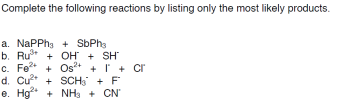 Complete the following reactions by listing only the most likely products. a. NapPh3 + SbPh3 b. Ru3+ + OH + SH C. Fe2+ + Os2+ + i + cl d. Cu2+ + SCH3 + F e. Hg2+ + NH3 + CN
 1) match the compounds on the left to the compound on the
right most likely to have the same electrical conductivity per
mole.
2) estimate the crystal field stabilization energy for the
octahedral ion tris(ethylenediamine)nickel(II), if the wavelength
of maximum absorption for the ion id 893 nm. ______ kJ mol^-1
[Co(NH3)5Cl]I2 C12H22011 NH4[Mn(CN)51 CuSO4 [Fe(CO)] Cu(NO3)2 [Pt(en)3](NO3)4 Fe(NO3)3 K3[PdF61 Fe2(SO4)3
1) match the compounds on the left to the compound on the
right most likely to have the same electrical conductivity per
mole.
2) estimate the crystal field stabilization energy for the
octahedral ion tris(ethylenediamine)nickel(II), if the wavelength
of maximum absorption for the ion id 893 nm. ______ kJ mol^-1
[Co(NH3)5Cl]I2 C12H22011 NH4[Mn(CN)51 CuSO4 [Fe(CO)] Cu(NO3)2 [Pt(en)3](NO3)4 Fe(NO3)3 K3[PdF61 Fe2(SO4)3
 6. The most common ion of bromine has a charge of A. +2 В. +1 C. -1 D. -2 E. bromine only forms covalent compounds. Which atom in Period 5 of the periodic table has the largest radius? 7. A. Xenon B. Cadmium C. Strontium D. Yttrium E. Rubidium 8. Which of the following covalent bonds is most polar? A. O-F В. Н-F C. C-F D. Cl-F None of these bonds is polar. E. 9. How many electrons are on...
 Question 9 (2 points) Which of the following carbocations is (are) likely to undergo rearrangement through a methyl shift? HC CH HC CH H₃C. CH INI a) both I and II b) both II and III OI d) 1 Question 10 (2 points) Choose a major product for the reaction below 0 Cl/AICI OCH, CI OCH OCH OCH a) I, II and Ill b) d)
 r each compound below, identify which position(s) is/are most likely to undergo an electrophilic aromatic substitution reaction? Circle the carbon that undergoes electrophilic substitution. (3) b. CH NO2 O2N What Wittig reagent and carbonyl compounds are used to synthesize the following compound? (2) c. (CH3CH2)2C-cHCHCH2CH3 Write the equations to convert benzene to the following compounds? Some conversions need more than one step. (10) 3. a. Toluene b. m-bromo nitrobenzene c. Benzene sulfonic acid d. Aniline e. Benzoic acid
r each...
r each compound below, identify which position(s) is/are most likely to undergo an electrophilic aromatic substitution reaction? Circle the carbon that undergoes electrophilic substitution. (3) b. CH NO2 O2N What Wittig reagent and carbonyl compounds are used to synthesize the following compound? (2) c. (CH3CH2)2C-cHCHCH2CH3 Write the equations to convert benzene to the following compounds? Some conversions need more than one step. (10) 3. a. Toluene b. m-bromo nitrobenzene c. Benzene sulfonic acid d. Aniline e. Benzoic acid
r each...
 Complete the following reactions by listing only the most likely products. a. NapPh3 + SbPh3 b. Ru3+ + OH + SH C. Fe2+ + Os2+ + i + cl d. Cu2+ + SCH3 + F e. Hg2+ + NH3 + CN
Most questions answered within 3 hours.
-
Where is the error in this code sequence?
String s1 = "Hello";
String s2 = "ello";...
asked 10 months ago -
Financial data for Joel de Paris, Inc., for last year
follow:
Joel de Paris, Inc.
Balance...
asked 10 months ago -
Consider this reaction:
Al2(SO4)3 (aq)+ BaCl3
(aq) Al2Cl6 (aq)- +
3BaSO4(s) . What is the...
asked 10 months ago -
Suppose that Savneet is considering increasing her
recent random sample from 20 car rentals to 40...
asked 10 months ago -
Trucks arrive at an unloading terminal at an average rate of 120
per hour.
Trucks arrive...
asked 10 months ago -
Why are methanol and ethanol completely soluble in water while
octanol is not very little soluble....
asked 10 months ago -
A facilities manager at a university reads in a research report
that the mean amount of...
asked 10 months ago -
When the CuSO4 is rehydrated by adding water to the anhydrous
compound, is this an endothermic...
asked 10 months ago -
A ray of sunlight is passing from diamond into crown glass; the
angle of incidence is...
asked 10 months ago -
A block of mass 0.249 kg is placed on top of a light, vertical
spring of...
asked 10 months ago -
how do the kidneys compensate in the presences of acidosis
a) trigger hyperventilate
b) reserve acid...
asked 10 months ago -
Question 501 pts
The rental rate of capital to the firm increases. Which of the
following...
asked 10 months ago