In the electrophillic substitution reactions of benzoic acid, which of the following statements best describes the...
In the electrophillic substitution reactions of benzoic acid, which of the following statements best describes the expected reactivity pattern?
A) The m-positions are most activated to attack by the electrophile.
B) The o,p-positions are most activated to attack by the electrophile.
C) The o,p-positions are most deactivated to attack by the electrophile.
D) The m-positions are most deactivated to attack by the electrophile.
E) All positions (o, m, and p) are equally activated to attack by the electrophile
Homework Answers
Option C is correct
The o,p-positions are most deactivated to attack by the electrophile.
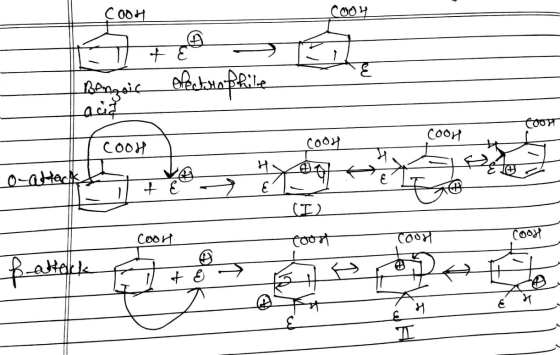
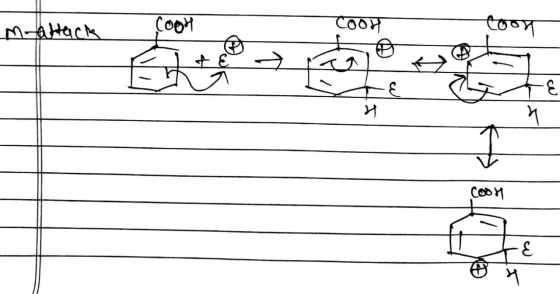
When the attack take place at o,p-position then it contribute the str. I & II which are highly unstable. Due the presence of postive charge on the carbon atom bearing electron withdrawing COOH group in str. I & II the system beacome highly unstable. this type of structure is not possible when attack take place at m-position.
As the system attain highly unstability when attack take place at o,p-position these positions are most deactivated to attack by the electrophile.
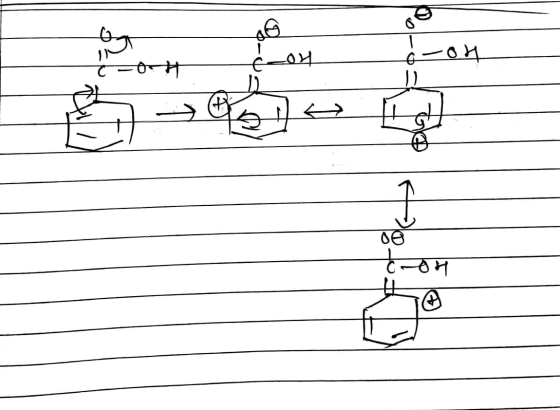
It is clearly seems that COOH Group withdraw the electron density at o,p-position and make these positions deactivated to attack by electrophile.
Add Answer to:
In the electrophillic substitution reactions of
benzoic acid, which of the following statements
best describes the...
4 (6 pts) For each of the following compounds, indicate which statement (A-E) best describes the...
 4 (6 pts) For each of the following compounds, indicate which statement (A-E) best describes the reactivity of the benzene ring in electrophilic aromatic substitution reactions (e.g., nitration). A. The ortbo and para positions are activated and the meta position is deactivated. C. The ortho and para positions are deactivated and the meta position is activated. A. All positions are activated -ortho and para are more activated than meta. D. All positions are deactivated -ortbo and para are more deactivated...
Which of the following reaction sequences best describes the formation of the nucleic acid in the...
 Which of the following reaction sequences best describes the formation of the nucleic acid in the biosynthesis of DNA? A) nucleophilic attack of a 5'-OH group of one nucleotide on the B-phosphorus of another B) nucleophilic attack of a 5'-OH group of one nucleotide on the a-phosphorus of another C) nucleophilic attack of a 3'-OH group of a nucleotide on the y-phosphorus of another D) nucleophilic attack of a 3'-OH group of one nucleotide on the B-phosphorus of another E)...
Benzene will engage in electrophile aromatic substitution reactions. Which of the following statemtns is NOT TRUE...
 Benzene will engage in electrophile aromatic substitution
reactions. Which of the following statemtns is NOT TRUE about the
mechanism for this reaction? please help I dont know what to
put!
3. Benzene will engage in electrophilic aromatic substitution reactions. Which of the following statements is not true about the mechanism for this reaction? A. Formation of a carbocation intermediate is the rate-determining step. B. The carbocation intermediate has an sp3-hybridized carbon in the ring. C. Benzene is an electrophile. D....
Benzene will engage in electrophile aromatic substitution
reactions. Which of the following statemtns is NOT TRUE about the
mechanism for this reaction? please help I dont know what to
put!
3. Benzene will engage in electrophilic aromatic substitution reactions. Which of the following statements is not true about the mechanism for this reaction? A. Formation of a carbocation intermediate is the rate-determining step. B. The carbocation intermediate has an sp3-hybridized carbon in the ring. C. Benzene is an electrophile. D....
Circle the correct answer. Which of the following statements best describes what would be expected to...
 Circle the correct answer. Which of the following statements best describes what would be expected to happen as you randomly add stocks to your portfolio? a. Adding more stocks to your portfolio reduces the portfolio's company- specific risk. b. Adding more stocks to your portfolio reduces the beta of your portfolio. c. Adding more stocks to your portfolio increases the portfolio's expected return. d. Statements a and care correct. e. All of the statements above are correct. Frank Lewis has...
Question 1 Identify all compounds below that CANNOT be made by the electrophilic aromatic substitution reactions...
 Question 1 Identify all compounds below that CANNOT be made by the electrophilic aromatic substitution reactions introduced in Sections 18.1-18.6 SOH Question 2. Match each pair of structures with the appropriate term. KEY 1 = Constitutional isomers 2 - Diastereomers 0 000 3 = Different conformations 4 = Resonance structures 5 = Bond-shift isomers Question 3. In this reaction, FeBrz is acting as a and the complex that is formed will react with benzene as a/n :Br: : Br-Br: Br-Br-Fe-Br:...
. Which of the following statements is not true regarding benzoic acid acids? a. The neutral...
. Which of the following statements is not true regarding benzoic acid acids? a. The neutral acid is the predominant species in aqueous solution at pH <2. b. The anionic carboxylate is the predominant species in aqueous solution at pH >7. c. Sodium benzoate is less soluble in water than benzoic acid. d. Benzoic acid is extracted out of diethyl ether by treatment with aqueous sodium bicarbonate. ANSWER: c Can you explain why the answers a,b,d are wrong please
4. Which of the following statements best describes why the sugar phosphate nucleic acid backbone is...
 4. Which of the following statements best describes why the sugar phosphate nucleic acid backbone is on the outer part of the DNA double helix while the nitrogen bases are on the inside of the double helix? A) The sugar phosphate backbone is hydrophilic while the bases are hydrophobic. B) The sugar phosphate backbone is hydrophobic while the bases are hydrophilic. C) The sugar phosphate backbones of the two strands are bonded together. D) The nitrogen bases are covalently bonded...
9. Which of the following statements about enzyme catalyzed reactions is NOT true? a. Enzymes form...
 9. Which of the following statements about enzyme catalyzed reactions is NOT true? a. Enzymes form complexes with their substrates b. Enzymes lower the activation energy for chemical reactions c. Enzymes change the Key for chemical reactions d. Many enzymes change shapes slightly when substrate binds 10. To overcome an energy barrier between reactants and products, energy must be provided to get the reaction started. This energy, which is recovered as the reaction proceeds, is called: a. Activation energy b....
Amino Acid Examples The following amino acid is aspartic acid. Which of the following best describes...
 Amino Acid Examples The following amino acid is aspartic acid. Which of the following best describes the properties its side chain has as part of a protein? A) Acidic он B) Basic C) Hydrophobic D) Hydrophilic H2N E) Special role ОН
3. Which of the following best describes the general reaction type exemplified by peptide bond formation?...
 3. Which of the following best describes the general reaction type exemplified by peptide bond formation? O Electrophilic aromatic substitution O Nucleophilic addition O Proton transfer (Brønsted acid-base reaction) O Nucleophilic acyl substitution O Electrophilic addition
 4 (6 pts) For each of the following compounds, indicate which statement (A-E) best describes the reactivity of the benzene ring in electrophilic aromatic substitution reactions (e.g., nitration). A. The ortbo and para positions are activated and the meta position is deactivated. C. The ortho and para positions are deactivated and the meta position is activated. A. All positions are activated -ortho and para are more activated than meta. D. All positions are deactivated -ortbo and para are more deactivated...
 Which of the following reaction sequences best describes the formation of the nucleic acid in the biosynthesis of DNA? A) nucleophilic attack of a 5'-OH group of one nucleotide on the B-phosphorus of another B) nucleophilic attack of a 5'-OH group of one nucleotide on the a-phosphorus of another C) nucleophilic attack of a 3'-OH group of a nucleotide on the y-phosphorus of another D) nucleophilic attack of a 3'-OH group of one nucleotide on the B-phosphorus of another E)...
 Benzene will engage in electrophile aromatic substitution
reactions. Which of the following statemtns is NOT TRUE about the
mechanism for this reaction? please help I dont know what to
put!
3. Benzene will engage in electrophilic aromatic substitution reactions. Which of the following statements is not true about the mechanism for this reaction? A. Formation of a carbocation intermediate is the rate-determining step. B. The carbocation intermediate has an sp3-hybridized carbon in the ring. C. Benzene is an electrophile. D....
Benzene will engage in electrophile aromatic substitution
reactions. Which of the following statemtns is NOT TRUE about the
mechanism for this reaction? please help I dont know what to
put!
3. Benzene will engage in electrophilic aromatic substitution reactions. Which of the following statements is not true about the mechanism for this reaction? A. Formation of a carbocation intermediate is the rate-determining step. B. The carbocation intermediate has an sp3-hybridized carbon in the ring. C. Benzene is an electrophile. D....
 Circle the correct answer. Which of the following statements best describes what would be expected to happen as you randomly add stocks to your portfolio? a. Adding more stocks to your portfolio reduces the portfolio's company- specific risk. b. Adding more stocks to your portfolio reduces the beta of your portfolio. c. Adding more stocks to your portfolio increases the portfolio's expected return. d. Statements a and care correct. e. All of the statements above are correct. Frank Lewis has...
 Question 1 Identify all compounds below that CANNOT be made by the electrophilic aromatic substitution reactions introduced in Sections 18.1-18.6 SOH Question 2. Match each pair of structures with the appropriate term. KEY 1 = Constitutional isomers 2 - Diastereomers 0 000 3 = Different conformations 4 = Resonance structures 5 = Bond-shift isomers Question 3. In this reaction, FeBrz is acting as a and the complex that is formed will react with benzene as a/n :Br: : Br-Br: Br-Br-Fe-Br:...
 4. Which of the following statements best describes why the sugar phosphate nucleic acid backbone is on the outer part of the DNA double helix while the nitrogen bases are on the inside of the double helix? A) The sugar phosphate backbone is hydrophilic while the bases are hydrophobic. B) The sugar phosphate backbone is hydrophobic while the bases are hydrophilic. C) The sugar phosphate backbones of the two strands are bonded together. D) The nitrogen bases are covalently bonded...
 9. Which of the following statements about enzyme catalyzed reactions is NOT true? a. Enzymes form complexes with their substrates b. Enzymes lower the activation energy for chemical reactions c. Enzymes change the Key for chemical reactions d. Many enzymes change shapes slightly when substrate binds 10. To overcome an energy barrier between reactants and products, energy must be provided to get the reaction started. This energy, which is recovered as the reaction proceeds, is called: a. Activation energy b....
 Amino Acid Examples The following amino acid is aspartic acid. Which of the following best describes the properties its side chain has as part of a protein? A) Acidic он B) Basic C) Hydrophobic D) Hydrophilic H2N E) Special role ОН
 3. Which of the following best describes the general reaction type exemplified by peptide bond formation? O Electrophilic aromatic substitution O Nucleophilic addition O Proton transfer (Brønsted acid-base reaction) O Nucleophilic acyl substitution O Electrophilic addition
Most questions answered within 3 hours.
-
Where is the error in this code sequence?
String s1 = "Hello";
String s2 = "ello";...
asked 10 months ago -
Financial data for Joel de Paris, Inc., for last year
follow:
Joel de Paris, Inc.
Balance...
asked 10 months ago -
Consider this reaction:
Al2(SO4)3 (aq)+ BaCl3
(aq) Al2Cl6 (aq)- +
3BaSO4(s) . What is the...
asked 10 months ago -
Suppose that Savneet is considering increasing her
recent random sample from 20 car rentals to 40...
asked 10 months ago -
Trucks arrive at an unloading terminal at an average rate of 120
per hour.
Trucks arrive...
asked 10 months ago -
Why are methanol and ethanol completely soluble in water while
octanol is not very little soluble....
asked 10 months ago -
A facilities manager at a university reads in a research report
that the mean amount of...
asked 10 months ago -
When the CuSO4 is rehydrated by adding water to the anhydrous
compound, is this an endothermic...
asked 10 months ago -
A ray of sunlight is passing from diamond into crown glass; the
angle of incidence is...
asked 10 months ago -
A block of mass 0.249 kg is placed on top of a light, vertical
spring of...
asked 10 months ago -
how do the kidneys compensate in the presences of acidosis
a) trigger hyperventilate
b) reserve acid...
asked 10 months ago -
Question 501 pts
The rental rate of capital to the firm increases. Which of the
following...
asked 10 months ago