What is a linked list? In this Discussion area, we will discuss another way to implement...
What is a linked list? In this Discussion area, we will discuss another way to implement the list abstract data type, the linked list, and we will explore aspects such as the definition of a linked list, how to implement them in C++, uses, and the STL list.
Homework Answers
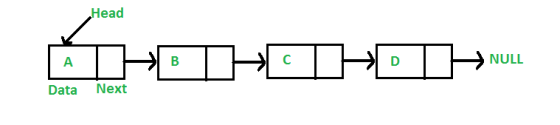
A linked list is a linear data structure, in which the elements are not stored at contiguous memory locations. The elements in a linked list are linked using pointers as shown in the below image:
Abstract Data type (ADT) is a type (or class) for objects whose behaviour is defined by a set of value and a set of operations.
The definition of ADT only mentions what operations are to be performed but not how these operations will be implemented. It does not specify how data will be organized in memory and what algorithms will be used for implementing the operations. It is called “abstract” because it gives an implementation-independent view. The process of providing only the essentials and hiding the details is known as abstraction
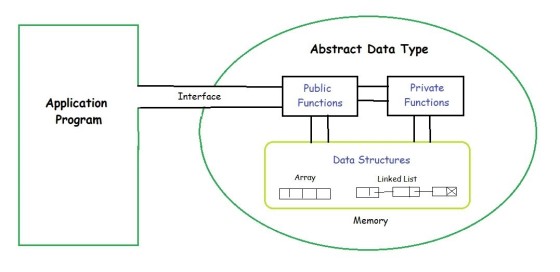
List ADT
- The data is generally stored in key sequence in a list which has a head structure consisting of count, pointers and address of compare function needed to compare the data in the list.
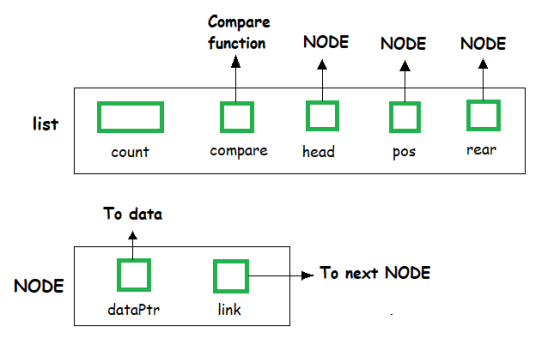
|
//List ADT Type Definitions typedef struct node { void *DataPtr; struct node *link; } Node; typedef struct { int count; Node *pos; Node *head; Node *rear; int (*compare) (void *argument1, void *argument2) } LIST; |
- The data node contains the pointer to a data structure and a self-referential pointer which points to the next node in the list.
Lists are sequence containers that allow non-contiguous memory allocation. As compared to vector, list has slow traversal, but once a position has been found, insertion and deletion are quick. Normally, when we say a List, we talk about doubly linked list. For implementing a singly linked list, we use forward list.
Below is the program to show the working of some functions of List:
#include <iostream>
#include <list>
#include <iterator>
using namespace std;
//function for printing the elements in a list
void showlist(list <int> g)
{
list <int> :: iterator it;
for(it = g.begin(); it != g.end(); ++it)
cout << '\t' <<
*it;
cout << '\n';
}
int main()
{
list <int> gqlist1, gqlist2;
for (int i = 0; i < 10; ++i)
{
gqlist1.push_back(i * 2);
gqlist2.push_front(i * 3);
}
cout << "\nList 1 (gqlist1) is : ";
showlist(gqlist1);
cout << "\nList 2 (gqlist2) is : ";
showlist(gqlist2);
cout << "\ngqlist1.front() : " <<
gqlist1.front();
cout << "\ngqlist1.back() : " <<
gqlist1.back();
cout << "\ngqlist1.pop_front() : ";
gqlist1.pop_front();
showlist(gqlist1);
cout << "\ngqlist2.pop_back() : ";
gqlist2.pop_back();
showlist(gqlist2);
cout << "\ngqlist1.reverse() : ";
gqlist1.reverse();
showlist(gqlist1);
cout << "\ngqlist2.sort(): ";
gqlist2.sort();
showlist(gqlist2);
return 0;
}
OUTPUT:-
List 1 (gqlist1) is :     0    2    4    6
8    10    12    14    16    18

List 2 (gqlist2) is :     27    24    21    18
15    12    9    6    3    0

gqlist1.front() : 0
gqlist1.back() : 18
gqlist1.pop_front() :     2    4    6    8
10    12    14    16    18

gqlist2.pop_back() :     27    24    21    18
15    12    9    6    3

gqlist1.reverse() :     18    16    14    12
10    8    6    4    2

gqlist2.sort():     3    6    9    12
15    18    21    24    27
Add Answer to:
What is a linked list? In this Discussion area, we will discuss
another way to implement...
Data Structures & Algorithms If we were to implement the list as a circular linked list...
Data Structures & Algorithms If we were to implement the list as a circular linked list (CLL) with a header node, how would this adjustment affect our ability to traverse the list? What advantage(s) would the adjusted list have over the current one?
In C++ - Learn how to implement linked lists Part 1 Node and Linked List Class...
In C++ - Learn how to implement linked lists Part 1 Node and Linked List Class (50 pts): Create node with public properties: Block type block and block ptr next. Create a linked list class that uses the node you generated without an add or delete method with a head and optional tail and counter. Make a driver that generates a node to test your implementation. Part 2 Add Method (30 pts): Create an add method in your linked list...
C++ Linked List Implementation Motivation As we discussed in class, the data structures that you use...
C++ Linked List Implementation Motivation As we discussed in class, the data structures that you use to implement your program can have a profound impact on it's overall performance. A poorly written program will often need much more RAM and CPU time then a well-written implementation. One of the most basic data structure questions revolves around the difference between an array and a linked list. After you finish this assignment you should have a firm understanding of their operation. Problem...
Suppose we implement a doubly linked list class template LinkedList with template type T. LinkedList has...
Suppose we implement a doubly linked list class template LinkedList with template type T. LinkedList has fields Node *headPtr, Node *tailPtr and int length, where the struct type Node has fields prev and next of type Node* along with data of type T. The prev and next pointers of each Node points to the previous and next Nodes in the list (or are respectively null in the case of the list’s head or tail node). We wish to detect "invalid"...
Given a singly-linked list interface and linked list node class, implement the singly-linked list which has...
Given a singly-linked list interface and linked list node class, implement the singly-linked list which has the following methods in Java: 1. Implement 3 add() methods. One will add to the front (must be O(1)), one will add to the back (must be O(1)), and one will add anywhere in the list according to given index (must be O(1) for index 0 and O(n) for all other indices). They are: void addAtIndex(int index, T data), void addToFront(T data), void addToBack(T...
Consider a singly linked list. What is true about the last node in the data structure?
Question 14 Consider a singly linked list. What is true about the last node in the data structure? The node cannot store data values. The node points to the head node. The node points to null. The node points to head. Question 15 When defining an interface, you cannot implement another interface. you may not include more than one method signature. you must provide the body of at least one method. you must provide signatures for each method Question 16 Generics are allowed in the class definition header but not in a method definition...
Part 1: Implement a singly linked list -------------------------------------- (a) Your job is to implement a generic...
Part 1: Implement a singly linked list -------------------------------------- (a) Your job is to implement a generic singly linked list that can hold any data type. The interface has been specified and provided to you in a header file called mylist.h. So your job is to write mylist.c that implements each function whose prototype is included in mylist.h. Specifically, you are asked to write the following functions: struct Node *addFront(struct List *list, void *data) void traverseList(struct List *list, void (*f)(void *))...
The question I want answered is in C++. How can I pass a value to a function and create a new linked list out of it? For example I have: void getIntegerInput(List<int> list) { int s; std::...
The question I want answered is in C++. How can I pass a value to a function and create a new linked list out of it? For example I have: void getIntegerInput(List<int> list) { int s; std::cout << "Type a positive integer then click enter to add it to the linked list\n"; std::cout << "Type -1 to stop\nType -2 to delete an item from the list\n"; std::cin >> s; while (s != -1) { if (s == -2) { int...
Please use C++ CS3358 Insert and delete a node Programming Project 2: The linked list -...
 Please use C++
CS3358 Insert and delete a node Programming Project 2: The linked list - Reference: chapter 18: Create an array of 15 student records that should not be sorted Create a liked list of 15 student record nodes. Each node is a node of one student record from the above unsorted array. The list of student records should be sorted by student ID. (Insert function without sort function to create a linked list.) (If you insert correctly, the...
Please use C++
CS3358 Insert and delete a node Programming Project 2: The linked list - Reference: chapter 18: Create an array of 15 student records that should not be sorted Create a liked list of 15 student record nodes. Each node is a node of one student record from the above unsorted array. The list of student records should be sorted by student ID. (Insert function without sort function to create a linked list.) (If you insert correctly, the...
c++ please Given the following skeleton of an unsorted list class that uses an unsorted linked...
c++ please Given the following skeleton of an unsorted list class that uses an unsorted linked list: template<class ItemType> struct NodeType { ItemType item; NodeType* next; }; template<class ItemType> class UList { public: UList(); // default constrctor UList(const UList &x); // we implement copy constructor with deep copy UList& operator = (UList &x); // equal sign operator with deep copy bool IsThere(ItemType item) const; // return true of false to indicate if item is...
 Please use C++
CS3358 Insert and delete a node Programming Project 2: The linked list - Reference: chapter 18: Create an array of 15 student records that should not be sorted Create a liked list of 15 student record nodes. Each node is a node of one student record from the above unsorted array. The list of student records should be sorted by student ID. (Insert function without sort function to create a linked list.) (If you insert correctly, the...
Please use C++
CS3358 Insert and delete a node Programming Project 2: The linked list - Reference: chapter 18: Create an array of 15 student records that should not be sorted Create a liked list of 15 student record nodes. Each node is a node of one student record from the above unsorted array. The list of student records should be sorted by student ID. (Insert function without sort function to create a linked list.) (If you insert correctly, the...
Most questions answered within 3 hours.
-
Where is the error in this code sequence?
String s1 = "Hello";
String s2 = "ello";...
asked 10 months ago -
Financial data for Joel de Paris, Inc., for last year
follow:
Joel de Paris, Inc.
Balance...
asked 10 months ago -
Consider this reaction:
Al2(SO4)3 (aq)+ BaCl3
(aq) Al2Cl6 (aq)- +
3BaSO4(s) . What is the...
asked 10 months ago -
Suppose that Savneet is considering increasing her
recent random sample from 20 car rentals to 40...
asked 10 months ago -
Trucks arrive at an unloading terminal at an average rate of 120
per hour.
Trucks arrive...
asked 10 months ago -
Why are methanol and ethanol completely soluble in water while
octanol is not very little soluble....
asked 10 months ago -
A facilities manager at a university reads in a research report
that the mean amount of...
asked 10 months ago -
When the CuSO4 is rehydrated by adding water to the anhydrous
compound, is this an endothermic...
asked 10 months ago -
A ray of sunlight is passing from diamond into crown glass; the
angle of incidence is...
asked 10 months ago -
A block of mass 0.249 kg is placed on top of a light, vertical
spring of...
asked 10 months ago -
how do the kidneys compensate in the presences of acidosis
a) trigger hyperventilate
b) reserve acid...
asked 10 months ago -
Question 501 pts
The rental rate of capital to the firm increases. Which of the
following...
asked 10 months ago