If I'm performing GPC analysis of Sample A in Sample B at a given temperature and...
If I'm performing GPC analysis of Sample A in Sample B at a given temperature and I'm given elution volume and concentration values. I then need to get those values into weights. When I do this will I use the MW of Sample A or Sample B to do this? Equation for reference below:
If my thinking of any of the following is also wrong, please inform me, thanks!
(Concentration)*(Elution Volume)*(Molecular Weight) = Weight
(Mol/L)*(L)*(g/mol) = g
Homework Answers
Let us have a mL of x M sample A mixed with b mL of y M sample B.
The total volume of the sample = (a + b) mL which is diluted by the solvent to get the elution volume, say V mL.
The concentrations of samples A and B in the eluted volume can be easily found out as the final concentration = (initial concentration)*(initial volume)/(final volume)
Therefore,
[A] = (x M)*(a mL)/(V mL)
= ax/V mM (mM = millimolar)
[B] = (y M)*(b Ml)/(V mL)
= by/V mM
Number of moles of A = (final concentration of A)*(final volume)
= (ax/V mM)*(V mL)
= ax mol
Number of moles of B = (final concentration of B)*(final volume)
= (by/V mM)*(V mL)
= by mol
Let MA and MB g/mol be the molar masses of samples A and B.
Mass or weight of A in the GPC mixture = (ax mol)*(MA g/mol)
= axMA g.
Mass or weight of B in the GPC mixture = (by mol)*(MB g/mol)
= byMB g (ans).
Add Answer to:
If I'm performing GPC analysis of Sample A in Sample B at a
given temperature and...
A 2.51 gram sample of an unknown gas is found to occupy a volume of 2.24...
A 2.51 gram sample of an unknown gas is found to occupy a volume of 2.24 L at a pressure of 632 mm Hg and a temperature of 49 °C. The molecular weight of the unknown gas is g/mol. The weight I got was 31.8 but it says it is wrong. What is the correct weight? Thank you!
Report: Report the individual concentration in [M] of Tartrazine and Sunset Yellow in the sample. Certificate...
Report: Report the individual concentration in [M] of Tartrazine and Sunset Yellow in the sample. Certificate of Analysis Purities: Tartrazine (M.W. 534.36): 89.0% (Calculated from Carbon, Nitrogen Analysis) Sunset Yellow (M.W. 452.37): 96.2% (By HPLC) Weight of Standards: Tartrazine: 0.1006 Gm Sunset Yellow: 0.1000 Gm Absorbances: 427 nm 4 81 nm Tartrazine: 0.936 0.274 Sunset Yellow: 0.414 0.956 Sample: 0.539 0.409 Data Analysis •Determine the weight of Tartrazine or Sunset Yellow in the standards by multiplying the weight of standard...
I'm in need of help on this question, i'm having a hard time on approaching it...
I'm in need of help on this question, i'm having a hard time on approaching it and I keep getting the wrong answer ,please show your work. Any help is appreciated . Thanks a bunch. Caproic acid has the odor of goats. The compound contains only C, H, and O and was experimentally found to have a molar mass of 110±10 g/mol . When a 1.000 g sample of caproic acid is burned in excess oxygen, 2.275 g CO2 and...
i need help with conversions. i have to fill in the table given the values. #...
 i need help with conversions. i have to fill in the table
given the values.
# of init #chain of Reagents: Complete the table below with the actual quantities of the reagents used in the reaction. (Circle which lactone used) & decalactone 8-dodecalactone 1,4-benzene dimethanol (BDM) 138.16 g/mol DPP (diphenyl phosphate) L-lactide MW 170.25 g/mol 198.30 g/mol 250.19 g/mol 144.13 g/mol Mass, & 2013 069, mmoles Volume, ml Density, g/mL 2.45 mL 0.942 g/mL 0.954 g/ml Theoretical molecular IAE
i need help with conversions. i have to fill in the table
given the values.
# of init #chain of Reagents: Complete the table below with the actual quantities of the reagents used in the reaction. (Circle which lactone used) & decalactone 8-dodecalactone 1,4-benzene dimethanol (BDM) 138.16 g/mol DPP (diphenyl phosphate) L-lactide MW 170.25 g/mol 198.30 g/mol 250.19 g/mol 144.13 g/mol Mass, & 2013 069, mmoles Volume, ml Density, g/mL 2.45 mL 0.942 g/mL 0.954 g/ml Theoretical molecular IAE
I'm determining the % Purity of KHP in an unknown sample. I have done two titrations:...
I'm determining the % Purity of KHP in an unknown sample. I have done two titrations: one with pure KHP titrated against a NaOH 0.1M solution, and the other is an unknown purity of KHP also titrated against a NaOH 0.1M solution. I am having trouble finding the percent purity of KHP, my professor said to recalculate my results because mine were too high (47.5%). Please help!!! Unknown Titration Trial Weight Initial Volume (mL) Final Volume (mL) 1 1.2030 1.37...
3. Concentrations in solids and solution. You send a 10-g sample of rice to the lab...
3. Concentrations in solids and solution. You send a 10-g sample of rice to the lab for the determination of the total arsenic content. The analyst dissolves 1.0 g of the rice in 5.0 mL of concentrated acid and then dilutes the solution to a final volume of 25.0 mL. When analyzed by ICP-MS, the solution concentration is found to be 35 µg L-1. What is the concentration of arsenic in the rice (in µg kg-1)? ___________ ppb Hint: Follow...
I'm not sure what the mean titre? My mean amount added is already stated in mean...
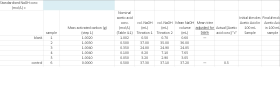 I'm not sure what the mean titre? My mean amount added is
already stated in mean NaOH, is and is my actual acetic acid
concentration to do with the amount added in the
titration?
Standardised NaOH conc (mol/L) = Initial #moles Final #mole Acetic Acid in Acetic Acid in 100 ml Sample sample sample blank Nominal acetic acid conc. (mol/L) (Table 4.1) 1.002 0.500 0.350 0.100 0.050 0.500 Mass activated carbon (g) (step 1) 1.0020 1.0030 1.0040 1.0040 1.0010 0.0000...
I'm not sure what the mean titre? My mean amount added is
already stated in mean NaOH, is and is my actual acetic acid
concentration to do with the amount added in the
titration?
Standardised NaOH conc (mol/L) = Initial #moles Final #mole Acetic Acid in Acetic Acid in 100 ml Sample sample sample blank Nominal acetic acid conc. (mol/L) (Table 4.1) 1.002 0.500 0.350 0.100 0.050 0.500 Mass activated carbon (g) (step 1) 1.0020 1.0030 1.0040 1.0040 1.0010 0.0000...
I am given the concentration of a substance in a solution (2.7 mg/100ml) and fhe molecular...
I am given the concentration of a substance in a solution (2.7 mg/100ml) and fhe molecular weight of the substance (180.158g/mol) how do i find the quantity in g of substance?
Consider a sample of phosphine gas (PH3), that behaves as an ideal gas. If the density...
Consider a sample of phosphine gas (PH3), that behaves as an ideal gas. If the density of the gas is 4.18g/L at 17ºC. What is the pressure of the gas in torr? I am having trouble getting these formulas to click in my head to the point where I can invert them based on values given. I'm not sure how to solve for P in this case. I feel like I'm missing a step. Thanks.
A 1.000 kg sample of an organic compound, C3H5N3O9, explodes and releases gases with a temperature...
A 1.000 kg sample of an organic compound, C3H5N3O9, explodes and releases gases with a temperature of 1985°C at 836.0 atm. What is the volume of gas produced? (always balance equations) C3H5N3O9(s) → CO2(g) + H2O(g) + N2(g) + O2(g) The listed answers are: 5378 L, 742.2 L, 3525 L, 4730 L, 352.5 L My answer: We have: 1.000 kg --> 1.000x10^3 g =1,000 g C3H5N3O9 T= 1985C --> 1985C+273= 2258K P= 836.0 atm V=? Balanced equation: 4C3H5N3O9-->12CO2+10H2O+6N2+O2 C= 3*12.0107...
 i need help with conversions. i have to fill in the table
given the values.
# of init #chain of Reagents: Complete the table below with the actual quantities of the reagents used in the reaction. (Circle which lactone used) & decalactone 8-dodecalactone 1,4-benzene dimethanol (BDM) 138.16 g/mol DPP (diphenyl phosphate) L-lactide MW 170.25 g/mol 198.30 g/mol 250.19 g/mol 144.13 g/mol Mass, & 2013 069, mmoles Volume, ml Density, g/mL 2.45 mL 0.942 g/mL 0.954 g/ml Theoretical molecular IAE
i need help with conversions. i have to fill in the table
given the values.
# of init #chain of Reagents: Complete the table below with the actual quantities of the reagents used in the reaction. (Circle which lactone used) & decalactone 8-dodecalactone 1,4-benzene dimethanol (BDM) 138.16 g/mol DPP (diphenyl phosphate) L-lactide MW 170.25 g/mol 198.30 g/mol 250.19 g/mol 144.13 g/mol Mass, & 2013 069, mmoles Volume, ml Density, g/mL 2.45 mL 0.942 g/mL 0.954 g/ml Theoretical molecular IAE
 I'm not sure what the mean titre? My mean amount added is
already stated in mean NaOH, is and is my actual acetic acid
concentration to do with the amount added in the
titration?
Standardised NaOH conc (mol/L) = Initial #moles Final #mole Acetic Acid in Acetic Acid in 100 ml Sample sample sample blank Nominal acetic acid conc. (mol/L) (Table 4.1) 1.002 0.500 0.350 0.100 0.050 0.500 Mass activated carbon (g) (step 1) 1.0020 1.0030 1.0040 1.0040 1.0010 0.0000...
I'm not sure what the mean titre? My mean amount added is
already stated in mean NaOH, is and is my actual acetic acid
concentration to do with the amount added in the
titration?
Standardised NaOH conc (mol/L) = Initial #moles Final #mole Acetic Acid in Acetic Acid in 100 ml Sample sample sample blank Nominal acetic acid conc. (mol/L) (Table 4.1) 1.002 0.500 0.350 0.100 0.050 0.500 Mass activated carbon (g) (step 1) 1.0020 1.0030 1.0040 1.0040 1.0010 0.0000...
Most questions answered within 3 hours.
-
Where is the error in this code sequence?
String s1 = "Hello";
String s2 = "ello";...
asked 10 months ago -
Financial data for Joel de Paris, Inc., for last year
follow:
Joel de Paris, Inc.
Balance...
asked 10 months ago -
Consider this reaction:
Al2(SO4)3 (aq)+ BaCl3
(aq) Al2Cl6 (aq)- +
3BaSO4(s) . What is the...
asked 10 months ago -
Suppose that Savneet is considering increasing her
recent random sample from 20 car rentals to 40...
asked 10 months ago -
Trucks arrive at an unloading terminal at an average rate of 120
per hour.
Trucks arrive...
asked 10 months ago -
Why are methanol and ethanol completely soluble in water while
octanol is not very little soluble....
asked 10 months ago -
A facilities manager at a university reads in a research report
that the mean amount of...
asked 10 months ago -
When the CuSO4 is rehydrated by adding water to the anhydrous
compound, is this an endothermic...
asked 10 months ago -
A ray of sunlight is passing from diamond into crown glass; the
angle of incidence is...
asked 10 months ago -
A block of mass 0.249 kg is placed on top of a light, vertical
spring of...
asked 10 months ago -
how do the kidneys compensate in the presences of acidosis
a) trigger hyperventilate
b) reserve acid...
asked 10 months ago -
Question 501 pts
The rental rate of capital to the firm increases. Which of the
following...
asked 10 months ago