1). the roller coaster car with a mass of 250 kg starts with an initial speed v0...
1). the roller coaster car with a mass of 250 kg starts with an initial speed v0 = 5.6 m/s at the top of the track . What is its speed (in m/s) at the lowest point of the track (which is 25m below the start point)? Keep 2 decimal places.
1 b) Recall what you learned in vertical circular motion.
If the lowest part of the track is approximated as circular with a radius of 6.20 m, What is the magnitude of the normal force (in Newtons) on the roller coaster car?
Don't use scientific notation.
2) As shown in the figure, a 11 kg block moves with an intial speed of 8.0 m/s on a rough floor. The coefficient of kinetic friction between the block and the floor is μk = 0.27.
You will find the distance through which the block slows down and comes to a stop.
(a) Solve for the magnitude of the normal force FN, it is:
a 2. What is the work (in Joules) done by the normal force? Pay attention to the angle in the work formula and the sign of work. Hint: even though the distance is not known yet, this question can still be answered.
(b) What is the work done by the gravitational force? Pay attention to the angle in the work formula and the sign of work. Hint: even though the distance is not known yet, this question can still be answered.
(c) What is the magnitude of the kinetic frictional force (in Newtons)?
(d) Write the work done by the kinetic frictional force in terms of the distance (distance is unknown). Pay attention to the angle in the work formula and the sign of work.
Apply the Work-Kinetic Energy Theorem:
What is the distance (in meters) after which the block comes to a stop?
d 2). Now the situation changes to:
The same block of 11 kg moves with the same intial speed of 8.0 m/s on another rough floor. The coefficient of kinetic friction between the block and the other floor μk is unknown. It is measured that the block comes to a stop after moving through a distance of 20.09 m. What is the μk ?
Homework Answers
Dear student,
Find this solution, and RATE IT ,If you find it is helpful .your rating is very important to me.If any incorrectness ,kindly let me know I will rectify them soon.
Thanks for asking ..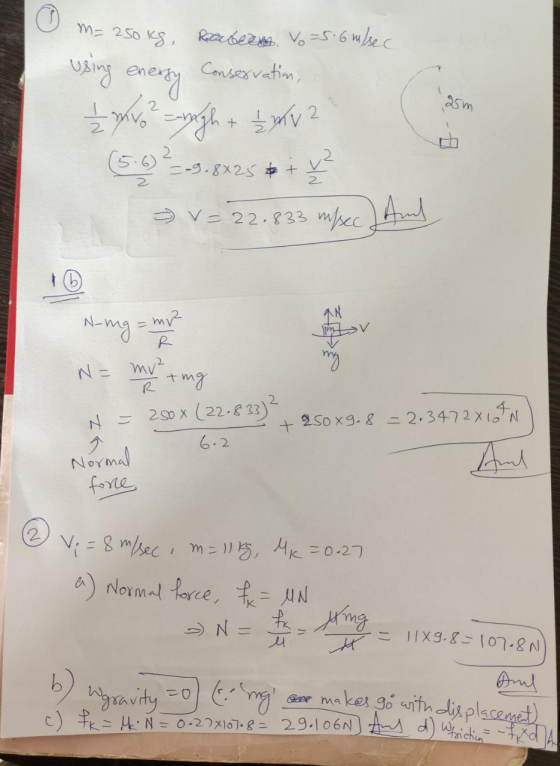
Add Answer to:
1). the roller coaster car with a mass of 250 kg
starts with an initial speed v0...
A 25.5 kg block is being pulled by a force F = 241 N up along...
A 25.5 kg block is being pulled by a force F = 241 N up along a rough incline. The coefficient of kinetic friction between the block and the incline is μk = 0.40. The block is pulled through a distance of 27.0 m. Angle is 33 degrees. (a) Solve for the magnitude of the normal force (in Newtons)? -Calculate the work (in Joules) done by the normal force. Pay attention to the angle in the work formula and the...
As shown in the figure, a 25 kg block is being pulled by a force F...
As shown in the figure, a 25 kg block is being pulled by a force F = 220 N up along a rough incline. The coefficient of kinetic friction between the block and the incline is μk = 0.30. The block is pulled through a distance of 23.0 m. (c) Calculate the work (in Joules) done by the pulling force F. Pay attention to the angle in the work formula and the sign of work. (d) Calculate the work (in...
20m Consider the image above that shows the trajectory of a roller coaster car. The roller...
 20m Consider the image above that shows the trajectory of a roller coaster car. The roller coaster car has a mass of 200kg and is released from rest at position A. 2. a. Find the velocity of the car at positions B, C, and D b. Determine the maximum possible radius of the circle such that the car will not lose contact with the track. C. Suppose a breaking force (F 10 newtons) is applied as the car traverses the...
The Outlaw Run roller coaster in Branson, Missouri, features a track that is inclined at 84...
The Outlaw Run roller coaster in Branson, Missouri, features a track that is inclined at 84 ∘ below the horizontal and that spans a 49.4-m (162 ft) change in height. A.) If the coefficient of friction for the roller coaster is μk=0.30, what is the magnitude of the friction force on a 1800-kg coaster train? B.) How much work is done by friction during the time the coaster train travels along the incline? C.) What is the speed of the...
A car of mass 500. kg on a roller coaster ride is raised from the ground...
 A car of mass 500. kg on a roller coaster ride is raised from
the ground (horizontal dotted line) to point A as shown in the
diagram above. When the car passes point A, its speed is 5.0 m/s,
and then it rolls freely through the rest of the ride with
negligible friction, passing points B, C, D and E. Note that point
D is the highest portion of a circular loop, and point E is the
lowest portion of...
A car of mass 500. kg on a roller coaster ride is raised from
the ground (horizontal dotted line) to point A as shown in the
diagram above. When the car passes point A, its speed is 5.0 m/s,
and then it rolls freely through the rest of the ride with
negligible friction, passing points B, C, D and E. Note that point
D is the highest portion of a circular loop, and point E is the
lowest portion of...
N1 weight Work and Kinetic Energy - 4 Forces - Horizontal Motion This problem is similar...
 N1 weight Work and Kinetic Energy - 4 Forces - Horizontal Motion This problem is similar to lecture example and discussion problem. As shown in the figure, a 25.5 kg block is pulled to the right by force F = 79 N. The coefficient of kinetic friction between the block and the floor is uk = 0.26. The block moves through a distance of 18.00 m. DON"T use scientific notation. Review on application of Newton's second law. Step 1: Start...
Work and Kinetic Energy - 4 Forces - Horizontal Motion This problem is similar to lecture...
 Work and Kinetic Energy - 4 Forces - Horizontal Motion This problem is similar to lecture example and discussion problem. As shown in the figure, a 23 kg block is pulled to the right by force F = 76 N. The coefficient of kinetic friction between the block and the floor is uk = 0.27. The block moves through a distance of 15.00 m. DON'T use scientific notation. Review on application of Newton's second law. Step 1: Start by drawing...
A 200-kg roller coaster reaches the top of the steepest hill with a speed of 5.60...
A 200-kg roller coaster reaches the top of the steepest hill with a speed of 5.60 km/h. It then descends the hill, which is at an angle of 25° and is 58.0 m long. What will its kinetic energy be when it reaches the bottom? Assume µk = 0.10. A boy pulls a 20.0-kg box with a 130-N force at 33° above a horizontal surface. If the coefficient of kinetic friction between the box and the horizontal surface is 0.29...
1. A roller coaster has a 300 kg car. Assume the track is frictionless. a) The...
 1. A roller coaster has a 300 kg car. Assume the track is frictionless. a) The car starts at a speed 20 m/s on a horizontal track. It then goes through a circular loop. What is the speed of the car when it is at the top of the loop, h = 10 m above the horizontal track? b) What is the normal force applied from the track at the point? Does this force point upward or downward? Assume the...
A student with mass 58.0 kg rides on a roller coaster with a vertical loop. At...
A student with mass 58.0 kg rides on a roller coaster with a vertical loop. At the top of the loop the track has a radius of 19.7 m and the roller coaster moves at speed of 21.9 m/s at the top. Determine the normal force from the seat on the student at the top of the loop. Give your answer in newtons (N) and with 3 significant figures.
 20m Consider the image above that shows the trajectory of a roller coaster car. The roller coaster car has a mass of 200kg and is released from rest at position A. 2. a. Find the velocity of the car at positions B, C, and D b. Determine the maximum possible radius of the circle such that the car will not lose contact with the track. C. Suppose a breaking force (F 10 newtons) is applied as the car traverses the...
 A car of mass 500. kg on a roller coaster ride is raised from
the ground (horizontal dotted line) to point A as shown in the
diagram above. When the car passes point A, its speed is 5.0 m/s,
and then it rolls freely through the rest of the ride with
negligible friction, passing points B, C, D and E. Note that point
D is the highest portion of a circular loop, and point E is the
lowest portion of...
A car of mass 500. kg on a roller coaster ride is raised from
the ground (horizontal dotted line) to point A as shown in the
diagram above. When the car passes point A, its speed is 5.0 m/s,
and then it rolls freely through the rest of the ride with
negligible friction, passing points B, C, D and E. Note that point
D is the highest portion of a circular loop, and point E is the
lowest portion of...
 N1 weight Work and Kinetic Energy - 4 Forces - Horizontal Motion This problem is similar to lecture example and discussion problem. As shown in the figure, a 25.5 kg block is pulled to the right by force F = 79 N. The coefficient of kinetic friction between the block and the floor is uk = 0.26. The block moves through a distance of 18.00 m. DON"T use scientific notation. Review on application of Newton's second law. Step 1: Start...
 Work and Kinetic Energy - 4 Forces - Horizontal Motion This problem is similar to lecture example and discussion problem. As shown in the figure, a 23 kg block is pulled to the right by force F = 76 N. The coefficient of kinetic friction between the block and the floor is uk = 0.27. The block moves through a distance of 15.00 m. DON'T use scientific notation. Review on application of Newton's second law. Step 1: Start by drawing...
 1. A roller coaster has a 300 kg car. Assume the track is frictionless. a) The car starts at a speed 20 m/s on a horizontal track. It then goes through a circular loop. What is the speed of the car when it is at the top of the loop, h = 10 m above the horizontal track? b) What is the normal force applied from the track at the point? Does this force point upward or downward? Assume the...
Most questions answered within 3 hours.
-
Where is the error in this code sequence?
String s1 = "Hello";
String s2 = "ello";...
asked 11 months ago -
Financial data for Joel de Paris, Inc., for last year
follow:
Joel de Paris, Inc.
Balance...
asked 11 months ago -
Consider this reaction:
Al2(SO4)3 (aq)+ BaCl3
(aq) Al2Cl6 (aq)- +
3BaSO4(s) . What is the...
asked 11 months ago -
Suppose that Savneet is considering increasing her
recent random sample from 20 car rentals to 40...
asked 11 months ago -
Trucks arrive at an unloading terminal at an average rate of 120
per hour.
Trucks arrive...
asked 11 months ago -
Why are methanol and ethanol completely soluble in water while
octanol is not very little soluble....
asked 11 months ago -
A facilities manager at a university reads in a research report
that the mean amount of...
asked 11 months ago -
When the CuSO4 is rehydrated by adding water to the anhydrous
compound, is this an endothermic...
asked 11 months ago -
A ray of sunlight is passing from diamond into crown glass; the
angle of incidence is...
asked 11 months ago -
A block of mass 0.249 kg is placed on top of a light, vertical
spring of...
asked 11 months ago -
how do the kidneys compensate in the presences of acidosis
a) trigger hyperventilate
b) reserve acid...
asked 11 months ago -
Question 501 pts
The rental rate of capital to the firm increases. Which of the
following...
asked 11 months ago