PART A. A near-sighted person has a far-point of 5.16 m. To correct their vision, what...
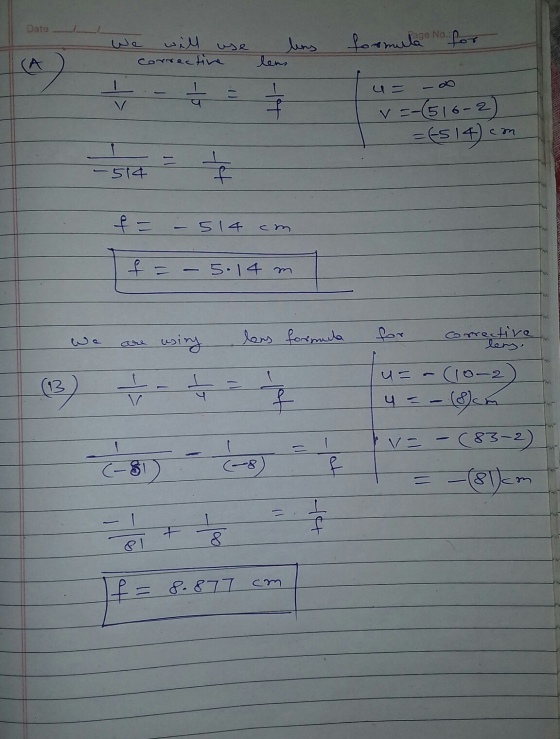
PART A. A near-sighted person has a far-point of 5.16 m. To correct their vision, what should be the focal length of the prescribed lens? Assume the lens will be 2 cm from the eye.
PART B. A far-sighted person has a near-point of 83 cm. To correct their vision so that they can see objects that are as close as 10 cm to their eye, what should be the focal length of the prescribed lens? Assume the lens will be 2 cm from the eye.
Homework Answers
This problem is from topic eye defects.
In near sightedness we will use diverging lens as a corrective lens
And in case of farsighedness we will use converging lens as a corrective measure.
And we will make adjustment of 2 cm while applying lens formula for corrective lens.
Add Answer to:
PART A. A near-sighted person has a far-point of 5.16 m.
To correct their vision, what...
A near-sighted person has a far point of 80 cm. A) What kind of corrective lens...
A near-sighted person has a far point of 80 cm. A) What kind of corrective lens the person will need if the lens is to be placed 1.5 cm from the eye? The answer is not 78.5, 80 or -1.27 B) What would be the power of the contact lens needed? Assume distance to contact lens from the eye to be zero.
Cameron has a far point of 2.50 meters - which makes her far sighted. 1. Assuming...
 Cameron has a far point of 2.50 meters - which makes her far sighted. 1. Assuming a distance from eye lens to retina of 2.0 cm, what are the focal length and strength of her eye lens when she focuses on an object at her near point? (This is the most strength her eye lens is able to achieve.) 2. If she had a "normal" near point of 25 cm, what would her eye lens strength and focal have to...
Background information A person with normal vision can focus on objects as close as a few centimeters from the eye up...
Background information A person with normal vision can focus on objects as close as a few centimeters from the eye up to objects infinitely far away. There exist, however, certain conditions under which the range of vision is not so extended. For example, a nearsighted person cannot focus on objects farther than a certain point (the far point), while a farsighted person cannot focus on objects closer than a certain point (the near point). Note that even though the presence...
a near sighted person has a far point 55 cm corrected glasses of what power are...
a near sighted person has a far point 55 cm corrected glasses of what power are acquired so that she can see far away ignore the eye to lense distance
Sometimes a person cannot clearly see objects close up or far away. To correct this type...
Sometimes a person cannot clearly see objects close up or far away. To correct this type of vision, bifocals are often used. The top half of the lens is used to view distant objects and the bottom half of the lens is used to view objects close to the eye. A person can clearly see objects only if they are located between 36 cm and 160 cm away from her eyes. Bifocal lenses are used to correct her vision. What...
Sometimes a person cannot clearly see objects close up or far away. To correct this type...
Sometimes a person cannot clearly see objects close up or far away. To correct this type of vision, bifocals are often used. The top half of the lens is used to view distant objects and the bottom half of the lens is used to view objects close to the eye. A person can clearly see objects only if they are located between 35 cm and 200 cm away from her eyes. Bifocal lenses are used to correct her vision. What...
Sometimes a person cannot clearly see objects close up or far away. To correct this type...
Sometimes a person cannot clearly see objects close up or far away. To correct this type of vision, bifocals are often used. The top half of the lens is used to view distant objects and the bottom half of the lens is used to view objects close to the eye. A person can clearly see objects only if they are located between 35 cm and 200 cm away from her eyes. Bifocal lenses are used to correct her vision. What...
Sometimes a person cannot clearly see objects close up or far away. To correct this type...
Sometimes a person cannot clearly see objects close up or far away. To correct this type of vision, bifocals are often used. The top half of the lens is used to view distant objects and the bottom half of the lens is used to view objects close to the eye. A person can clearly see objects only if they are located between 33 cm and 176 cm away from her eyes. Bifocal lenses are used to correct her vision. What...
Part A Constants |Periodic Table A near-sighted person might correct his vision by wearing diverging lenses...
 Part A Constants |Periodic Table A near-sighted person might correct his vision by wearing diverging lenses with focal length f =-40 cm. When wearing his glasses, he looks not at actual objects but at the virtual images of those objects formed by his glasses. Suppose he looks at a 14 cm -long pencil held vertically 2.1 m from his glasses Use ray tracing to determine the location of the image. Express your answer using two significant figures. 国? s, =...
Sometimes a person cannot clearly see objects close up or far away. To correct this type...
Sometimes a person cannot clearly see objects close up or far away. To correct this type of vision, bifocals are often used. The top half of the lens is used to view distant objects and the bottom half of the lens is used to view objects close to the eye. A person can clearly see objects only if they are located between 44 cm and 194 cm away from his eyes. Bifocal lenses are used to correct his vision. What...
 Cameron has a far point of 2.50 meters - which makes her far sighted. 1. Assuming a distance from eye lens to retina of 2.0 cm, what are the focal length and strength of her eye lens when she focuses on an object at her near point? (This is the most strength her eye lens is able to achieve.) 2. If she had a "normal" near point of 25 cm, what would her eye lens strength and focal have to...
 Part A Constants |Periodic Table A near-sighted person might correct his vision by wearing diverging lenses with focal length f =-40 cm. When wearing his glasses, he looks not at actual objects but at the virtual images of those objects formed by his glasses. Suppose he looks at a 14 cm -long pencil held vertically 2.1 m from his glasses Use ray tracing to determine the location of the image. Express your answer using two significant figures. 国? s, =...
Most questions answered within 3 hours.
-
Where is the error in this code sequence?
String s1 = "Hello";
String s2 = "ello";...
asked 11 months ago -
Financial data for Joel de Paris, Inc., for last year
follow:
Joel de Paris, Inc.
Balance...
asked 11 months ago -
Consider this reaction:
Al2(SO4)3 (aq)+ BaCl3
(aq) Al2Cl6 (aq)- +
3BaSO4(s) . What is the...
asked 11 months ago -
Suppose that Savneet is considering increasing her
recent random sample from 20 car rentals to 40...
asked 11 months ago -
Trucks arrive at an unloading terminal at an average rate of 120
per hour.
Trucks arrive...
asked 11 months ago -
Why are methanol and ethanol completely soluble in water while
octanol is not very little soluble....
asked 11 months ago -
A facilities manager at a university reads in a research report
that the mean amount of...
asked 11 months ago -
When the CuSO4 is rehydrated by adding water to the anhydrous
compound, is this an endothermic...
asked 11 months ago -
A ray of sunlight is passing from diamond into crown glass; the
angle of incidence is...
asked 11 months ago -
A block of mass 0.249 kg is placed on top of a light, vertical
spring of...
asked 11 months ago -
how do the kidneys compensate in the presences of acidosis
a) trigger hyperventilate
b) reserve acid...
asked 11 months ago -
Question 501 pts
The rental rate of capital to the firm increases. Which of the
following...
asked 11 months ago