Q2) Write the products name and formula of white ppt after adding 15M NH3 and few...
Q2) Write the products name and formula of white ppt after adding 15M NH3 and few drops of (NH4)2CO3 with mixture of cations.
Homework Answers
I am assuming you have precipitated all cations till Group IV.
Then the Cations that will be precipitated are Ba2+, Ca2+ and Sr2+.
All of them will precipitate as carbonates Ba2+ as BaCO3,Ca2+ as CaCO3 Sr2+ as SrCO3.
Barium Carbonate=> BaCO3
Calcium Carbonate => CaCO3
Strontium Carbonate => SrCO3.
Add Answer to:
Q2) Write the products name and formula of white ppt after
adding 15M NH3 and few...
3. Suppose after adding HCl to ppt 16, you do not have any black solid. What,...
 3. Suppose after adding HCl to ppt 16, you do not have any black solid. What, if anything, should you do to test for Co2 and Ni*? Qual Scheme: Group III: Co?(pink), N1" (green), Fet+ (yellow), Cr" (blue-grey), Mn(pink), AP (colorless), Zn? (colorless). Unknown B Solution: Use 10 dps of unknown sample and 10 dps of H20 and go to Procedure for Group III. Procedure for Group II: Add 2 dps NHCl soln, add 6M NHOH until just basic to...
Aluminum ion in solution reacts with water to form aqueous hexaaguaaluminum ()ion. Write this reaction below,...
 Aluminum ion in solution reacts with water to form aqueous hexaaguaaluminum ()ion. Write this reaction below, remember phases. Aluminum is more likely to form a hydrated complex than the other four ions remaining in solution, because of its relatively small size and high charge To separate the Group B2 ion, the solution first is made basic by adding ammonia. In the presence of this weak base the pH is adjusted to 9-10 and the group B ions form insoluble hydroxides....
Name or write the formula for the following coordination compounds (spelling counts): a. [Co(NH3)2Cl]Cl2 ______________________________ b....
Name or write the formula for the following coordination compounds (spelling counts): a. [Co(NH3)2Cl]Cl2 ______________________________ b. Sodium hexachloromanganate(III) _______________________ c. [Pt(NH3)4](ClO4)2 _____________________________________ d. Potassium tetracyanonickelate(0)
Name or write the formula for the following coordination compounds (spelling counts): a. [Co(NH3)2CI]Cl2 b. Sodium...
 Name or write the formula for the following coordination compounds (spelling counts): a. [Co(NH3)2CI]Cl2 b. Sodium hexachloromanganate(III) c. [Pt(NH3)4](C104)2 d. Potassium tetracyanonickelate(0)
14. write the formula of the products. Name each of the reaction type. Ar-H + HNO3,...
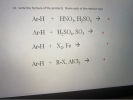 14. write the formula of the products. Name each of the reaction type. Ar-H + HNO3, H2SO4 → a Ar-H + H2SO4, SO3 → Ar-H + X2, Fe → Ar-H + R-X, AICI, → d
4) Predict the products and write the formula on the lines. Solubility rules may be used...
 4) Predict the products and write the formula on the lines. Solubility rules may be used to predict which product is the solid. Name of each Barium chloride Sulfuric Acid compound B HS04sul oni acid Chemical formula What is the appearance of Colorless, clear , d each reactant and Solution com|ジ product, provide the state. Write a balanced chemical reaction showing all states Show all ions that are present in each solution. Write solids and liquids as neutral BaSO4 (s)...
When you write the answers, please write the page number for which the question is located....
 When you write the answers, please write the page number for
which the question is located. Thank you!
Experiment 8 Name: Double Replacement Reactions Background: Some reactions have the net effect of causing the cation of cach reactant to trade places, forming a compound with the other anion. These reactions are known as double replacement reactions. In the example below (unbalanced equation), the barium and sodium cations switch places so that barium forms a product with sulfate while sodium forms...
When you write the answers, please write the page number for
which the question is located. Thank you!
Experiment 8 Name: Double Replacement Reactions Background: Some reactions have the net effect of causing the cation of cach reactant to trade places, forming a compound with the other anion. These reactions are known as double replacement reactions. In the example below (unbalanced equation), the barium and sodium cations switch places so that barium forms a product with sulfate while sodium forms...
Q30. Write the formula for each compound (the composition is given after each name): a. zinc...
Q30. Write the formula for each compound (the composition is given after each name): a. zinc oxide: 1 atom Zn, 1 atom O b. potassium chlorate: 1 atom K, 1 atom Cl, 3 atoms O c. sodium hydroxide: 1 atom Na, 1 atom O, 1 atom H d. ethyl alcohol: 2 atoms C, 6 atoms H, 1 atom O e. (a) aluminum bromide : 1 atom Al, 3 atoms Br f. (b) calcium fluoride: 1 atom Ca, 2 atoms F...
QUESTIONS: Expt. 21 Name: Silver nitrate is added to solution containing an unknown salt. An off-white...
 QUESTIONS: Expt. 21 Name: Silver nitrate is added to solution containing an unknown salt. An off-white colored precipitate Torms Nitric acid is added to the mixture the precipitate dissolves and gas is given off Analyze this data and determine the anion present a CH b. Br d POS- e. CO 2 A dark glass bottle of chemicals is found in cleaning out an old basement Part of the label has been eaten away with age. Only the last part of...
FesCN (aq), and LeChâtelier's Explain in terms of the equation, Fe" (aq) + SCN (aq) Principle...
 FesCN (aq), and LeChâtelier's Explain in terms of the equation, Fe" (aq) + SCN (aq) Principle (4 ) Observation after adding KSCN: turned darker more red like original solution brown Explain in terms of the equation, Fe (aq) + SCN (aq) + FeSCN- (aq), and LeChâtelier's Principle. (ps.) Observation after adding AgNO3: Turned milky white + thieverf less transparent Using the ions present in the solution, write a net ionic equation that would explain the precipitate observed Use the above...
 3. Suppose after adding HCl to ppt 16, you do not have any black solid. What, if anything, should you do to test for Co2 and Ni*? Qual Scheme: Group III: Co?(pink), N1" (green), Fet+ (yellow), Cr" (blue-grey), Mn(pink), AP (colorless), Zn? (colorless). Unknown B Solution: Use 10 dps of unknown sample and 10 dps of H20 and go to Procedure for Group III. Procedure for Group II: Add 2 dps NHCl soln, add 6M NHOH until just basic to...
 Aluminum ion in solution reacts with water to form aqueous hexaaguaaluminum ()ion. Write this reaction below, remember phases. Aluminum is more likely to form a hydrated complex than the other four ions remaining in solution, because of its relatively small size and high charge To separate the Group B2 ion, the solution first is made basic by adding ammonia. In the presence of this weak base the pH is adjusted to 9-10 and the group B ions form insoluble hydroxides....
 Name or write the formula for the following coordination compounds (spelling counts): a. [Co(NH3)2CI]Cl2 b. Sodium hexachloromanganate(III) c. [Pt(NH3)4](C104)2 d. Potassium tetracyanonickelate(0)
 14. write the formula of the products. Name each of the reaction type. Ar-H + HNO3, H2SO4 → a Ar-H + H2SO4, SO3 → Ar-H + X2, Fe → Ar-H + R-X, AICI, → d
 4) Predict the products and write the formula on the lines. Solubility rules may be used to predict which product is the solid. Name of each Barium chloride Sulfuric Acid compound B HS04sul oni acid Chemical formula What is the appearance of Colorless, clear , d each reactant and Solution com|ジ product, provide the state. Write a balanced chemical reaction showing all states Show all ions that are present in each solution. Write solids and liquids as neutral BaSO4 (s)...
 When you write the answers, please write the page number for
which the question is located. Thank you!
Experiment 8 Name: Double Replacement Reactions Background: Some reactions have the net effect of causing the cation of cach reactant to trade places, forming a compound with the other anion. These reactions are known as double replacement reactions. In the example below (unbalanced equation), the barium and sodium cations switch places so that barium forms a product with sulfate while sodium forms...
When you write the answers, please write the page number for
which the question is located. Thank you!
Experiment 8 Name: Double Replacement Reactions Background: Some reactions have the net effect of causing the cation of cach reactant to trade places, forming a compound with the other anion. These reactions are known as double replacement reactions. In the example below (unbalanced equation), the barium and sodium cations switch places so that barium forms a product with sulfate while sodium forms...
 QUESTIONS: Expt. 21 Name: Silver nitrate is added to solution containing an unknown salt. An off-white colored precipitate Torms Nitric acid is added to the mixture the precipitate dissolves and gas is given off Analyze this data and determine the anion present a CH b. Br d POS- e. CO 2 A dark glass bottle of chemicals is found in cleaning out an old basement Part of the label has been eaten away with age. Only the last part of...
 FesCN (aq), and LeChâtelier's Explain in terms of the equation, Fe" (aq) + SCN (aq) Principle (4 ) Observation after adding KSCN: turned darker more red like original solution brown Explain in terms of the equation, Fe (aq) + SCN (aq) + FeSCN- (aq), and LeChâtelier's Principle. (ps.) Observation after adding AgNO3: Turned milky white + thieverf less transparent Using the ions present in the solution, write a net ionic equation that would explain the precipitate observed Use the above...
Most questions answered within 3 hours.
-
Where is the error in this code sequence?
String s1 = "Hello";
String s2 = "ello";...
asked 11 months ago -
Financial data for Joel de Paris, Inc., for last year
follow:
Joel de Paris, Inc.
Balance...
asked 11 months ago -
Consider this reaction:
Al2(SO4)3 (aq)+ BaCl3
(aq) Al2Cl6 (aq)- +
3BaSO4(s) . What is the...
asked 11 months ago -
Suppose that Savneet is considering increasing her
recent random sample from 20 car rentals to 40...
asked 11 months ago -
Trucks arrive at an unloading terminal at an average rate of 120
per hour.
Trucks arrive...
asked 11 months ago -
Why are methanol and ethanol completely soluble in water while
octanol is not very little soluble....
asked 11 months ago -
A facilities manager at a university reads in a research report
that the mean amount of...
asked 11 months ago -
When the CuSO4 is rehydrated by adding water to the anhydrous
compound, is this an endothermic...
asked 11 months ago -
A ray of sunlight is passing from diamond into crown glass; the
angle of incidence is...
asked 11 months ago -
A block of mass 0.249 kg is placed on top of a light, vertical
spring of...
asked 11 months ago -
how do the kidneys compensate in the presences of acidosis
a) trigger hyperventilate
b) reserve acid...
asked 11 months ago -
Question 501 pts
The rental rate of capital to the firm increases. Which of the
following...
asked 11 months ago