benzoic acid, benzoyl chloride, acetamide, succinic acid, acetic anhydride and acetyl chloride. Place them in correct...
benzoic acid, benzoyl chloride, acetamide, succinic acid, acetic anhydride and acetyl chloride. Place them in correct order of reactivity in term of solubility in water, AgNO3 test, And PH. Explain?
Homework Answers

Add Answer to:
benzoic acid, benzoyl chloride, acetamide, succinic acid, acetic
anhydride and acetyl chloride. Place them in correct...
benzoic acid, benzoyl chloride, acetamide, succinic acid, acetic anhydride and acetyl chloride react with NaOH and...
benzoic acid, benzoyl chloride, acetamide, succinic acid, acetic anhydride and acetyl chloride react with NaOH and HCl solution. Correlate the reactivity of the compounds to the leaving group and write equation for each reaction occur. Explain the result.
1) Rank from most to least reactive. acetic acid, methyl acetate, methyl acetamide, acetic anhydride, acetyl...
1) Rank from most to least reactive. acetic acid, methyl acetate, methyl acetamide, acetic anhydride, acetyl chloride 2) Also does more negative Gibbs Free Energy of formation mean more reactive?
QUESTION 1 Propanoyl chloride reacts with an acetate anion to give which product? Acetic propanoic anhydride...
 QUESTION 1 Propanoyl chloride reacts with an acetate anion to give which product? Acetic propanoic anhydride propanoic acetic anhydride propyl acetate Cacetyl propanoate QUESTION 2 Reaction of benzoic acid with thionyl chloride produces compound A. Compound A is reacted with 2 moles of ammonia to give compound B which is then reacted with thionyl chloride to furnish compound C. Compounds C is then treated with NaOH in the first step and acidified with acid in the second step to give...
the tests performed were: •hydrolysis of acid derivatives- esters, amides •alcoholysis: Schotten-Baumann reaction- acetic acetyl chloride, acetic anhydride •aminolysis:anilide formation •hydroxamic a...
 the tests performed were:
•hydrolysis of acid derivatives- esters, amides
•alcoholysis: Schotten-Baumann reaction- acetic acetyl
chloride, acetic anhydride
•aminolysis:anilide formation
•hydroxamic acid test
uations involved in the chemical tests. it necessary ary to perform a preliminary test on the sample before doing the hydroxamic acid 2 W est: necessany to perfom a preliminary kst on the sam ple bsfore doing mic auicl test bese pylnery st eliminates the phenels ard t is the hadroxamic Unbis which give felx psive reso...
the tests performed were:
•hydrolysis of acid derivatives- esters, amides
•alcoholysis: Schotten-Baumann reaction- acetic acetyl
chloride, acetic anhydride
•aminolysis:anilide formation
•hydroxamic acid test
uations involved in the chemical tests. it necessary ary to perform a preliminary test on the sample before doing the hydroxamic acid 2 W est: necessany to perfom a preliminary kst on the sam ple bsfore doing mic auicl test bese pylnery st eliminates the phenels ard t is the hadroxamic Unbis which give felx psive reso...
I know the reactivity of carboxylic acid is acid halide > anhydride> ester > amide. "Recall...
I know the reactivity of carboxylic acid is acid halide > anhydride> ester > amide. "Recall that benzoyl chloride was slow to react with water, does this fit with the trend you just described? Why or why not?" So I think the answer to this statement should be it doesn't fit the trend. But could someone explain why?
they are asking just in general. like what is the trend of all of them. but...
 they are asking just in general. like what is the trend of all of
them. but in the lab we used benzoyl chloride, methyl benzoate,
benzoic acid, benzamide
4) Discuss the relative reactivity of carboxylic acid derivatives. List carboxylic acid derivatives in order of most reactive to least reactive. Recall that benzoyl chloride was slow to react with water, does this fit with the trend you just described? Why or why not?
they are asking just in general. like what is the trend of all of
them. but in the lab we used benzoyl chloride, methyl benzoate,
benzoic acid, benzamide
4) Discuss the relative reactivity of carboxylic acid derivatives. List carboxylic acid derivatives in order of most reactive to least reactive. Recall that benzoyl chloride was slow to react with water, does this fit with the trend you just described? Why or why not?
A. Carboxylic Acids and Their Salts | Benzoic Acid Acetic Acid A.1 Condensed structural formulas CCo...
 A. Carboxylic Acids and Their Salts | Benzoic Acid Acetic Acid A.1 Condensed structural formulas CCo A.2 Solubility in cold water es A.3 pH 2t A.4 Solubility in hot water A.5 NaOH A.6 HCI Sulmable
Complete the following table for the two carboxylic acids fill out with the information for acetic acid and benzoic...
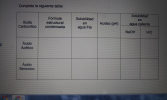 Complete the following table for the two carboxylic
acids fill out with the information for acetic acid and benzoic
acid with it's condensed structural formula,solubility, pH and
solubility with NaOH and HCL in hot water
Complete la siguiente tabla: Solubilidad Formula estructural condensada Solubilidad en Acido Acidez (pH) en agua caliente Carboxllico agua fría NaOH HCI Acido Acético Acido Benzoico
Complete the following table for the two carboxylic
acids fill out with the information for acetic acid and benzoic
acid with it's condensed structural formula,solubility, pH and
solubility with NaOH and HCL in hot water
Complete la siguiente tabla: Solubilidad Formula estructural condensada Solubilidad en Acido Acidez (pH) en agua caliente Carboxllico agua fría NaOH HCI Acido Acético Acido Benzoico
1) Which reactant, salicylic acid or acetic anhydride, is in excess? Show your work. 2) If you we...
 1) Which reactant, salicylic acid or acetic anhydride, is in
excess? Show your work.
2) If you were to use 3.17 g of starting material, how much
product would you expect? Again, show your work.
3) Why is phosphoric acid added to the reaction?
4) A small amount of water is added at the end of the reaction
to react with the excess acetic anhydride. Show a balanced equation
for that reaction.
5) Explain the purpose of the FeCl3 test...
1) Which reactant, salicylic acid or acetic anhydride, is in
excess? Show your work.
2) If you were to use 3.17 g of starting material, how much
product would you expect? Again, show your work.
3) Why is phosphoric acid added to the reaction?
4) A small amount of water is added at the end of the reaction
to react with the excess acetic anhydride. Show a balanced equation
for that reaction.
5) Explain the purpose of the FeCl3 test...
Place 3.0 g of salicylic acid in a 125-ml Erlenmeyer flask. Carefully add, stirring constantly, 6...
 Place 3.0 g of salicylic acid in a 125-ml Erlenmeyer flask. Carefully add, stirring constantly, 6 mL of acetic anhydride, followed by 10 drops of concentrated sulfuric acid. Swirl the contents of the flask so that the reactants are thoroughly mixed. Stopper the flask with a one- hole cork fitted with an inverted Pasteur pipet to prevent condensation of water in the reaction flask during heating on the steam bath. Heat the flask in a boiling-water or steam bath for...
 QUESTION 1 Propanoyl chloride reacts with an acetate anion to give which product? Acetic propanoic anhydride propanoic acetic anhydride propyl acetate Cacetyl propanoate QUESTION 2 Reaction of benzoic acid with thionyl chloride produces compound A. Compound A is reacted with 2 moles of ammonia to give compound B which is then reacted with thionyl chloride to furnish compound C. Compounds C is then treated with NaOH in the first step and acidified with acid in the second step to give...
 the tests performed were:
•hydrolysis of acid derivatives- esters, amides
•alcoholysis: Schotten-Baumann reaction- acetic acetyl
chloride, acetic anhydride
•aminolysis:anilide formation
•hydroxamic acid test
uations involved in the chemical tests. it necessary ary to perform a preliminary test on the sample before doing the hydroxamic acid 2 W est: necessany to perfom a preliminary kst on the sam ple bsfore doing mic auicl test bese pylnery st eliminates the phenels ard t is the hadroxamic Unbis which give felx psive reso...
the tests performed were:
•hydrolysis of acid derivatives- esters, amides
•alcoholysis: Schotten-Baumann reaction- acetic acetyl
chloride, acetic anhydride
•aminolysis:anilide formation
•hydroxamic acid test
uations involved in the chemical tests. it necessary ary to perform a preliminary test on the sample before doing the hydroxamic acid 2 W est: necessany to perfom a preliminary kst on the sam ple bsfore doing mic auicl test bese pylnery st eliminates the phenels ard t is the hadroxamic Unbis which give felx psive reso...
 they are asking just in general. like what is the trend of all of
them. but in the lab we used benzoyl chloride, methyl benzoate,
benzoic acid, benzamide
4) Discuss the relative reactivity of carboxylic acid derivatives. List carboxylic acid derivatives in order of most reactive to least reactive. Recall that benzoyl chloride was slow to react with water, does this fit with the trend you just described? Why or why not?
they are asking just in general. like what is the trend of all of
them. but in the lab we used benzoyl chloride, methyl benzoate,
benzoic acid, benzamide
4) Discuss the relative reactivity of carboxylic acid derivatives. List carboxylic acid derivatives in order of most reactive to least reactive. Recall that benzoyl chloride was slow to react with water, does this fit with the trend you just described? Why or why not?
 A. Carboxylic Acids and Their Salts | Benzoic Acid Acetic Acid A.1 Condensed structural formulas CCo A.2 Solubility in cold water es A.3 pH 2t A.4 Solubility in hot water A.5 NaOH A.6 HCI Sulmable
 Complete the following table for the two carboxylic
acids fill out with the information for acetic acid and benzoic
acid with it's condensed structural formula,solubility, pH and
solubility with NaOH and HCL in hot water
Complete la siguiente tabla: Solubilidad Formula estructural condensada Solubilidad en Acido Acidez (pH) en agua caliente Carboxllico agua fría NaOH HCI Acido Acético Acido Benzoico
Complete the following table for the two carboxylic
acids fill out with the information for acetic acid and benzoic
acid with it's condensed structural formula,solubility, pH and
solubility with NaOH and HCL in hot water
Complete la siguiente tabla: Solubilidad Formula estructural condensada Solubilidad en Acido Acidez (pH) en agua caliente Carboxllico agua fría NaOH HCI Acido Acético Acido Benzoico
 1) Which reactant, salicylic acid or acetic anhydride, is in
excess? Show your work.
2) If you were to use 3.17 g of starting material, how much
product would you expect? Again, show your work.
3) Why is phosphoric acid added to the reaction?
4) A small amount of water is added at the end of the reaction
to react with the excess acetic anhydride. Show a balanced equation
for that reaction.
5) Explain the purpose of the FeCl3 test...
1) Which reactant, salicylic acid or acetic anhydride, is in
excess? Show your work.
2) If you were to use 3.17 g of starting material, how much
product would you expect? Again, show your work.
3) Why is phosphoric acid added to the reaction?
4) A small amount of water is added at the end of the reaction
to react with the excess acetic anhydride. Show a balanced equation
for that reaction.
5) Explain the purpose of the FeCl3 test...
 Place 3.0 g of salicylic acid in a 125-ml Erlenmeyer flask. Carefully add, stirring constantly, 6 mL of acetic anhydride, followed by 10 drops of concentrated sulfuric acid. Swirl the contents of the flask so that the reactants are thoroughly mixed. Stopper the flask with a one- hole cork fitted with an inverted Pasteur pipet to prevent condensation of water in the reaction flask during heating on the steam bath. Heat the flask in a boiling-water or steam bath for...
Most questions answered within 3 hours.
-
Where is the error in this code sequence?
String s1 = "Hello";
String s2 = "ello";...
asked 11 months ago -
Financial data for Joel de Paris, Inc., for last year
follow:
Joel de Paris, Inc.
Balance...
asked 11 months ago -
Consider this reaction:
Al2(SO4)3 (aq)+ BaCl3
(aq) Al2Cl6 (aq)- +
3BaSO4(s) . What is the...
asked 11 months ago -
Suppose that Savneet is considering increasing her
recent random sample from 20 car rentals to 40...
asked 11 months ago -
Trucks arrive at an unloading terminal at an average rate of 120
per hour.
Trucks arrive...
asked 11 months ago -
Why are methanol and ethanol completely soluble in water while
octanol is not very little soluble....
asked 11 months ago -
A facilities manager at a university reads in a research report
that the mean amount of...
asked 11 months ago -
When the CuSO4 is rehydrated by adding water to the anhydrous
compound, is this an endothermic...
asked 11 months ago -
A ray of sunlight is passing from diamond into crown glass; the
angle of incidence is...
asked 11 months ago -
A block of mass 0.249 kg is placed on top of a light, vertical
spring of...
asked 11 months ago -
how do the kidneys compensate in the presences of acidosis
a) trigger hyperventilate
b) reserve acid...
asked 11 months ago -
Question 501 pts
The rental rate of capital to the firm increases. Which of the
following...
asked 11 months ago