A railroad handcar is moving along straight, frictionless tracks with negligible air resistance. In the following...
A railroad handcar is moving along straight, frictionless tracks with negligible air resistance. In the following cases, the car initially has a total mass (car and contents) of 190 kg and is traveling east with a velocity of magnitude 5.30 m/s. Find the final velocity of the car in each case, assuming that the handcar does not leave the tracks.
An object with a mass of 25.0 kgkg is thrown sideways out of the car with a speed of 2.50 m/sm/s relative to the car's initial velocity.
Express your answer with the appropriate units.
An object with a mass of 25.0 kg is thrown backward out of the car with a velocity of 5.30 m/sm/s relative to the initial motion of the car.
Express your answer with the appropriate units.
An object with a mass of 25.0 kg is thrown into the car with a velocity of 6.00 m/sm/s relative to the ground and opposite in direction to the initial velocity of the car.
Express your answer with the appropriate units.
Homework Answers

Add Answer to:
A railroad handcar is moving along straight, frictionless tracks
with negligible air resistance. In the following...
A railroad handcar is moving along straight, frictionless tracks with negligible air resistance. In the following...
 A railroad handcar is moving along straight, frictionless tracks with negligible air resistance. In the following cases, the car initially has a total mass (car and contents) of 160 kg and is travelling east with a velocity of magnitude 5.20 m/s. Find the final velocity of the car in each case, assuming that the handcar does not leave the tracks. An object with a mass of 22.0 kg is thrown sideways out of the car with a speed of 1.60...
A 6450-kg railroad car travels alone on a level frictionless track with a constant speed of...
A 6450-kg railroad car travels alone on a level frictionless track with a constant speed of 20.0 m/s . A 3850-kg load, initially at rest, is dropped onto the car. Part A What will be the car's new speed? Express your answer to three significant figures and include the appropriate units.
A railroad hopper car filled with sand is rolling with an initial speed of 15 m/s on straight, horizontal tracks. You c...
A railroad hopper car filled with sand is rolling with an initial speed of 15 m/s on straight, horizontal tracks. You can ignore frictional forces on the railroad car. The total mass of the car plus sand is 85,000 kg. The hopper door is not fully closed so sand leaks out the bottoms. After 10 minutes, 13,000 kg of sand has leaked out. So I thought that because it does not say that it is elastic or inelastic that I...
A 10,000 kg railroad car is rolling at 8.00 m/s when a 6000 kg load of...
A 10,000 kg railroad car is rolling at 8.00 m/s when a 6000 kg load of gravel is suddenly dropped in. What is the car's speed just after the gravel is loaded? Express your answer with the appropriate units.
Two railway cars are on a straight railroad track. The first, with mass 8000 kg, moves...
Two railway cars are on a straight railroad track. The first, with mass 8000 kg, moves slowly at a velocity of 0.05 m/s to the right in the direction of the second car of mass 15000 kg, which is stationary. (a) What is the total momentum (relative to the ground) of both cars together? kg m/s They collide and stick to each other. What is the total momentum right after the collision? For the short times involved, you can take...
A 2.00×10⁴ kg railroad car is rolling at 2.00 m/s when a 7000 kg load of...
A 2.00×10⁴ kg railroad car is rolling at 2.00 m/s when a 7000 kg load of gravel is suddenly dropped in. Part A What is the car's speed just after the gravel is loaded? Express your answer with the appropriate units.
A 1190-kg flatbed train car rolls along frictionless tracks at a speed of 0.132 m/s. A...
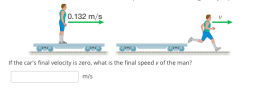 A 1190-kg flatbed train car rolls along frictionless tracks at a
speed of 0.132 m/s. A 62.2-kg man stands on the flatbed and, in
order to stop the car, runs to the edge and jumps off.
0.132 m/s If the car's final velocity is zero, what is the final speed v of the man? m/s
A 1190-kg flatbed train car rolls along frictionless tracks at a
speed of 0.132 m/s. A 62.2-kg man stands on the flatbed and, in
order to stop the car, runs to the edge and jumps off.
0.132 m/s If the car's final velocity is zero, what is the final speed v of the man? m/s
A race car starts from rest and travels east along a straight and level track. For...
 A race car starts from rest and travels east along a straight and level track. For the first 5.0 s of the car's motion, the eastward component of the car's velocity is given by What is the acceleration of the car when vx 16.5 m/s? Express your answer with the appropriate units. ()(0.930 /s)t2 aValue Units
A 1.20 103 kg railroad car is traveling at 9.00 m/s when it bumps into and...
 A 1.20 103 kg railroad car is traveling at 9.00 m/s when it bumps into and connects to a 0.45 10 raroad car that is moving down the tracks in the same direction but with a speed of 3.55 m/s. After they connect together they both continue on. A) What properties are conserved within this system: energy, momentum, both, or neither? B) What is the initial momentum and energy of the first car? C) What is the initial momentum and...
A railroad car of mass 1.85e4 kg moving at 3.14 m/s collides and couples with two coupled railroad cars, each of the sa...
 A railroad car of mass 1.85e4 kg moving at 3.14 m/s collides and
couples with two coupled railroad cars, each of the same mass as
the single car and moving in the same direction at 1.24 m/s.
b)
How much kinetic energy is lost in the collision?
USE THIS DATA:
17400 kg; 3.27 m/s; (help me see how you get the correct answer
of 2.39e4 J.
16-4 A railroad car of mass 1.85e4 kg moving at 3.14 m/s collides and...
A railroad car of mass 1.85e4 kg moving at 3.14 m/s collides and
couples with two coupled railroad cars, each of the same mass as
the single car and moving in the same direction at 1.24 m/s.
b)
How much kinetic energy is lost in the collision?
USE THIS DATA:
17400 kg; 3.27 m/s; (help me see how you get the correct answer
of 2.39e4 J.
16-4 A railroad car of mass 1.85e4 kg moving at 3.14 m/s collides and...
 A railroad handcar is moving along straight, frictionless tracks with negligible air resistance. In the following cases, the car initially has a total mass (car and contents) of 160 kg and is travelling east with a velocity of magnitude 5.20 m/s. Find the final velocity of the car in each case, assuming that the handcar does not leave the tracks. An object with a mass of 22.0 kg is thrown sideways out of the car with a speed of 1.60...
 A 1190-kg flatbed train car rolls along frictionless tracks at a
speed of 0.132 m/s. A 62.2-kg man stands on the flatbed and, in
order to stop the car, runs to the edge and jumps off.
0.132 m/s If the car's final velocity is zero, what is the final speed v of the man? m/s
A 1190-kg flatbed train car rolls along frictionless tracks at a
speed of 0.132 m/s. A 62.2-kg man stands on the flatbed and, in
order to stop the car, runs to the edge and jumps off.
0.132 m/s If the car's final velocity is zero, what is the final speed v of the man? m/s
 A race car starts from rest and travels east along a straight and level track. For the first 5.0 s of the car's motion, the eastward component of the car's velocity is given by What is the acceleration of the car when vx 16.5 m/s? Express your answer with the appropriate units. ()(0.930 /s)t2 aValue Units
 A 1.20 103 kg railroad car is traveling at 9.00 m/s when it bumps into and connects to a 0.45 10 raroad car that is moving down the tracks in the same direction but with a speed of 3.55 m/s. After they connect together they both continue on. A) What properties are conserved within this system: energy, momentum, both, or neither? B) What is the initial momentum and energy of the first car? C) What is the initial momentum and...
 A railroad car of mass 1.85e4 kg moving at 3.14 m/s collides and
couples with two coupled railroad cars, each of the same mass as
the single car and moving in the same direction at 1.24 m/s.
b)
How much kinetic energy is lost in the collision?
USE THIS DATA:
17400 kg; 3.27 m/s; (help me see how you get the correct answer
of 2.39e4 J.
16-4 A railroad car of mass 1.85e4 kg moving at 3.14 m/s collides and...
A railroad car of mass 1.85e4 kg moving at 3.14 m/s collides and
couples with two coupled railroad cars, each of the same mass as
the single car and moving in the same direction at 1.24 m/s.
b)
How much kinetic energy is lost in the collision?
USE THIS DATA:
17400 kg; 3.27 m/s; (help me see how you get the correct answer
of 2.39e4 J.
16-4 A railroad car of mass 1.85e4 kg moving at 3.14 m/s collides and...
Most questions answered within 3 hours.
-
Where is the error in this code sequence?
String s1 = "Hello";
String s2 = "ello";...
asked 10 months ago -
Financial data for Joel de Paris, Inc., for last year
follow:
Joel de Paris, Inc.
Balance...
asked 10 months ago -
Consider this reaction:
Al2(SO4)3 (aq)+ BaCl3
(aq) Al2Cl6 (aq)- +
3BaSO4(s) . What is the...
asked 10 months ago -
Suppose that Savneet is considering increasing her
recent random sample from 20 car rentals to 40...
asked 10 months ago -
Trucks arrive at an unloading terminal at an average rate of 120
per hour.
Trucks arrive...
asked 10 months ago -
Why are methanol and ethanol completely soluble in water while
octanol is not very little soluble....
asked 10 months ago -
A facilities manager at a university reads in a research report
that the mean amount of...
asked 10 months ago -
When the CuSO4 is rehydrated by adding water to the anhydrous
compound, is this an endothermic...
asked 10 months ago -
A ray of sunlight is passing from diamond into crown glass; the
angle of incidence is...
asked 10 months ago -
A block of mass 0.249 kg is placed on top of a light, vertical
spring of...
asked 10 months ago -
how do the kidneys compensate in the presences of acidosis
a) trigger hyperventilate
b) reserve acid...
asked 10 months ago -
Question 501 pts
The rental rate of capital to the firm increases. Which of the
following...
asked 10 months ago