3. Write the shortest sequence of VHDL statements to multiply a 16 bit unsigned variable x...
3. Write the shortest sequence of VHDL statements to multiply a 16 bit unsigned variable x by constant 113 without using a multiplication operator
Homework Answers


Add Answer to:
3. Write the shortest sequence of VHDL statements to multiply a
16 bit unsigned variable x...
VI. Write the shortest sequence of instructions to multiply a value b concurrent statements. (8 p...
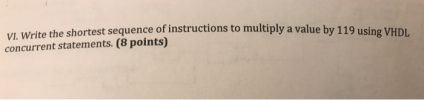 VI. Write the shortest sequence of instructions to multiply a value b concurrent statements. (8 points) ng V HDL
VI. Write the shortest sequence of instructions to multiply a value b concurrent statements. (8 points) ng V HDL
VI. Write the shortest sequence of instructions to multiply a value b concurrent statements. (8 points) ng V HDL
1. Consider the following 7-bit binary sequence "1010001" a. Assuming the sequence is 7-bit unsigned binary,...
 1. Consider the following 7-bit binary sequence "1010001" a. Assuming the sequence is 7-bit unsigned binary, convert it to decimal. [5 points] b. Assuming the sequence is 7-bit 2's complement format, convert it to decimal. (5 points c. What is the range of numbers (in decimal) that can be represented using 7-bit binary, signed 2's complement format? [5 points 2. Consider the following Boolean function: F(x, y, z) = (x + y)z'+xy! a. Implement the circuit for the function using...
1. Consider the following 7-bit binary sequence "1010001" a. Assuming the sequence is 7-bit unsigned binary,...
 1. Consider the following 7-bit binary sequence "1010001" a. Assuming the sequence is 7-bit unsigned binary, convert it to decimal. 15 points] b. Assuming the sequence is 7-bit 2's complement format, convert it to decimal. (5 points c. What is the range of numbers (in decimal) that can be represented using 7-bit binary, signed 2's complement format? 15 points 2. Consider the following Boolean function: F(x, y, z) = (x + y). z'+xy' a. Implement the circuit for the function...
Using Atmel Studio Assembler, Write a subroutine to multiply two unsigned 16-bit integers 0x3732 and 0x4148...
Using Atmel Studio Assembler, Write a subroutine to multiply two unsigned 16-bit integers 0x3732 and 0x4148 passed in r16:r17 and r18:r19, and return the product in r22, r23, r24, and r25. r17 and r19 hold the upper bytes of two numbers to be multiplied, and r25 down to r22 hold the most significant to the least significant bytes of the product.
a. Multiply the following numbers using signed by unsigned multiplication and write output Qn.m format. (101111)...
a. Multiply the following numbers using signed by unsigned multiplication and write output Qn.m format. (101111) signed Q3.3 x (111101) Unsigned Q2.4
a. Multiply the following numbers using signed by unsigned multiplication and write output On.m format (101111)...
 a. Multiply the following numbers using signed by unsigned multiplication and write output On.m format (101111) signed Q3.3 x (111101) Unsigned Q2.4
5.1. Attempt the following questions. [CL0-3] [5] a. Multiply the following numbers using signed by unsigned...
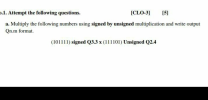 5.1. Attempt the following questions. [CL0-3] [5] a. Multiply the following numbers using signed by unsigned multiplication and write output Qn.m format. (101111) signed Q3.3 x (111101) Unsigned Q2.4
Here is the 16-bit, unsigned binary representation of 4100: 0001 0000 0000 0100 Write the 16-bit,...
 Here is the 16-bit, unsigned binary representation of 4100: 0001 0000 0000 0100 Write the 16-bit, unsigned binary representation of 2050. TT T Arial + 3(12pt) * T - 12 i 52 Path: P Words:0 QUESTION 8 What are the largest and smallest numbers that you can represent using the 9-bit, 2's complement representation scheme? Write both the bit strings and the equivalent decimals.
Exercises: 1. Write the VHDL statements to describe a 4-bit comparator. Use the appropriate relational operators....
 Exercises: 1. Write the VHDL statements to describe a 4-bit comparator. Use the appropriate relational operators. Use input ports A and B, described above, as the inputs to the 4-bit comparator. Assume that three output ports, EQ, GT, and LT, have been declared in the Entity statement. Use them as the outputs from the comparator 2. Identify the package (or packages) that must be included in your VHDL code in order to use the relational operators with signals of type...
Let variable x be a 32-bit non-negative integer of type unsigned int with an actual value...
Let variable x be a 32-bit non-negative integer of type unsigned int with an actual value between 1 and 1000. Without using a calculator (and actual arithmetic computations), describe an efficient way to find x * 2^17 represented in a binary form, Using your idea, find the binary representation of the number 537 * 2^17. .
 VI. Write the shortest sequence of instructions to multiply a value b concurrent statements. (8 points) ng V HDL
VI. Write the shortest sequence of instructions to multiply a value b concurrent statements. (8 points) ng V HDL
VI. Write the shortest sequence of instructions to multiply a value b concurrent statements. (8 points) ng V HDL
 1. Consider the following 7-bit binary sequence "1010001" a. Assuming the sequence is 7-bit unsigned binary, convert it to decimal. [5 points] b. Assuming the sequence is 7-bit 2's complement format, convert it to decimal. (5 points c. What is the range of numbers (in decimal) that can be represented using 7-bit binary, signed 2's complement format? [5 points 2. Consider the following Boolean function: F(x, y, z) = (x + y)z'+xy! a. Implement the circuit for the function using...
 1. Consider the following 7-bit binary sequence "1010001" a. Assuming the sequence is 7-bit unsigned binary, convert it to decimal. 15 points] b. Assuming the sequence is 7-bit 2's complement format, convert it to decimal. (5 points c. What is the range of numbers (in decimal) that can be represented using 7-bit binary, signed 2's complement format? 15 points 2. Consider the following Boolean function: F(x, y, z) = (x + y). z'+xy' a. Implement the circuit for the function...
 a. Multiply the following numbers using signed by unsigned multiplication and write output On.m format (101111) signed Q3.3 x (111101) Unsigned Q2.4
 5.1. Attempt the following questions. [CL0-3] [5] a. Multiply the following numbers using signed by unsigned multiplication and write output Qn.m format. (101111) signed Q3.3 x (111101) Unsigned Q2.4
 Here is the 16-bit, unsigned binary representation of 4100: 0001 0000 0000 0100 Write the 16-bit, unsigned binary representation of 2050. TT T Arial + 3(12pt) * T - 12 i 52 Path: P Words:0 QUESTION 8 What are the largest and smallest numbers that you can represent using the 9-bit, 2's complement representation scheme? Write both the bit strings and the equivalent decimals.
 Exercises: 1. Write the VHDL statements to describe a 4-bit comparator. Use the appropriate relational operators. Use input ports A and B, described above, as the inputs to the 4-bit comparator. Assume that three output ports, EQ, GT, and LT, have been declared in the Entity statement. Use them as the outputs from the comparator 2. Identify the package (or packages) that must be included in your VHDL code in order to use the relational operators with signals of type...
Most questions answered within 3 hours.
-
Where is the error in this code sequence?
String s1 = "Hello";
String s2 = "ello";...
asked 10 months ago -
Financial data for Joel de Paris, Inc., for last year
follow:
Joel de Paris, Inc.
Balance...
asked 10 months ago -
Consider this reaction:
Al2(SO4)3 (aq)+ BaCl3
(aq) Al2Cl6 (aq)- +
3BaSO4(s) . What is the...
asked 10 months ago -
Suppose that Savneet is considering increasing her
recent random sample from 20 car rentals to 40...
asked 10 months ago -
Trucks arrive at an unloading terminal at an average rate of 120
per hour.
Trucks arrive...
asked 10 months ago -
Why are methanol and ethanol completely soluble in water while
octanol is not very little soluble....
asked 10 months ago -
A facilities manager at a university reads in a research report
that the mean amount of...
asked 10 months ago -
When the CuSO4 is rehydrated by adding water to the anhydrous
compound, is this an endothermic...
asked 10 months ago -
A ray of sunlight is passing from diamond into crown glass; the
angle of incidence is...
asked 10 months ago -
A block of mass 0.249 kg is placed on top of a light, vertical
spring of...
asked 10 months ago -
how do the kidneys compensate in the presences of acidosis
a) trigger hyperventilate
b) reserve acid...
asked 10 months ago -
Question 501 pts
The rental rate of capital to the firm increases. Which of the
following...
asked 10 months ago