Write the equations that describe the synthesis of (NH4)2PbCl6 starting from Pb(II) ie. Pb(NO3)2. Hint: There...
Write the equations that describe the synthesis of (NH4)2PbCl6 starting from Pb(II) ie. Pb(NO3)2. Hint: There is a redox reaction in the first step where the bleach (ClO-) is oxidizing agent. Other reagents include NaOH and HCl
Homework Answers

Add Answer to:
Write the equations that describe the synthesis of (NH4)2PbCl6
starting from Pb(II) ie. Pb(NO3)2. Hint: There...
1. A 75.0-mL sample of 0.200 M Lead(II) nitrate, Pb(NO3)2, is reacted with 75.0 mL of...
1. A 75.0-mL sample of 0.200 M Lead(II) nitrate, Pb(NO3)2, is reacted with 75.0 mL of 0.450 M KI solution and the following precipitation reaction occurs. Pb(NO3)2(aq) + 2KI(aq) → PbI2(s) + 2KNO3(aq) (a) Determine the limiting reactant. (b) How many grams of PbI2 will be formed if the yield is 100%? (c) What is the percent yield if 6.45 g of PbI2 were obtained? (2) K2Cr2O7(aq) + FeCl2(aq) → CrCl3(aq) + Fe(NO3)3(aq) (a) Determine the net ionic reactions and...
Review Topics References Devise the most efficient synthesis for the carboxylic acid below using a starting...
 Review Topics References Devise the most efficient synthesis for the carboxylic acid below using a starting material and reagents from the tables. Give your route by specifying the number of the starting material followed by the letters of the reagents you would use beginning with the first step. The answer 4th means treat t-butanol(4) with conc. HC (then treat the product with KOH in alcoholch). Starting materials OH B Reagents a Mg/ dry other KMnO/H,0 . Aqueous H,SO, at reflux...
(II). Write chemical equations for synthesis of the following compound from phenol (CeHsOH) and 1,2-dichloroethane (CICH2CH2CI)....
 (II). Write chemical equations for synthesis of the following compound from phenol (CeHsOH) and 1,2-dichloroethane (CICH2CH2CI). You may use any neces sary inorganic reagents. Show reaction mechanism for each of the synthetic steps
1(i). Balance the following equations, and then write the net ionic equation (a) (NH4)2CO3(aq) + Cu(NO3)2(aq)...
1(i). Balance the following equations, and then write the net ionic equation (a) (NH4)2CO3(aq) + Cu(NO3)2(aq) → CuCO3(s) + NH4NO3(aq) (b) Mg(OH)2(s) + HCl(aq) → MgCl2(aq) + H2O(l) (c) BaCO3(s) + HBr(aq) → BaBr2(aq) + H2O(l) + CO2(g) (ii). For each reaction equation, identify the driving force of the reaction 2. What is an electrolyte? How can you experimentally differentiate between a weak electrolyte and a strong electrolyte? Name and give the formulas of a strong electrolyte and a weak...
1. (14 pts) Suppose Professor Koh has founded a pharmaceutical company. The company produces a synthetic...
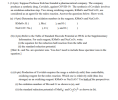 1. (14 pts) Suppose Professor Koh has founded a pharmaceutical company. The company produces a synthetic drug, Covidale, against COVID-19. The synthesis of Covidale involves an oxidation-reduction step. Two strong oxidizing reagents, KMnO4 and Na2Cr2O7, are considered as an agent for the redox reaction. Answer the questions below. Show work. (a) (4 pts) Determine the oxidation numbers in the reagents, KMnO and Na2Cr2O7. KMnO4K ), Mn ), and o Na2Cr2O7: Na ), Cr ), and ) (b) (4 pts) Refer...
Data analysis: write the net ionic equations for any reactions that occurred between the metals and metal ions list occurred with N.R. Indicate any combinations where no reaction ed below (sect...
 Data analysis: write the net ionic equations for any reactions that occurred between the metals and metal ions list occurred with N.R. Indicate any combinations where no reaction ed below (section la). e Lead ion and zinc . Lead ion and copper Zinc ion and lead . Zinc ion and copper . Copper(II) ion and lead . Copper(II) ion and zinc 2. In your notebook, write the net ionic equations for the react tions that occurred between the metals and...
1) Choose one molecule from the set and create an 8-step synthesis scheme using the chosen...
 1) Choose one molecule from the set and create an 8-step synthesis scheme using the chosen molecule as your starting material. You need to write the complete set of reagents and draw the product expected from each step. Reagents typically used together are considered one step, eg. 1) LAH 2) H.O should be considered as one step Your 8 steps must include at least one reaction from each of the chapters, aldehydes and ketones, carboxylic acid derivatives, alcohols. You can...
please answer all question and type please Problems and questions 1. Balance the following equations: -...
 please answer all question and type please
Problems and questions 1. Balance the following equations: - Na + H₂O NaOH + H2 PbO + _NH Pb + _Ny +_ H_O CH. +_ - _CO+ H2O a) — _NayCO; + _Mg(NO3)2 - > MgCO, + NaNO, 2. Write the correct balanced equation for each of the following reactions. Include the proper subscripts and include the state of matter for all reactants and products. Write the type of reaction on the blank...
please answer all question and type please
Problems and questions 1. Balance the following equations: - Na + H₂O NaOH + H2 PbO + _NH Pb + _Ny +_ H_O CH. +_ - _CO+ H2O a) — _NayCO; + _Mg(NO3)2 - > MgCO, + NaNO, 2. Write the correct balanced equation for each of the following reactions. Include the proper subscripts and include the state of matter for all reactants and products. Write the type of reaction on the blank...
BACKGROUND: Synthesis of Potassium Iron (III) Oxalate Hydrate Salt The iron(II) ions from Fe(NH4)2(SO4)2•6H2O will be precipitated as iron(II) oxalate. Fe^2+(aq) + C2O4^2-(aq) --> FeC2O4 (s) The su...
 BACKGROUND: Synthesis of Potassium Iron
(III) Oxalate Hydrate Salt
The iron(II) ions from
Fe(NH4)2(SO4)2•6H2O
will be precipitated as iron(II) oxalate.
Fe^2+(aq) + C2O4^2-(aq) --> FeC2O4 (s)
The supernatant liquid, containing the ammonium and sulfate
ions, as well as excess oxalate ions and oxalic acid will be
decanted and discarded. The solid will then be re-dissolved and the
iron(II) ions will be oxidized to iron(III) ions by reaction with
hydrogen peroxide.
2Fe^2+(aq) + H2O2(aq) --> 2Fe^3+(aq) +2 OH^ - (aq)
The...
BACKGROUND: Synthesis of Potassium Iron
(III) Oxalate Hydrate Salt
The iron(II) ions from
Fe(NH4)2(SO4)2•6H2O
will be precipitated as iron(II) oxalate.
Fe^2+(aq) + C2O4^2-(aq) --> FeC2O4 (s)
The supernatant liquid, containing the ammonium and sulfate
ions, as well as excess oxalate ions and oxalic acid will be
decanted and discarded. The solid will then be re-dissolved and the
iron(II) ions will be oxidized to iron(III) ions by reaction with
hydrogen peroxide.
2Fe^2+(aq) + H2O2(aq) --> 2Fe^3+(aq) +2 OH^ - (aq)
The...
Page 1 Synthesis using Carbonyl O-Substitution Chemistry Preamble This experiment involves the synthesis of target molecules...
 Page 1 Synthesis using Carbonyl O-Substitution Chemistry Preamble This experiment involves the synthesis of target molecules using a-substitution chemistry. You are assigned two target molecules, one of which is best synthesized by an alkylation approach, while the other is best synthesized by an addition or condensation approach. You must do the following: 1. Perform a retrosynthetic analysis on the two target molecules assigned to you. In each case the organic starting material (what you have to work backwards toward) depends...
 Review Topics References Devise the most efficient synthesis for the carboxylic acid below using a starting material and reagents from the tables. Give your route by specifying the number of the starting material followed by the letters of the reagents you would use beginning with the first step. The answer 4th means treat t-butanol(4) with conc. HC (then treat the product with KOH in alcoholch). Starting materials OH B Reagents a Mg/ dry other KMnO/H,0 . Aqueous H,SO, at reflux...
 (II). Write chemical equations for synthesis of the following compound from phenol (CeHsOH) and 1,2-dichloroethane (CICH2CH2CI). You may use any neces sary inorganic reagents. Show reaction mechanism for each of the synthetic steps
 1. (14 pts) Suppose Professor Koh has founded a pharmaceutical company. The company produces a synthetic drug, Covidale, against COVID-19. The synthesis of Covidale involves an oxidation-reduction step. Two strong oxidizing reagents, KMnO4 and Na2Cr2O7, are considered as an agent for the redox reaction. Answer the questions below. Show work. (a) (4 pts) Determine the oxidation numbers in the reagents, KMnO and Na2Cr2O7. KMnO4K ), Mn ), and o Na2Cr2O7: Na ), Cr ), and ) (b) (4 pts) Refer...
 Data analysis: write the net ionic equations for any reactions that occurred between the metals and metal ions list occurred with N.R. Indicate any combinations where no reaction ed below (section la). e Lead ion and zinc . Lead ion and copper Zinc ion and lead . Zinc ion and copper . Copper(II) ion and lead . Copper(II) ion and zinc 2. In your notebook, write the net ionic equations for the react tions that occurred between the metals and...
 1) Choose one molecule from the set and create an 8-step synthesis scheme using the chosen molecule as your starting material. You need to write the complete set of reagents and draw the product expected from each step. Reagents typically used together are considered one step, eg. 1) LAH 2) H.O should be considered as one step Your 8 steps must include at least one reaction from each of the chapters, aldehydes and ketones, carboxylic acid derivatives, alcohols. You can...
 please answer all question and type please
Problems and questions 1. Balance the following equations: - Na + H₂O NaOH + H2 PbO + _NH Pb + _Ny +_ H_O CH. +_ - _CO+ H2O a) — _NayCO; + _Mg(NO3)2 - > MgCO, + NaNO, 2. Write the correct balanced equation for each of the following reactions. Include the proper subscripts and include the state of matter for all reactants and products. Write the type of reaction on the blank...
please answer all question and type please
Problems and questions 1. Balance the following equations: - Na + H₂O NaOH + H2 PbO + _NH Pb + _Ny +_ H_O CH. +_ - _CO+ H2O a) — _NayCO; + _Mg(NO3)2 - > MgCO, + NaNO, 2. Write the correct balanced equation for each of the following reactions. Include the proper subscripts and include the state of matter for all reactants and products. Write the type of reaction on the blank...
 BACKGROUND: Synthesis of Potassium Iron
(III) Oxalate Hydrate Salt
The iron(II) ions from
Fe(NH4)2(SO4)2•6H2O
will be precipitated as iron(II) oxalate.
Fe^2+(aq) + C2O4^2-(aq) --> FeC2O4 (s)
The supernatant liquid, containing the ammonium and sulfate
ions, as well as excess oxalate ions and oxalic acid will be
decanted and discarded. The solid will then be re-dissolved and the
iron(II) ions will be oxidized to iron(III) ions by reaction with
hydrogen peroxide.
2Fe^2+(aq) + H2O2(aq) --> 2Fe^3+(aq) +2 OH^ - (aq)
The...
BACKGROUND: Synthesis of Potassium Iron
(III) Oxalate Hydrate Salt
The iron(II) ions from
Fe(NH4)2(SO4)2•6H2O
will be precipitated as iron(II) oxalate.
Fe^2+(aq) + C2O4^2-(aq) --> FeC2O4 (s)
The supernatant liquid, containing the ammonium and sulfate
ions, as well as excess oxalate ions and oxalic acid will be
decanted and discarded. The solid will then be re-dissolved and the
iron(II) ions will be oxidized to iron(III) ions by reaction with
hydrogen peroxide.
2Fe^2+(aq) + H2O2(aq) --> 2Fe^3+(aq) +2 OH^ - (aq)
The...
 Page 1 Synthesis using Carbonyl O-Substitution Chemistry Preamble This experiment involves the synthesis of target molecules using a-substitution chemistry. You are assigned two target molecules, one of which is best synthesized by an alkylation approach, while the other is best synthesized by an addition or condensation approach. You must do the following: 1. Perform a retrosynthetic analysis on the two target molecules assigned to you. In each case the organic starting material (what you have to work backwards toward) depends...
Most questions answered within 3 hours.
-
Where is the error in this code sequence?
String s1 = "Hello";
String s2 = "ello";...
asked 10 months ago -
Financial data for Joel de Paris, Inc., for last year
follow:
Joel de Paris, Inc.
Balance...
asked 10 months ago -
Consider this reaction:
Al2(SO4)3 (aq)+ BaCl3
(aq) Al2Cl6 (aq)- +
3BaSO4(s) . What is the...
asked 10 months ago -
Suppose that Savneet is considering increasing her
recent random sample from 20 car rentals to 40...
asked 10 months ago -
Trucks arrive at an unloading terminal at an average rate of 120
per hour.
Trucks arrive...
asked 10 months ago -
Why are methanol and ethanol completely soluble in water while
octanol is not very little soluble....
asked 10 months ago -
A facilities manager at a university reads in a research report
that the mean amount of...
asked 10 months ago -
When the CuSO4 is rehydrated by adding water to the anhydrous
compound, is this an endothermic...
asked 10 months ago -
A ray of sunlight is passing from diamond into crown glass; the
angle of incidence is...
asked 10 months ago -
A block of mass 0.249 kg is placed on top of a light, vertical
spring of...
asked 10 months ago -
how do the kidneys compensate in the presences of acidosis
a) trigger hyperventilate
b) reserve acid...
asked 10 months ago -
Question 501 pts
The rental rate of capital to the firm increases. Which of the
following...
asked 10 months ago