Use molecular orbital theory to discuss the biochemical reactivity of O2, N2, and NO.
Use molecular orbital theory to discuss the biochemical reactivity of O2, N2, and NO.
Homework Answers

Add Answer to:
Use molecular orbital theory to discuss the biochemical
reactivity of O2, N2, and NO.
Use the molecular orbital theory to describe the bonding in O2 + , O2, O2 -...
Use the molecular orbital theory to describe the bonding in O2 + , O2, O2 - and O2 2- . Predict the bond order and relative bond lengths for these four species. Are they paramagnetic or diamagnetic?
4. (15 Points) Use Frontier Molecular Orbital Theory (FMO) to rationalize the lack of reactivity between...
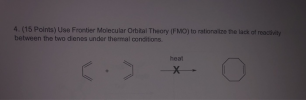 4. (15 Points) Use Frontier Molecular Orbital Theory (FMO) to rationalize the lack of reactivity between the two dienes under thermal conditions. heat
Use molecular orbital theory to predict the following properties of the N2 2+ ion: (a) electron...
Use molecular orbital theory to predict the following properties of the N2 2+ ion: (a) electron configuration; (b) bond order; (c) magnetic character (paramagnetic or diamagnetic); (d) whether the bond length is longer or shorter than in the N2 molecule; (e) whether the bond strength is greater or less than in the N2 molecule. Use the M.O. diagram for N2 in Figure 10.13 of Tro, Fridgen and Shaw as a starting point for this question.
Question 1) By drawing molecular orbital diagrams for B2, C2, N2, O2, and F2, predict which...
 Question 1) By drawing molecular orbital diagrams for B2, C2,
N2, O2, and F2, predict which of these homonuclear diatomic
molecules are magnetic.
Question 2) Based on the molecular orbital diagram for NO, which
of the following electronic configurations and statements are most
correct?
Question 1) By drawing molecular orbital diagrams for B2, C2,
N2, O2, and F2, predict which of these homonuclear diatomic
molecules are magnetic.
Question 2) Based on the molecular orbital diagram for NO, which
of the following electronic configurations and statements are most
correct?
How to use molecular orbital theory to explain nucleophile attack carbonyl carbon,not oxygen? Please use molecular...
How to use molecular orbital theory to explain nucleophile attack carbonyl carbon,not oxygen? Please use molecular orbital theory.
Using the Molecular Orbital Theory, discuss the delocalized system in NO3 - . Hence, determine the...
Using the Molecular Orbital Theory, discuss the delocalized system in NO3 - . Hence, determine the bond order for N-O bond.
Use molecular orbital theory to determine whether the Ne 2 + ion is likely to be...
 Use molecular orbital theory to determine whether the Ne
2
+
ion is likely to be
bound, and if so, to predict its bo
Use molecular orbital theory to determine whether the Ne
2
+
ion is likely to be
bound, and if so, to predict its bo
Use molecular orbital theory to determine whether the Ne2 ion is likely to be bound, and if so, to predict its bond order.
Use molecular orbital theory to determine whether the Ne
2
+
ion is likely to be
bound, and if so, to predict its bo
Use molecular orbital theory to determine whether the Ne
2
+
ion is likely to be
bound, and if so, to predict its bo
Use molecular orbital theory to determine whether the Ne2 ion is likely to be bound, and if so, to predict its bond order.
Discuss "Molecular Orbital Theory" by giving one example. Your explanation should include the comparison of this...
Discuss "Molecular Orbital Theory" by giving one example. Your explanation should include the comparison of this theory with hybridization and Lewis structures.
Use molecular orbital theory to determine the bond order of the F2 + ion.
Use molecular orbital theory to determine the bond order of the F2 + ion.
Molecular orbital theory? I've looked at tons of videos on molecular orbital theory and I'm still...
Molecular orbital theory? I've looked at tons of videos on molecular orbital theory and I'm still so confused. Is there anyway you can dumb down and summarize an explanation of MO theory and what to do? I'm in orgo 1 and have a test tomorrow and really need to know what I should understand about MO and valence bond theory without confusing myself again. Thanks in advance!!!
 4. (15 Points) Use Frontier Molecular Orbital Theory (FMO) to rationalize the lack of reactivity between the two dienes under thermal conditions. heat
 Question 1) By drawing molecular orbital diagrams for B2, C2,
N2, O2, and F2, predict which of these homonuclear diatomic
molecules are magnetic.
Question 2) Based on the molecular orbital diagram for NO, which
of the following electronic configurations and statements are most
correct?
Question 1) By drawing molecular orbital diagrams for B2, C2,
N2, O2, and F2, predict which of these homonuclear diatomic
molecules are magnetic.
Question 2) Based on the molecular orbital diagram for NO, which
of the following electronic configurations and statements are most
correct?
 Use molecular orbital theory to determine whether the Ne
2
+
ion is likely to be
bound, and if so, to predict its bo
Use molecular orbital theory to determine whether the Ne
2
+
ion is likely to be
bound, and if so, to predict its bo
Use molecular orbital theory to determine whether the Ne2 ion is likely to be bound, and if so, to predict its bond order.
Use molecular orbital theory to determine whether the Ne
2
+
ion is likely to be
bound, and if so, to predict its bo
Use molecular orbital theory to determine whether the Ne
2
+
ion is likely to be
bound, and if so, to predict its bo
Use molecular orbital theory to determine whether the Ne2 ion is likely to be bound, and if so, to predict its bond order.
Most questions answered within 3 hours.
-
Where is the error in this code sequence?
String s1 = "Hello";
String s2 = "ello";...
asked 10 months ago -
Financial data for Joel de Paris, Inc., for last year
follow:
Joel de Paris, Inc.
Balance...
asked 10 months ago -
Consider this reaction:
Al2(SO4)3 (aq)+ BaCl3
(aq) Al2Cl6 (aq)- +
3BaSO4(s) . What is the...
asked 10 months ago -
Suppose that Savneet is considering increasing her
recent random sample from 20 car rentals to 40...
asked 10 months ago -
Trucks arrive at an unloading terminal at an average rate of 120
per hour.
Trucks arrive...
asked 10 months ago -
Why are methanol and ethanol completely soluble in water while
octanol is not very little soluble....
asked 10 months ago -
A facilities manager at a university reads in a research report
that the mean amount of...
asked 10 months ago -
When the CuSO4 is rehydrated by adding water to the anhydrous
compound, is this an endothermic...
asked 10 months ago -
A ray of sunlight is passing from diamond into crown glass; the
angle of incidence is...
asked 10 months ago -
A block of mass 0.249 kg is placed on top of a light, vertical
spring of...
asked 10 months ago -
how do the kidneys compensate in the presences of acidosis
a) trigger hyperventilate
b) reserve acid...
asked 10 months ago -
Question 501 pts
The rental rate of capital to the firm increases. Which of the
following...
asked 10 months ago