Given a binary tree, determine if it is height-balanced. For this problem, a height-balanced binary tree...
Given a binary tree, determine if it is height-balanced.
For this problem, a height-balanced binary tree is defined as:
a binary tree in which the depth of the two subtrees of every node never differ by more than 1.
Use following Node class, no height is stored in the Node
/**
* Definition for a binary tree node. *
public class TreeNode
{
* int val;
* TreeNode left;
* TreeNode right;
* TreeNode(int x) { val = x; }
* }
*/ class Solution
{
public boolean isBalanced(TreeNode root)
{ }
}
Homework Answers
public class TreeNode {
int val;
TreeNode left;
TreeNode right;
TreeNode(int x) {
val = x;
}
}
class Solution {
public boolean isBalanced(TreeNode root) {
// left tree height
int lh;
// right tree height
int rh;
// if tree is empty returning
true
if (root == null)
return
true;
// getting the heght of left and
right
lh = getHeight(root.left);
rh = getHeight(root.right);
// checking if the difference is -1
or 1 or 0
if (Math.abs(lh - rh) <= 1
&& isBalanced(root.left) &&
isBalanced(root.right))
return true;
return false;
}
// returns the height of tree
int getHeight(TreeNode node) {
if (node == null)
return 0;
return 1 +
Math.max(getHeight(node.left), getHeight(node.right));
}
}
Add Answer to:
Given a binary tree, determine if it is height-balanced.
For this problem, a height-balanced binary tree...
C++ ONLY This question has 2 parts (a, and b). The partial definition of tree with...
C++ ONLY This question has 2 parts (a, and b). The partial definition of tree with up to 3-nodes for each node is given below. This is not a binary search tree! class Tree3 { public : Tree3() {} private : class Node { public : int Val ; Node * Left ; Node * Middle ; Node * Right ; }; }; Node * Root { nullptr }; a) A Node is considered balanced if the sum of the...
The code is in JAVA public class CheckBST { //method to implement public static boolean isValidBST(TreeNode...
 The code is in JAVA
public class CheckBST {
//method to implement
public static boolean isValidBST(TreeNode root) {
}
public static void main(String[] args) {
TreeNode a = new TreeNode(1);
TreeNode b = new TreeNode(2);
TreeNode c = new TreeNode(3);
a.left = b;
a.right = c;
System.out.println(isValidBST(a));
TreeNode d = new TreeNode(2);
TreeNode e = new TreeNode(1);
TreeNode f = new TreeNode(3);
d.left = e;
d.right = f;
System.out.println(isValidBST(d));
}
}
TreeNode.java
class TreeNode {
int val;
TreeNode left;
TreeNode...
The code is in JAVA
public class CheckBST {
//method to implement
public static boolean isValidBST(TreeNode root) {
}
public static void main(String[] args) {
TreeNode a = new TreeNode(1);
TreeNode b = new TreeNode(2);
TreeNode c = new TreeNode(3);
a.left = b;
a.right = c;
System.out.println(isValidBST(a));
TreeNode d = new TreeNode(2);
TreeNode e = new TreeNode(1);
TreeNode f = new TreeNode(3);
d.left = e;
d.right = f;
System.out.println(isValidBST(d));
}
}
TreeNode.java
class TreeNode {
int val;
TreeNode left;
TreeNode...
answer in java Given a Binary Search Tree containing integer values, write a method to print...
 answer in java
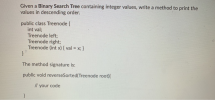
Given a Binary Search Tree containing integer values, write a method to print the values in descending order. public class Treenode { int val; Treenode left; Treenode right; Treenode (int x) { val = x; } The method signature is: public void reverseSorted(Treenode root){ // your code
answer in java
Given a Binary Search Tree containing integer values, write a method to print the values in descending order. public class Treenode { int val; Treenode left; Treenode right; Treenode (int x) { val = x; } The method signature is: public void reverseSorted(Treenode root){ // your code
Coding Language: C++ Function Header: vector<vector<int>> printFromButtom(TreeNode* root) {} Definition for a binary tree node: struct...
 Coding Language: C++
Function Header: vector<vector<int>>
printFromButtom(TreeNode* root) {}
Definition for a binary tree node:
struct TreeNode {
int val;
TreeNode *left;
TreeNode *right;
};
The Problem Complete the printFromButtom function that accepts a BST TreeNode and returns the nodes' value from left to right, level by level from leaf to root. This function will return vector<vector int which similar to a 2-D array. Function std: reverse (myvector.begin myVector en might be helpful. Definition for a binary tree node: struct...
Coding Language: C++
Function Header: vector<vector<int>>
printFromButtom(TreeNode* root) {}
Definition for a binary tree node:
struct TreeNode {
int val;
TreeNode *left;
TreeNode *right;
};
The Problem Complete the printFromButtom function that accepts a BST TreeNode and returns the nodes' value from left to right, level by level from leaf to root. This function will return vector<vector int which similar to a 2-D array. Function std: reverse (myvector.begin myVector en might be helpful. Definition for a binary tree node: struct...
Consider the class specifications for the Binary Tree class and BinarySearch Tree class below: // Binary...
 Consider the class specifications for the Binary Tree class and BinarySearch Tree class below: // Binary Tree.h #include <iostream> using namespace std; //Definition of the Node template <class elemType struct TreeNode { elemType data; TreeNode<elemType> *left; TreeNode<elemType *right; }; //Definition of class Binary Tree template <class elemType> class Binary Tree { protected: TreeNode<elemType> *root; public: BinaryTree(); BinaryTreel const BinaryTree<elemType>& otherTree); -Binary Tree(): bool is Empty() const; virtual bool search(const elemTypes searchItem) const = 0; virtual void insert(const elemTypek insertItem) =...
Consider the class specifications for the Binary Tree class and Binary Search Tree class in the...
 Consider the class specifications for the Binary Tree class and Binary Search Tree class in the attached files // BinaryTree.h #include <iostream> using namespace std; //Definition of the Node template <class elemType> struct TreeNode { elemType data; TreeNode<elemType> *left; TreeNode<elemType> *right; }; //Definition of class Binary Tree template <class elemType> class BinaryTree { protected: TreeNode<elemType> *root; public: BinaryTree(); BinaryTreel const BinaryTree<elemType>& otherTree); BinaryTree(); bool is Empty() const; virtual boot search(const elemType& searchItem) const = 0; virtual void insert(const elemType& insertItem)...
By definition, the height of a node in a binary tree is the number of edges...
 By definition, the height of a node in a binary tree is the number of edges along the longest path from the node to any leaf. Assume the following node structure struct TreeNode int data; node Type right; // points to right child node Type "Left; // points to left child ) Write a recursive function that takes a pointer to a node in a binary tree and returns its height. Note: the height of a leaf node is 0...
2. A regular binary tree is a binary tree whose internal nodes all have two subtrees...
 2. A regular binary tree is a binary tree whose internal nodes all have two subtrees (left and right). In other words, all their nodes have either zero subtrees (in which case they are leaves) or two subtrees (in which case they are internal nodes). Suppose that you have a boolean function that tells you, for each node of the tree, whether it is a leaf or not (call it: leaf(n), for node n). a) Write a recursive function that...
A balanced binary tree is a binary tree structure in which the left and right subtrees of every node differ
 Data structures C++1- A balanced binary tree is a binary tree structure in which the left and right subtrees of every node differ in height by no more than 1 Out of the following choices, which is the minimum set of nodes, if removed, will make the BST balanced?2- Which of the following is true for Red-Black Trees ? Select all choices that apply! Select one or more: a. For each node in the tree, all paths from that node to any leaf nodes contain...
Java class TreeNode is defined as below: public class TreeNode { public int val; public TreeNode...
Java class TreeNode is defined as below: public class TreeNode { public int val; public TreeNode left, right; public TreeNode(int x) { val = x; } public TreeNode(int x, TreeNode lChild, TreeNode rChild) { val = x; left = lChild; right = rChild; } } Suppose you only have the reference of the root, please write a method that returns a deep copy of the binary tree. Your method returns the root of the deep copy. Your algorithm should...
 The code is in JAVA
public class CheckBST {
//method to implement
public static boolean isValidBST(TreeNode root) {
}
public static void main(String[] args) {
TreeNode a = new TreeNode(1);
TreeNode b = new TreeNode(2);
TreeNode c = new TreeNode(3);
a.left = b;
a.right = c;
System.out.println(isValidBST(a));
TreeNode d = new TreeNode(2);
TreeNode e = new TreeNode(1);
TreeNode f = new TreeNode(3);
d.left = e;
d.right = f;
System.out.println(isValidBST(d));
}
}
TreeNode.java
class TreeNode {
int val;
TreeNode left;
TreeNode...
The code is in JAVA
public class CheckBST {
//method to implement
public static boolean isValidBST(TreeNode root) {
}
public static void main(String[] args) {
TreeNode a = new TreeNode(1);
TreeNode b = new TreeNode(2);
TreeNode c = new TreeNode(3);
a.left = b;
a.right = c;
System.out.println(isValidBST(a));
TreeNode d = new TreeNode(2);
TreeNode e = new TreeNode(1);
TreeNode f = new TreeNode(3);
d.left = e;
d.right = f;
System.out.println(isValidBST(d));
}
}
TreeNode.java
class TreeNode {
int val;
TreeNode left;
TreeNode...
 answer in java
Given a Binary Search Tree containing integer values, write a method to print the values in descending order. public class Treenode { int val; Treenode left; Treenode right; Treenode (int x) { val = x; } The method signature is: public void reverseSorted(Treenode root){ // your code
answer in java
Given a Binary Search Tree containing integer values, write a method to print the values in descending order. public class Treenode { int val; Treenode left; Treenode right; Treenode (int x) { val = x; } The method signature is: public void reverseSorted(Treenode root){ // your code
 Coding Language: C++
Function Header: vector<vector<int>>
printFromButtom(TreeNode* root) {}
Definition for a binary tree node:
struct TreeNode {
int val;
TreeNode *left;
TreeNode *right;
};
The Problem Complete the printFromButtom function that accepts a BST TreeNode and returns the nodes' value from left to right, level by level from leaf to root. This function will return vector<vector int which similar to a 2-D array. Function std: reverse (myvector.begin myVector en might be helpful. Definition for a binary tree node: struct...
Coding Language: C++
Function Header: vector<vector<int>>
printFromButtom(TreeNode* root) {}
Definition for a binary tree node:
struct TreeNode {
int val;
TreeNode *left;
TreeNode *right;
};
The Problem Complete the printFromButtom function that accepts a BST TreeNode and returns the nodes' value from left to right, level by level from leaf to root. This function will return vector<vector int which similar to a 2-D array. Function std: reverse (myvector.begin myVector en might be helpful. Definition for a binary tree node: struct...
 Consider the class specifications for the Binary Tree class and BinarySearch Tree class below: // Binary Tree.h #include <iostream> using namespace std; //Definition of the Node template <class elemType struct TreeNode { elemType data; TreeNode<elemType> *left; TreeNode<elemType *right; }; //Definition of class Binary Tree template <class elemType> class Binary Tree { protected: TreeNode<elemType> *root; public: BinaryTree(); BinaryTreel const BinaryTree<elemType>& otherTree); -Binary Tree(): bool is Empty() const; virtual bool search(const elemTypes searchItem) const = 0; virtual void insert(const elemTypek insertItem) =...
 Consider the class specifications for the Binary Tree class and Binary Search Tree class in the attached files // BinaryTree.h #include <iostream> using namespace std; //Definition of the Node template <class elemType> struct TreeNode { elemType data; TreeNode<elemType> *left; TreeNode<elemType> *right; }; //Definition of class Binary Tree template <class elemType> class BinaryTree { protected: TreeNode<elemType> *root; public: BinaryTree(); BinaryTreel const BinaryTree<elemType>& otherTree); BinaryTree(); bool is Empty() const; virtual boot search(const elemType& searchItem) const = 0; virtual void insert(const elemType& insertItem)...
 By definition, the height of a node in a binary tree is the number of edges along the longest path from the node to any leaf. Assume the following node structure struct TreeNode int data; node Type right; // points to right child node Type "Left; // points to left child ) Write a recursive function that takes a pointer to a node in a binary tree and returns its height. Note: the height of a leaf node is 0...
 2. A regular binary tree is a binary tree whose internal nodes all have two subtrees (left and right). In other words, all their nodes have either zero subtrees (in which case they are leaves) or two subtrees (in which case they are internal nodes). Suppose that you have a boolean function that tells you, for each node of the tree, whether it is a leaf or not (call it: leaf(n), for node n). a) Write a recursive function that...
Most questions answered within 3 hours.
-
Where is the error in this code sequence?
String s1 = "Hello";
String s2 = "ello";...
asked 11 months ago -
Financial data for Joel de Paris, Inc., for last year
follow:
Joel de Paris, Inc.
Balance...
asked 11 months ago -
Consider this reaction:
Al2(SO4)3 (aq)+ BaCl3
(aq) Al2Cl6 (aq)- +
3BaSO4(s) . What is the...
asked 11 months ago -
Suppose that Savneet is considering increasing her
recent random sample from 20 car rentals to 40...
asked 11 months ago -
Trucks arrive at an unloading terminal at an average rate of 120
per hour.
Trucks arrive...
asked 11 months ago -
Why are methanol and ethanol completely soluble in water while
octanol is not very little soluble....
asked 11 months ago -
A facilities manager at a university reads in a research report
that the mean amount of...
asked 11 months ago -
When the CuSO4 is rehydrated by adding water to the anhydrous
compound, is this an endothermic...
asked 11 months ago -
A ray of sunlight is passing from diamond into crown glass; the
angle of incidence is...
asked 11 months ago -
A block of mass 0.249 kg is placed on top of a light, vertical
spring of...
asked 11 months ago -
how do the kidneys compensate in the presences of acidosis
a) trigger hyperventilate
b) reserve acid...
asked 11 months ago -
Question 501 pts
The rental rate of capital to the firm increases. Which of the
following...
asked 11 months ago