how do to compute voltage current and resistance of UJT, dc motor and strain gauge
Homework Answers
Unijunction Transistor:- Although a unijunction transistor is not a thyristor, this device can trigger large thyristors with a pulse at base B1. A unijunction transistor is composed of a bar of N-type Silicon having a P-type connection in middle. The connection at the end of the bar are known as base B1 and B2, the P-type mid point is the emitter. With the emitter disconnected, the total resistance RBBO, a datasheet item, is the sum of RB1 and RB2
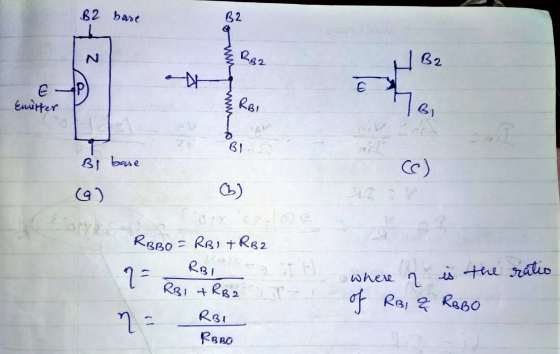
the above figure a,b,c are showing the symbolic representation of the unijunction transistor.
UJT is another solid state three terminal device that can be used in gate pulse, timing circuits and trigger generator applications to switch and control either thyristors and triac’s for AC power control type applications.
Like diodes, unijunction transistors are constructed from separate P-type and N-type semiconductor materials forming a single (hence its name Uni-Junction) PN-junction within the main conducting N-type channel of the device.
Although the Unijunction Transistor has the name of a transistor, its switching characteristics are very different from those of a conventional bipolar or field effect transistor as it can not be used to amplify a signal but instead is used as a ON-OFF switching transistor. UJT’s have unidirectional conductivity and negative impedance characteristics acting more like a variable voltage divider during breakdown.
The Unijunction emitter current vs voltage characteristic curve shows that as VE increases, current IE increases up IP at the peak point. Beyond the peak point, current increases as voltage decreases in the negative resistance region. The voltage reaches a minimum at the valley point. The resistance of RB1, the saturation resistance is lowest at the valley point.
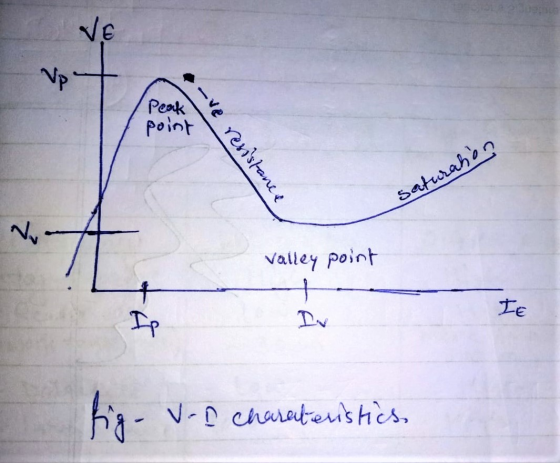
the above figure of V-I characteristics shown is the graph between the voltage and current in which the graph is gradually increasing and got a peak value then is starts decreasing towards the valley point and then gradually going towards the saturation point.
In the DC motor to compute the voltage and current we use Ohms law as usual we use for all
to find the voltage (V) , V = I X R
to find the current (I), I = V/R
to find the resistance (R), R = V/I..
.
Add Answer to:
how
do to compute voltage current and resistance of UJT, dc motor and
strain gauge
A 120 ? strain gauge with a gauge factor of 2 is mounted on a beam...
 A 120 Ω strain gauge with a gauge factor of 2 is mounted on a beam and connected in a Wheatstone bridge as shown in Figure Q1a. The bridge is powered by a 12 V DC supply in series with a 510 Ω resistance. The beam is subject to a tensile force, which produces an axial strain of 940 microstrain measured by the strain gauge .a) Under no strain, calculate the current in the strain gauge and the power dissipated by the...
3. A resistance strain gauge with R-120 ohm and a gauge factor of 2 is placed...
 3. A resistance strain gauge with R-120 ohm and a gauge factor of 2 is placed in an equal-arm Wheatstone bridge in which all the resistances are equal to 120 ohm. If the maximum gauge current is to be 0.05A, what is the maximum allowable bridge excitation voltage?
Consider a DC motor with 0.1 mH of inductance. 1 A DC current is flowing in...
Consider a DC motor with 0.1 mH of inductance. 1 A DC current is flowing in the motor, what is the voltage drop across this inductance (neglecting resistance for this question)? Subsequently, this 1 A current is switched off and drops linearly from 1 A to 0 within 1μs. How much voltage is created by shutting off this current? Explain how the electronics is protected from this current.
A strain gauge has a normal resistance of 360Ω and a gauge factor of 2.01. It...
 A strain gauge has a normal resistance of 360Ω and a gauge factor of 2.01. It is used in a quarter bridge with the other fixed resistors being 360s2 and with a supply voltage of 3.0V. The bridge is initially balanced and then the gauge is heated to 300°C without any stress applied. What will be the bridge's linearised output Volin mV) if at 300°C, the apparent strain is 75strain and the S variation is +1.025%? (Answer must match to...
2) One arm of a Wheatstone bridge is a 50 k2 strain gauge (S = 2.0)....
 2) One arm of a Wheatstone bridge is a 50 k2 strain gauge (S = 2.0). This strain gauge is bonded to a metal fixture for tensile loading, and the metal has a Young's Modulus E-2.5 MPa. The other 3 arms are fixed 50 kO resistors. The bridge is powered by 5Vv DC as shown, and Eo is the output voltage. a) Derive a relationship for Eo as a function of tensile stress o in the metal substrate, ΔL ....
A strain gauge that has a nominal resistance of 350 ? and a gauge factor of...
 A strain gauge that has a nominal resistance of 350 ? and a gauge factor of 1.8 is mounted in an equal-arm bridge, which is balanced at a zero applied strain condition. The gauge is mounted on a 11.8 1-cm aluminum rod, with E 70 GPa. The gauge senses axial strain. The bridge output is 1 mV for a bridge input of 5 V. What is the applied load, assuming the rod is in uniaxial tension?
The strain gauge forms one arm while three fixed value resistors (R1, R2 and R3) mounted on the other arms. The bridge is in balance when the strain gauge resistance is of its nominal value. The strain gauge has a nominal length of 5.2 cm and gauge factor
 (a)State two possible errors of the measurement.precision resistance tolerance(b)Determine the nominal resistance of the strain gauge.(c)Determine the change in resistance (DR) when the force is applied to the gauge.(d)Determine the output voltage Vo and state whether the potential at node A is higher or lower than node B.(e)Determine the resultant length of the strain gauge.(f)Suggest one method to improve the accuracy and one method to improve the sensitivity of the bridge.
Calculate the corrected gauge factor K0 for the three wire connected strain gauge above, Gauge resistance...
 Calculate the corrected gauge factor K0 for the three wire
connected strain gauge above,
Gauge resistance =120Ω
Wire resistance Rwire1=Rwire2=Rwire3=2Ω
Gauge factor 2.1
Three-wire, quarter bridge strain gauge circuit R R Rule! R. R. w R2
Calculate the corrected gauge factor K0 for the three wire
connected strain gauge above,
Gauge resistance =120Ω
Wire resistance Rwire1=Rwire2=Rwire3=2Ω
Gauge factor 2.1
Three-wire, quarter bridge strain gauge circuit R R Rule! R. R. w R2
Po G Q26. A strain gauge (with original resistance of 1000 ohm, gauge factor of 2.0)...
 Po G Q26. A strain gauge (with original resistance of 1000 ohm, gauge factor of 2.0) is firmly glued to a structure. When the structure is strained its resistance is measured as 1000.2 ohm. What is the strain in the structure to which the gauge is glued? (1 micro-strain -10%
A strain gauge that has a nominal resistance of 3500 and a gauge factor of 1.8...
 A strain gauge that has a nominal resistance of 3500 and a gauge factor of 1.8 is mounted in an equal-arm bridge, which is balanced at a zero applied strain condition. The gauge is mounted on a 1cm2 aluminum rod, with Em 70GPa. The gauge senses axial strain. The bridge output is 1mV for a bridge input of 5V. What is the applied load, assuming the rod is in uniaxial tension? Select the correct answer. Select one: 241.9N 2619N 2319N...
 A 120 Ω strain gauge with a gauge factor of 2 is mounted on a beam and connected in a Wheatstone bridge as shown in Figure Q1a. The bridge is powered by a 12 V DC supply in series with a 510 Ω resistance. The beam is subject to a tensile force, which produces an axial strain of 940 microstrain measured by the strain gauge .a) Under no strain, calculate the current in the strain gauge and the power dissipated by the...
 3. A resistance strain gauge with R-120 ohm and a gauge factor of 2 is placed in an equal-arm Wheatstone bridge in which all the resistances are equal to 120 ohm. If the maximum gauge current is to be 0.05A, what is the maximum allowable bridge excitation voltage?
 A strain gauge has a normal resistance of 360Ω and a gauge factor of 2.01. It is used in a quarter bridge with the other fixed resistors being 360s2 and with a supply voltage of 3.0V. The bridge is initially balanced and then the gauge is heated to 300°C without any stress applied. What will be the bridge's linearised output Volin mV) if at 300°C, the apparent strain is 75strain and the S variation is +1.025%? (Answer must match to...
 2) One arm of a Wheatstone bridge is a 50 k2 strain gauge (S = 2.0). This strain gauge is bonded to a metal fixture for tensile loading, and the metal has a Young's Modulus E-2.5 MPa. The other 3 arms are fixed 50 kO resistors. The bridge is powered by 5Vv DC as shown, and Eo is the output voltage. a) Derive a relationship for Eo as a function of tensile stress o in the metal substrate, ΔL ....
 A strain gauge that has a nominal resistance of 350 ? and a gauge factor of 1.8 is mounted in an equal-arm bridge, which is balanced at a zero applied strain condition. The gauge is mounted on a 11.8 1-cm aluminum rod, with E 70 GPa. The gauge senses axial strain. The bridge output is 1 mV for a bridge input of 5 V. What is the applied load, assuming the rod is in uniaxial tension?
 Calculate the corrected gauge factor K0 for the three wire
connected strain gauge above,
Gauge resistance =120Ω
Wire resistance Rwire1=Rwire2=Rwire3=2Ω
Gauge factor 2.1
Three-wire, quarter bridge strain gauge circuit R R Rule! R. R. w R2
Calculate the corrected gauge factor K0 for the three wire
connected strain gauge above,
Gauge resistance =120Ω
Wire resistance Rwire1=Rwire2=Rwire3=2Ω
Gauge factor 2.1
Three-wire, quarter bridge strain gauge circuit R R Rule! R. R. w R2
 Po G Q26. A strain gauge (with original resistance of 1000 ohm, gauge factor of 2.0) is firmly glued to a structure. When the structure is strained its resistance is measured as 1000.2 ohm. What is the strain in the structure to which the gauge is glued? (1 micro-strain -10%
 A strain gauge that has a nominal resistance of 3500 and a gauge factor of 1.8 is mounted in an equal-arm bridge, which is balanced at a zero applied strain condition. The gauge is mounted on a 1cm2 aluminum rod, with Em 70GPa. The gauge senses axial strain. The bridge output is 1mV for a bridge input of 5V. What is the applied load, assuming the rod is in uniaxial tension? Select the correct answer. Select one: 241.9N 2619N 2319N...
Most questions answered within 3 hours.
-
Where is the error in this code sequence?
String s1 = "Hello";
String s2 = "ello";...
asked 10 months ago -
Financial data for Joel de Paris, Inc., for last year
follow:
Joel de Paris, Inc.
Balance...
asked 10 months ago -
Consider this reaction:
Al2(SO4)3 (aq)+ BaCl3
(aq) Al2Cl6 (aq)- +
3BaSO4(s) . What is the...
asked 10 months ago -
Suppose that Savneet is considering increasing her
recent random sample from 20 car rentals to 40...
asked 10 months ago -
Trucks arrive at an unloading terminal at an average rate of 120
per hour.
Trucks arrive...
asked 10 months ago -
Why are methanol and ethanol completely soluble in water while
octanol is not very little soluble....
asked 10 months ago -
A facilities manager at a university reads in a research report
that the mean amount of...
asked 10 months ago -
When the CuSO4 is rehydrated by adding water to the anhydrous
compound, is this an endothermic...
asked 10 months ago -
A ray of sunlight is passing from diamond into crown glass; the
angle of incidence is...
asked 10 months ago -
A block of mass 0.249 kg is placed on top of a light, vertical
spring of...
asked 10 months ago -
how do the kidneys compensate in the presences of acidosis
a) trigger hyperventilate
b) reserve acid...
asked 10 months ago -
Question 501 pts
The rental rate of capital to the firm increases. Which of the
following...
asked 10 months ago