A 1.00 g piece of Mn metal (54.94 g/mol) was placed in 200. mL of a...
A 1.00 g piece of Mn metal (54.94 g/mol) was placed in 200. mL of a nitric acid solution with an initial pH of 0.602. After all of the Mn metal has reacted (producing hydrogen gas and Mn2+ and NO3- ions), what should be the final pH of the solution? (Assume constant volume.) 1.17 0.80 1.87 0.74
Homework Answers
Sol . As Reaction :
Mn + 2HNO3 ---> Mn2+ + 2NO3- + H2
Now , initial pH = 0.602
So , initial concentration of HNO3 = [HNO3] =[H+] = antilog(-initial pH) = antilog(-0.602) = 0.250 M
As volume of solution = 200 mL = 0.2 L
So ,initial moles of HNO3 = Conc. × volume = 0.250 × 0.2 = 0.05 moles
Now , mass of Mn = 1.00 g
molar mass of Mn = 54.94 g/mol
So, moles of Mn = mass/molar mass = 1.00/54.94 = 0.0182 moles
Now , from the reaction , 1 mole of Mn combines with 2 moles of HNO3 .
So, 0.0182 moles of Mn combines with = 2 × 0.0182 = 0.0364 moles of HNO3 .
Therefore , moles of HNO3 reacted = 0.0364 moles
and , moles of HNO3 unreacted = initial moles of HNO3 - moles of HNO3 reacted = 0.05 - 0.0364 = 0.0136 moles
Now , volume of solution = 0.2 L
So, final conc. of HNO3 = [H+] = moles/volume
= 0.0136 / 0.2 = 0.068 M
Therefore , final pH = -log[H+] = - log(0.068) = 1.17
So, Answer is 1.17
Add Answer to:
A 1.00 g piece of Mn metal (54.94 g/mol) was placed in 200. mL
of a...
A sample of aluminum metal is placed in a graduated cylinder. It is noted that 5.50...
 A sample of aluminum metal is placed in a graduated cylinder. It is noted that 5.50 mL of water is displaced by the aluminum. The aluminum is then reacted with excess nitric acid to produce aluminum nitrate and hydrogen gas. Given the density for aluminum is 2.702 g/mL, how many grams of aluminum nitrate are produced in the reaction? 2Al(s) + 6HNO3(aq) + 2Al(NO3)3(aq) + 3H2(g)
16. When 1.10 g of zinc metal is treated with 300.0 mL of 0.800 M nitric...
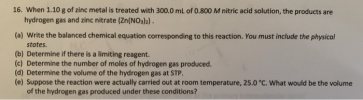 16. When 1.10 g of zinc metal is treated with 300.0 mL of 0.800 M nitric acid solution, the products are hydrogen gas and zinc nitrate (Zn(NO3)2). (a) Write the balanced chemical equation corresponding to this reaction. You must include the physical states. (b) Determine if there is a limiting reagent. (c) Determine the number of moles of hydrogen gas produced. (d) Determine the volume of the hydrogen gas at STP. (e) Suppose the reaction were actually carried out at...
1.53 g of aluminum metal is placed in a Erlenmeyer flask with 1.5 M sulfuric acid....
1.53 g of aluminum metal is placed in a Erlenmeyer flask with 1.5 M sulfuric acid. The hydrogen gas produced from the reaction is collected over water as seen in the diagram below. The aluminum is allowed to react with the sulfuric acid until it stops reacting. There is still some unreacted aluminum left in the reaction flask. The gas in the collection flask is brought to the same atmospheric pressure as the surroundings, 765.25 torr and a temperature of...
1. A weak monoprotic acid has molar mass 180 g/mol. When 1.00 g of this acid is...
1. A weak monoprotic acid has molar mass 180 g/mol. When 1.00 g of this acid is dissolved in enough water to obtain a 300 mL solution, the pH of the resulting solution is found to be 2.62. What is the value of Ka for this acid? 2. A weak monoprotic acid has pKa = 3.08. Calculate the percent ionization of a 0.35 M solution of this acid. 3. Calculate the pH of a solution that is 0.050 M in CH3COOH...
Part A Manganese reacts with hydrochloric acid to produce manganese(II) chloride and hydrogen gas. Mn(s) +...
 Part A Manganese reacts with hydrochloric acid to produce manganese(II) chloride and hydrogen gas. Mn(s) + 2 HCl(aq) + MnCl, (aq) + H (9) When 0.620 g Mn is combined with enough hydrochloric acid to make 100.0 mL of solution in a coffee-cup calorimeter, all of the Mn reacts, raising the temperature of the solution from 23.5°C to 28.6 °C. Find AHxn for the reaction as written. (Assume that the specific heat capacity of the solution is 4.18 J/g °C...
Pre lab Q8 A piece of metal weighing 1.00 g at a temperature of 46.9 oC...
Pre lab Q8 A piece of metal weighing 1.00 g at a temperature of 46.9 oC was placed in a calorimeter in 20.20 mL of water at 16.7 oC . The final equilibrium temperature was found to be 28.8 oC . What is the specific heat of the metal? (----------) J/K-g
In lab, you reacted copper metal with aqueous nitric acid to produce aqueous Copper (11) nitrate,...
 In lab, you reacted copper metal with aqueous nitric acid to produce aqueous Copper (11) nitrate, nitrogen dioxide gas and water. Cu (s) + 4HNO3 (aq) ---- > Cu(NO3)2 (aq) + 2NO2 (g) + 2H20 (1) a) If 0.210 gram of copper is reacted with 35.0 mL of 0.551 mol/L nitric acid, how many molecules and how grams of copper (II) nitrate are produced? b) How many moles of the reagent that is in excess are left over? c) If...
In lab, you reacted copper metal with aqueous nitric acid to produce aqueous copper (II) nitrate,...
In lab, you reacted copper metal with aqueous nitric acid to produce aqueous copper (II) nitrate, nitrogen dioxide gas and water. Cu (s) + 4HNO3 (aq) ---- > Cu(NO3)2 (aq) + 2NO2 (g) + 2H2O (l) a) If 0.210 gram of copper is reacted with 35.0 mL of 0.551 mol/L nitric acid, how many molecules and how grams of copper (II) nitrate are produced? b) How many moles of the reagent that is in excess are left over? c) If...
In lab, you reacted copper metal with aqueous nitric acid to produce aqueous copper (II) nitrate,...
In lab, you reacted copper metal with aqueous nitric acid to produce aqueous copper (II) nitrate, nitrogen dioxide gas and water. Cu (s) + 4HNO3 (aq) ---- > Cu(NO3)2 (aq) + 2NO2 (g) + 2H2O (l) a) If 0.210 gram of copper is reacted with 35.0 mL of 0.551 mol/L nitric acid, how many molecules and how grams of copper (II) nitrate are produced? b) How many moles of the reagent that is in excess are left over? c) If...
A sample of iron metal is placed in a graduated cylinder. It is noted that 10.4...
 A sample of iron metal is placed in a graduated cylinder. It is noted that 10.4 mL of water is displaced by the iron. The iron is then reacted with excess hydrochloric acid to produce iron (II) chloride and hydrogen gas. Given the density for iron is 7.86 g/mL, how many grams of iron (II) chloride are produced in the reaction? Fe(s) + 2HCl(aq) - FeCl2(aq) + H2(g)
 A sample of aluminum metal is placed in a graduated cylinder. It is noted that 5.50 mL of water is displaced by the aluminum. The aluminum is then reacted with excess nitric acid to produce aluminum nitrate and hydrogen gas. Given the density for aluminum is 2.702 g/mL, how many grams of aluminum nitrate are produced in the reaction? 2Al(s) + 6HNO3(aq) + 2Al(NO3)3(aq) + 3H2(g)
 16. When 1.10 g of zinc metal is treated with 300.0 mL of 0.800 M nitric acid solution, the products are hydrogen gas and zinc nitrate (Zn(NO3)2). (a) Write the balanced chemical equation corresponding to this reaction. You must include the physical states. (b) Determine if there is a limiting reagent. (c) Determine the number of moles of hydrogen gas produced. (d) Determine the volume of the hydrogen gas at STP. (e) Suppose the reaction were actually carried out at...
 Part A Manganese reacts with hydrochloric acid to produce manganese(II) chloride and hydrogen gas. Mn(s) + 2 HCl(aq) + MnCl, (aq) + H (9) When 0.620 g Mn is combined with enough hydrochloric acid to make 100.0 mL of solution in a coffee-cup calorimeter, all of the Mn reacts, raising the temperature of the solution from 23.5°C to 28.6 °C. Find AHxn for the reaction as written. (Assume that the specific heat capacity of the solution is 4.18 J/g °C...
 In lab, you reacted copper metal with aqueous nitric acid to produce aqueous Copper (11) nitrate, nitrogen dioxide gas and water. Cu (s) + 4HNO3 (aq) ---- > Cu(NO3)2 (aq) + 2NO2 (g) + 2H20 (1) a) If 0.210 gram of copper is reacted with 35.0 mL of 0.551 mol/L nitric acid, how many molecules and how grams of copper (II) nitrate are produced? b) How many moles of the reagent that is in excess are left over? c) If...
 A sample of iron metal is placed in a graduated cylinder. It is noted that 10.4 mL of water is displaced by the iron. The iron is then reacted with excess hydrochloric acid to produce iron (II) chloride and hydrogen gas. Given the density for iron is 7.86 g/mL, how many grams of iron (II) chloride are produced in the reaction? Fe(s) + 2HCl(aq) - FeCl2(aq) + H2(g)
Most questions answered within 3 hours.
-
Where is the error in this code sequence?
String s1 = "Hello";
String s2 = "ello";...
asked 11 months ago -
Financial data for Joel de Paris, Inc., for last year
follow:
Joel de Paris, Inc.
Balance...
asked 11 months ago -
Consider this reaction:
Al2(SO4)3 (aq)+ BaCl3
(aq) Al2Cl6 (aq)- +
3BaSO4(s) . What is the...
asked 11 months ago -
Suppose that Savneet is considering increasing her
recent random sample from 20 car rentals to 40...
asked 11 months ago -
Trucks arrive at an unloading terminal at an average rate of 120
per hour.
Trucks arrive...
asked 11 months ago -
Why are methanol and ethanol completely soluble in water while
octanol is not very little soluble....
asked 11 months ago -
A facilities manager at a university reads in a research report
that the mean amount of...
asked 11 months ago -
When the CuSO4 is rehydrated by adding water to the anhydrous
compound, is this an endothermic...
asked 11 months ago -
A ray of sunlight is passing from diamond into crown glass; the
angle of incidence is...
asked 11 months ago -
A block of mass 0.249 kg is placed on top of a light, vertical
spring of...
asked 11 months ago -
how do the kidneys compensate in the presences of acidosis
a) trigger hyperventilate
b) reserve acid...
asked 11 months ago -
Question 501 pts
The rental rate of capital to the firm increases. Which of the
following...
asked 11 months ago