Identify the Lewis base in the following reaction: PH3(g) + H+(g) ---> PH4+(g) Select one: a....
Identify the Lewis base in the following reaction:
PH3(g) + H+(g) ---> PH4+(g)
Select one:
a. None of these is a base
b. PH4+
c. All of these are bases.
d. H+
e. PH3
Homework Answers

Add Answer to:
Identify the Lewis base in the following reaction:
PH3(g) + H+(g) --->
PH4+(g)
Select one:
a....
which of the combination of substances below constitute a Lewis acid-base reaction? a) PH3+ H+ b)...
which of the combination of substances below constitute a Lewis acid-base reaction? a) PH3+ H+ b) Ag+ + NH3 c) BF3 + NH3 d) CH3CH2OCH2CH3 +AlCl3 I'm stuck between a and b, but I am very confused because both seem to be lewis acids and bases to me
Select all that apply. Identify the Lewis acid and Lewis base in the reaction. Co3+(aq) +...
 Select all that apply. Identify the Lewis acid and Lewis base in the reaction. Co3+(aq) + 6NH3(aq) = Co(NH3)63+ (aq) Co3+ is the Lewis acid Co3+ is the Lewis base O NHz is the Lewis acid NH, is the Lewis base
Identify the Lewis acid and Lewis base from among the reactants in each of the following...
 Identify the Lewis acid and Lewis base from among the reactants in each of the following equations. a. Fe^3+(aq) + 6H_2O(l) Fe(H_20)^3+_6 (aq) b. Zn^2+(aq) + 4(NH_3) (aq) Zn(NH_3)^2+_4 (aq) c. (CH_3)_3N(g) + BF_3 (g) (CH_3)_3NBF_3(aq) Fill in the blank for the following. d. Non-metal oxides are _____ acids. e. Metal oxides are _____ bases. f. Non-metal hydroxides are _____ acids. g. Metal hydroxides are _____ bases.
B. Build models for species PH3 and PH4 How do the H-P-H bond angles compare in...
B. Build models for species PH3 and PH4 How do the H-P-H bond angles compare in both species? If different, explain why? C. Build the models for species PH3 and H2S. How do the bond angles compare in both species? If different, explain why. How do your electronic and molecular geometries compare?
Using the Lewis concept of acids and bases, identify the Lewis acid and base in each...
Using the Lewis concept of acids and bases, identify the Lewis acid and base in each of the following reactions: Ni(NO3)3(s)+6H2O(l)→Ni(H2O)63+(aq)+3NO3−(aq) Can someone explain to me why Ni(NO3)3 is a lewis acid if it's accepting h2o and why h2o is a lewis base if it's giving itself instead of receiving an e-? CH3NH2(g)+HBr(g)→CH3NH3Br(s) Can someone also explain to me why HBR is a lewis base it's donating a H+? And why CH3NH2 is a lewis acid for accepting a H+?...
Identify the Lewis acid and Lewis base in each reaction. 1) BF3 + NH3 ⇌ F3BNH3...
Identify the Lewis acid and Lewis base in each reaction. 1) BF3 + NH3 ⇌ F3BNH3 2) Fe3+(aq) + 6 H2O(l) ⇌ Fe(H2O)63+(aq) * In Reaction (1), BF3 is the [ Select ] ["Lewis base", "Lewis acid"] and NH3 is the [ Select ] ["Lewis acid", "Lewis base"] . * In Reaction (2), Fe3+(aq) is the [ Select ] ["Lewis acid", "Lewis base"] and H2O(l) is the [ Select ] ["Lewis acid", "Lewis base"] .
Identify the Lewis Acid and Lewis Base in each reaction shown here. F F H-F +...
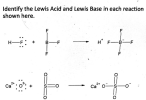 Identify the Lewis Acid and Lewis Base in each reaction shown here. F F H-F + B-F HF-B-F F 2+ Ca Calt 05.
(d) Conjugate acid: OH"; conjugate base: H3* (e) None of these 5. Identify the conjugate acid/base...
 (d) Conjugate acid: OH"; conjugate base: H3* (e) None of these 5. Identify the conjugate acid/base pairs in the following equation (10) HASO4 + H2O <H2AsO4 + OH (A). HASO. (acid)HAsO4 (base): H2O (acid)/ OH (base) (B). HASO4 (acid)/HASO. (base): H2O (acid)/ OH (base) (C). H2AsO4 (acid)/ OH (base) ; H2O (acid)/HASO4 (base) (D). H AsO4 and H20 (acids): OH and HASO4(bases) (E). None of these 6. Which is an INCORRECT statement?(10) a) The conjugate base of H2O is OH....
Question Completion Status: QUESTION 10 Select the Lewis acid and Lewis base in this reaction. Cu2+(aq)...
 Question Completion Status: QUESTION 10 Select the Lewis acid and Lewis base in this reaction. Cu2+(aq) + 6 NH3(aq) - Cu(NH3162 (aq) Cu2+ is the Lewis acid, and NH3 is the Lewis base, NH3 is a base, but there is no acid NH3 is the Lewis acid, and Cu?" is the Lewis base None of the above QUESTION 11 The following combination of species will result in buffer solution a. HCO3 and cog-2 True False QUESTION 12 The complex lon...
Answer the question below: 1: i) Identify the Lewis acids and bases in each of the...
Answer the question below: 1: i) Identify the Lewis acids and bases in each of the following reactions: a. NH3 + BF3 → F3B NH3 b. H2O + SO3 → H2SO4 c. NH4+ + OH- → NH3 + H2O d. CO2 + H2O → H2CO3 e. OH−+H+→H2O ii) Identify the following compounds as either a Lewis acid or Lewis base and as either Soft or Hard: a. Cr3+ b. SO3 c. SCN− d. I
 Select all that apply. Identify the Lewis acid and Lewis base in the reaction. Co3+(aq) + 6NH3(aq) = Co(NH3)63+ (aq) Co3+ is the Lewis acid Co3+ is the Lewis base O NHz is the Lewis acid NH, is the Lewis base
 Identify the Lewis acid and Lewis base from among the reactants in each of the following equations. a. Fe^3+(aq) + 6H_2O(l) Fe(H_20)^3+_6 (aq) b. Zn^2+(aq) + 4(NH_3) (aq) Zn(NH_3)^2+_4 (aq) c. (CH_3)_3N(g) + BF_3 (g) (CH_3)_3NBF_3(aq) Fill in the blank for the following. d. Non-metal oxides are _____ acids. e. Metal oxides are _____ bases. f. Non-metal hydroxides are _____ acids. g. Metal hydroxides are _____ bases.
 Identify the Lewis Acid and Lewis Base in each reaction shown here. F F H-F + B-F HF-B-F F 2+ Ca Calt 05.
 (d) Conjugate acid: OH"; conjugate base: H3* (e) None of these 5. Identify the conjugate acid/base pairs in the following equation (10) HASO4 + H2O <H2AsO4 + OH (A). HASO. (acid)HAsO4 (base): H2O (acid)/ OH (base) (B). HASO4 (acid)/HASO. (base): H2O (acid)/ OH (base) (C). H2AsO4 (acid)/ OH (base) ; H2O (acid)/HASO4 (base) (D). H AsO4 and H20 (acids): OH and HASO4(bases) (E). None of these 6. Which is an INCORRECT statement?(10) a) The conjugate base of H2O is OH....
 Question Completion Status: QUESTION 10 Select the Lewis acid and Lewis base in this reaction. Cu2+(aq) + 6 NH3(aq) - Cu(NH3162 (aq) Cu2+ is the Lewis acid, and NH3 is the Lewis base, NH3 is a base, but there is no acid NH3 is the Lewis acid, and Cu?" is the Lewis base None of the above QUESTION 11 The following combination of species will result in buffer solution a. HCO3 and cog-2 True False QUESTION 12 The complex lon...
Most questions answered within 3 hours.
-
Where is the error in this code sequence?
String s1 = "Hello";
String s2 = "ello";...
asked 10 months ago -
Financial data for Joel de Paris, Inc., for last year
follow:
Joel de Paris, Inc.
Balance...
asked 10 months ago -
Consider this reaction:
Al2(SO4)3 (aq)+ BaCl3
(aq) Al2Cl6 (aq)- +
3BaSO4(s) . What is the...
asked 10 months ago -
Suppose that Savneet is considering increasing her
recent random sample from 20 car rentals to 40...
asked 10 months ago -
Trucks arrive at an unloading terminal at an average rate of 120
per hour.
Trucks arrive...
asked 10 months ago -
Why are methanol and ethanol completely soluble in water while
octanol is not very little soluble....
asked 10 months ago -
A facilities manager at a university reads in a research report
that the mean amount of...
asked 10 months ago -
When the CuSO4 is rehydrated by adding water to the anhydrous
compound, is this an endothermic...
asked 10 months ago -
A ray of sunlight is passing from diamond into crown glass; the
angle of incidence is...
asked 10 months ago -
A block of mass 0.249 kg is placed on top of a light, vertical
spring of...
asked 10 months ago -
how do the kidneys compensate in the presences of acidosis
a) trigger hyperventilate
b) reserve acid...
asked 10 months ago -
Question 501 pts
The rental rate of capital to the firm increases. Which of the
following...
asked 10 months ago