A coin is placed 21.0 cm from the axis of a rotating turntable of variable speed....
Homework Answers
The only force which holds the coin on its position on the rotating table is the force of friction.
Now, when the coin is not sliding, it is following a circular track and the centripetal force is provided by the frictional force.
The centripetal force is given by

And the frictional force is given by

Equating the forces we get


Now, the critical position comes when the angular velocity reaches 45 rpm, the coin starts to move along the radius.
So, putting these values in the equation

So, the coefficient of static friction is 0.476.
Add Answer to:
A
coin is placed 21.0 cm from the axis of a rotating turntable of
variable speed....
A coin is placed 14 cm from the axis of a rotating turntable of variable speed....
A coin is placed 14 cm from the axis of a rotating turntable of variable speed. When the speed of the turntable is slowly increased, the coin remains fixed on the turntable until a rate of 30 rpm is reached, at which point the coin slides off. What is the coefficient of static friction between the coin and the turntable?
A coin is placed 15.0 cm from the axis of a rotating turntable of variable speed....
A coin is placed 15.0 cm from the axis of a rotating turntable of variable speed. When the speed of the turntable is slowly increased, the coin remains fixed on the turntable until a rate of 36.0 rpm (revolutions per minute) is reached, at which point the coin slides off. What is the coefficient of static friction between the coin and the turntable?
A coin is placed 12.0 cm from the axis of a rotating turntable of variable speed....
 A coin is placed 12.0 cm from the axis of a rotating turntable of variable speed. When the speed of the turntable is slowly increased, the coin remains fixed on the turntable until a rate of 36.0 rpm (revolutions per minute) is reached, at which point the coin slides off. Part A What is the coefficient of static friction between the coin and the turntable?
A coin is placed 14.0 cm from the axis of a rotating turntable of variable speed....
A coin is placed 14.0 cm from the axis of a rotating turntable of variable speed. When the speed of the turntable is slowly increased, the coin remains fixed on the turntable until a rate of 31.0 rpm (revolutions per minute) is reached, at which point the coin slides off. What is the coefficient of static friction between the coin and the turntable? Express answer using three different figures....
9. A coin is placed 10 cm from the axis of a rotating turnitable of variable...
 9. A coin is placed 10 cm from the axis of a rotating turnitable of variable speed. When the speed of the turntable is slowly increased, the coin remains fixed on the turntable until a rate of 32 rpm is reached, at which point the coin slides off. What is the coefficient of static friction between the coin and the turntable?
A coin placed 29.0 cm from the center of a rotating, horizontal turntable slips when its...
A coin placed 29.0 cm from the center of a rotating, horizontal turntable slips when its speed is 50.2 cm/s. (a) What force causes the centripetal acceleration when the coin is stationary relative to the turntable? static frictioninertia kinetic frictioncentrifugal force (b) What is the coefficient of static friction between coin and turntable?
A coin is placed 34 cm from the center of a horizontal turntable, initially at rest....
A coin is placed 34 cm from the center of a horizontal turntable, initially at rest. The turntable then begins to rotate. When the speed of the coin is 120 cm/s (rotating at a constant rate), the coin just begins to slip. The acceleration of gravity is 980 cm/s^2. What is the coefficient of static friction between the coin and the turntable?
A 5.0 g coin is placed 20 cm from the center of a turntable. The coin...
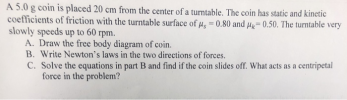 A 5.0 g coin is placed 20 cm from the center of a turntable. The coin has static and kinetic coefficients of friction with the turntable surface of us = 0.80 and Mr=0.50. The turntable very slowly speeds up to 60 rpm. A. Draw the free body diagram of coin. B. Write Newton's laws in the two directions of forces. C. Solve the equations in part B and find if the coin slides off. What acts as a centripetal force...
010 10.0 points A coin is placed 25 cm from the center of a horizontal turntable,...
 010 10.0 points A coin is placed 25 cm from the center of a horizontal turntable, initially at rest. The turntable then begins to rotate. When the speed of the coin is 110 cm/s (rotating at a constant rate), the coin just begins to slip The acceleration of gravity is 980 cm/s What is the coefficient of static friction be-
What is the coefficient of the static friction between the coin and the turntable? 010 10.0...
 What is the coefficient of the static friction between the
coin and the turntable?
010 10.0 points A coin is placed 27 cm from the center of a horizontal turntable, initially at rest. The turntable then begins to rotate. When the speed of the coin is 130 cm/s (rotating at a constant rate), the coin just begins to slip. The acceleration of gravity is 980 cm/s What is the coefficient of static friction be
What is the coefficient of the static friction between the
coin and the turntable?
010 10.0 points A coin is placed 27 cm from the center of a horizontal turntable, initially at rest. The turntable then begins to rotate. When the speed of the coin is 130 cm/s (rotating at a constant rate), the coin just begins to slip. The acceleration of gravity is 980 cm/s What is the coefficient of static friction be
 A coin is placed 12.0 cm from the axis of a rotating turntable of variable speed. When the speed of the turntable is slowly increased, the coin remains fixed on the turntable until a rate of 36.0 rpm (revolutions per minute) is reached, at which point the coin slides off. Part A What is the coefficient of static friction between the coin and the turntable?
 9. A coin is placed 10 cm from the axis of a rotating turnitable of variable speed. When the speed of the turntable is slowly increased, the coin remains fixed on the turntable until a rate of 32 rpm is reached, at which point the coin slides off. What is the coefficient of static friction between the coin and the turntable?
 A 5.0 g coin is placed 20 cm from the center of a turntable. The coin has static and kinetic coefficients of friction with the turntable surface of us = 0.80 and Mr=0.50. The turntable very slowly speeds up to 60 rpm. A. Draw the free body diagram of coin. B. Write Newton's laws in the two directions of forces. C. Solve the equations in part B and find if the coin slides off. What acts as a centripetal force...
 010 10.0 points A coin is placed 25 cm from the center of a horizontal turntable, initially at rest. The turntable then begins to rotate. When the speed of the coin is 110 cm/s (rotating at a constant rate), the coin just begins to slip The acceleration of gravity is 980 cm/s What is the coefficient of static friction be-
 What is the coefficient of the static friction between the
coin and the turntable?
010 10.0 points A coin is placed 27 cm from the center of a horizontal turntable, initially at rest. The turntable then begins to rotate. When the speed of the coin is 130 cm/s (rotating at a constant rate), the coin just begins to slip. The acceleration of gravity is 980 cm/s What is the coefficient of static friction be
What is the coefficient of the static friction between the
coin and the turntable?
010 10.0 points A coin is placed 27 cm from the center of a horizontal turntable, initially at rest. The turntable then begins to rotate. When the speed of the coin is 130 cm/s (rotating at a constant rate), the coin just begins to slip. The acceleration of gravity is 980 cm/s What is the coefficient of static friction be
Most questions answered within 3 hours.
-
Where is the error in this code sequence?
String s1 = "Hello";
String s2 = "ello";...
asked 11 months ago -
Financial data for Joel de Paris, Inc., for last year
follow:
Joel de Paris, Inc.
Balance...
asked 11 months ago -
Consider this reaction:
Al2(SO4)3 (aq)+ BaCl3
(aq) Al2Cl6 (aq)- +
3BaSO4(s) . What is the...
asked 11 months ago -
Suppose that Savneet is considering increasing her
recent random sample from 20 car rentals to 40...
asked 11 months ago -
Trucks arrive at an unloading terminal at an average rate of 120
per hour.
Trucks arrive...
asked 11 months ago -
Why are methanol and ethanol completely soluble in water while
octanol is not very little soluble....
asked 11 months ago -
A facilities manager at a university reads in a research report
that the mean amount of...
asked 11 months ago -
When the CuSO4 is rehydrated by adding water to the anhydrous
compound, is this an endothermic...
asked 11 months ago -
A ray of sunlight is passing from diamond into crown glass; the
angle of incidence is...
asked 11 months ago -
A block of mass 0.249 kg is placed on top of a light, vertical
spring of...
asked 11 months ago -
how do the kidneys compensate in the presences of acidosis
a) trigger hyperventilate
b) reserve acid...
asked 11 months ago -
Question 501 pts
The rental rate of capital to the firm increases. Which of the
following...
asked 11 months ago