Find a prenex normal form for the following wff. ∃x p(x) ∧ ∃x q(x) → ∃x...
Find a prenex normal form for the following wff. ∃x p(x) ∧ ∃x q(x) → ∃x (p(x) ∨ q(x))
Homework Answers
Alogorithm for prenex normal form:-

Answer for Question:-

Note: Could you please consider my efoort on this work and give up vote. Thank you :)
Add Answer to:
Find a prenex normal form for the following wff. ∃x p(x) ∧ ∃x
q(x) → ∃x...
For each wff, find an interpretation in which it is true and one in which it is false. Please an...
 For each wff, find an interpretation in which it is true and one
in which it is false.
Please answer both a and c
8. For each wff, find an interpretation in which it is true and one in which it is false. a. ( x)[A(x)Л (Vy)B(x,y)] b. [(Vx)A(x) -> (Vx)B(x)]-(Vx)[A(a) >B(x) c. (3x)[P(x) V Q(x)] /\ (Vx)[P(x)- Q(x)]
8. For each wff, find an interpretation in which it is true and one in which it is false. a. (...
For each wff, find an interpretation in which it is true and one
in which it is false.
Please answer both a and c
8. For each wff, find an interpretation in which it is true and one in which it is false. a. ( x)[A(x)Л (Vy)B(x,y)] b. [(Vx)A(x) -> (Vx)B(x)]-(Vx)[A(a) >B(x) c. (3x)[P(x) V Q(x)] /\ (Vx)[P(x)- Q(x)]
8. For each wff, find an interpretation in which it is true and one in which it is false. a. (...
Determine these are WFF(well formed formula) or not (rAG(p → (q=r)))) c. (rAG(p → (q=r)))) c.
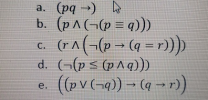 Determine these are WFF(well formed formula) or
not
(rAG(p → (q=r)))) c.
(rAG(p → (q=r)))) c.
Determine these are WFF(well formed formula) or
not
(rAG(p → (q=r)))) c.
(rAG(p → (q=r)))) c.
please expand the following expression into a two elememt universe. please note: Expanding a WFF is...
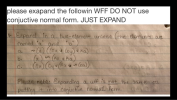 please expand the following expression into a two elememt universe.
please note: Expanding a WFF is NOT the same as putting it
into conjuctive normal form
please exapand the followin WFF DO NOT use conjuctive normal form. JUST EXPAND 1. Expand in a two-element universe (the Orements are named a² and 6²) a. ~G) ((Ex V Gy) v ka) b. (x) ~ (kx uka) c. (Ex) (Cy v (FX ou Ga)) Please note: Expanding a wff is not the same...
please expand the following expression into a two elememt universe.
please note: Expanding a WFF is NOT the same as putting it
into conjuctive normal form
please exapand the followin WFF DO NOT use conjuctive normal form. JUST EXPAND 1. Expand in a two-element universe (the Orements are named a² and 6²) a. ~G) ((Ex V Gy) v ka) b. (x) ~ (kx uka) c. (Ex) (Cy v (FX ou Ga)) Please note: Expanding a wff is not the same...
Convert the following sentences to Conjunctive Normal Form (CNF). 3.1. ¬((¬P ↔ R) → ((Q ∧...
Convert the following sentences to Conjunctive Normal Form (CNF). 3.1. ¬((¬P ↔ R) → ((Q ∧ R) ∨ P)) 3.2. ¬((P ∨ Q) → ((P ∨ Q ∨ ¬R) ∧ (R ∨ P ∨ Q)))
Use technique of quantifier expansions, find a quantifier free wff that is equivalent to∃y∀x Lxy in...
Use technique of quantifier expansions, find a quantifier free wff that is equivalent to∃y∀x Lxy in the two - element domain {a,b} .
Express the statement (p → q) Λ (q Λ r) in disjunctive normal form.
Express the statement (p → q) Λ (q Λ r) in disjunctive normal form. (¬р Λ q Λ r) (¬р Λ q Λ r) V (р Λ ¬q Λ r) V (р Λ q Λ r) (р Λ q Λ r) V (¬р Λ q Λ r) (¬р Λ q Λ r) V (р Λ ¬q Λ r)
1. Use a truth table in canonical form below to show that ¬p∧q and ¬p∧¬q are...
1. Use a truth table in canonical form below to show that ¬p∧q and ¬p∧¬q are not equivalent. Feel free to make necessary adjustments to the table. p q p∧q ¬p ¬q ¬p∧q ¬p∧¬q 2. Tell whether the following two expressions are equivalent by constructing their truth tables in canonical form. You may make necessary adjustments to the table provided below. Is p∨q∧rlogically equivalent to p∨q∧p∨r? p q r q∧r p∨q p∨r 3. Prove or Disprove (make sure to show...
Use long division to find the quotient Q(x) and the remainder R(x) when P(x) is divided...
 Use long division to find the quotient Q(x) and the remainder R(x) when P(x) is divided by d(x) and express P(x) in the form d(x) • Q(x) + R(x). P(x) = x3 + 5x? - 17x+172 d(x) = x + 9 P(x) = (x+9)( +
Use the cross product to help find the normal form of the equation of a plane....
 Use the cross product to help find the normal form of the
equation of a plane.
4. Use the cross product to help find the normal form of the equation of the plane. a. The plane passing through P= (1,0, –2), parallel to [0] u= 1 and v= -1 [ 2] b. The plane passing through P= (0,-1,1), Q = (2,0, 2), and R= (1, 2, -1)
Use the cross product to help find the normal form of the
equation of a plane.
4. Use the cross product to help find the normal form of the equation of the plane. a. The plane passing through P= (1,0, –2), parallel to [0] u= 1 and v= -1 [ 2] b. The plane passing through P= (0,-1,1), Q = (2,0, 2), and R= (1, 2, -1)
1(a) Find the square roots of the complex number z -3 + j4, expressing your answer in the form a + jb. Hence find the roots for the quadratic equation: x2-x(1- 0 giving your answer in the form p+ q w...
 1(a) Find the square roots of the complex number z -3 + j4, expressing your answer in the form a + jb. Hence find the roots for the quadratic equation: x2-x(1- 0 giving your answer in the form p+ q where p is a real number and q is a complex number. I7 marks] (b) Express: 3 + in the form ω-reje (r> 0, 0 which o is real and positive. θ < 2π). Hence find the smallest value of...
 For each wff, find an interpretation in which it is true and one
in which it is false.
Please answer both a and c
8. For each wff, find an interpretation in which it is true and one in which it is false. a. ( x)[A(x)Л (Vy)B(x,y)] b. [(Vx)A(x) -> (Vx)B(x)]-(Vx)[A(a) >B(x) c. (3x)[P(x) V Q(x)] /\ (Vx)[P(x)- Q(x)]
8. For each wff, find an interpretation in which it is true and one in which it is false. a. (...
For each wff, find an interpretation in which it is true and one
in which it is false.
Please answer both a and c
8. For each wff, find an interpretation in which it is true and one in which it is false. a. ( x)[A(x)Л (Vy)B(x,y)] b. [(Vx)A(x) -> (Vx)B(x)]-(Vx)[A(a) >B(x) c. (3x)[P(x) V Q(x)] /\ (Vx)[P(x)- Q(x)]
8. For each wff, find an interpretation in which it is true and one in which it is false. a. (...
 Determine these are WFF(well formed formula) or
not
(rAG(p → (q=r)))) c.
(rAG(p → (q=r)))) c.
Determine these are WFF(well formed formula) or
not
(rAG(p → (q=r)))) c.
(rAG(p → (q=r)))) c.
 please expand the following expression into a two elememt universe.
please note: Expanding a WFF is NOT the same as putting it
into conjuctive normal form
please exapand the followin WFF DO NOT use conjuctive normal form. JUST EXPAND 1. Expand in a two-element universe (the Orements are named a² and 6²) a. ~G) ((Ex V Gy) v ka) b. (x) ~ (kx uka) c. (Ex) (Cy v (FX ou Ga)) Please note: Expanding a wff is not the same...
please expand the following expression into a two elememt universe.
please note: Expanding a WFF is NOT the same as putting it
into conjuctive normal form
please exapand the followin WFF DO NOT use conjuctive normal form. JUST EXPAND 1. Expand in a two-element universe (the Orements are named a² and 6²) a. ~G) ((Ex V Gy) v ka) b. (x) ~ (kx uka) c. (Ex) (Cy v (FX ou Ga)) Please note: Expanding a wff is not the same...
 Use long division to find the quotient Q(x) and the remainder R(x) when P(x) is divided by d(x) and express P(x) in the form d(x) • Q(x) + R(x). P(x) = x3 + 5x? - 17x+172 d(x) = x + 9 P(x) = (x+9)( +
 Use the cross product to help find the normal form of the
equation of a plane.
4. Use the cross product to help find the normal form of the equation of the plane. a. The plane passing through P= (1,0, –2), parallel to [0] u= 1 and v= -1 [ 2] b. The plane passing through P= (0,-1,1), Q = (2,0, 2), and R= (1, 2, -1)
Use the cross product to help find the normal form of the
equation of a plane.
4. Use the cross product to help find the normal form of the equation of the plane. a. The plane passing through P= (1,0, –2), parallel to [0] u= 1 and v= -1 [ 2] b. The plane passing through P= (0,-1,1), Q = (2,0, 2), and R= (1, 2, -1)
 1(a) Find the square roots of the complex number z -3 + j4, expressing your answer in the form a + jb. Hence find the roots for the quadratic equation: x2-x(1- 0 giving your answer in the form p+ q where p is a real number and q is a complex number. I7 marks] (b) Express: 3 + in the form ω-reje (r> 0, 0 which o is real and positive. θ < 2π). Hence find the smallest value of...
Most questions answered within 3 hours.
-
Where is the error in this code sequence?
String s1 = "Hello";
String s2 = "ello";...
asked 11 months ago -
Financial data for Joel de Paris, Inc., for last year
follow:
Joel de Paris, Inc.
Balance...
asked 11 months ago -
Consider this reaction:
Al2(SO4)3 (aq)+ BaCl3
(aq) Al2Cl6 (aq)- +
3BaSO4(s) . What is the...
asked 11 months ago -
Suppose that Savneet is considering increasing her
recent random sample from 20 car rentals to 40...
asked 11 months ago -
Trucks arrive at an unloading terminal at an average rate of 120
per hour.
Trucks arrive...
asked 11 months ago -
Why are methanol and ethanol completely soluble in water while
octanol is not very little soluble....
asked 11 months ago -
A facilities manager at a university reads in a research report
that the mean amount of...
asked 11 months ago -
When the CuSO4 is rehydrated by adding water to the anhydrous
compound, is this an endothermic...
asked 11 months ago -
A ray of sunlight is passing from diamond into crown glass; the
angle of incidence is...
asked 11 months ago -
A block of mass 0.249 kg is placed on top of a light, vertical
spring of...
asked 11 months ago -
how do the kidneys compensate in the presences of acidosis
a) trigger hyperventilate
b) reserve acid...
asked 11 months ago -
Question 501 pts
The rental rate of capital to the firm increases. Which of the
following...
asked 11 months ago