Part II – Short Answer Questions: For each of the following questions, write your answer in...
Part II – Short Answer Questions: For each of the following questions, write your answer in the space provided on this page. Do not be too wordy; just answer the question given.
- Explain the methods and results of the 3 following experiments used to support the functional equivalency hypothesis of visual images: A) Mental Image Rotation Experiments; B) Image Scanning Experiments; C) Size and Shape Judgments. (4 Points Each Experiment)
Homework Answers
Mental image Rotation experiment - Mental rotation was tested by Shepard and Metzler. The participants were given with three-dimensional, assymetrical assemblages of cubes, on the left. On the right, a assemblage of similar pictures wrre given, which were slightly rotated from the original one or was a mirror image. The participants were to press button identifying which were identical except rotated image or mirror image. The experiments found out that, people were quick in identifying identical images which were slightly rotated, ad if they mentally rotated the original images.
Image scanning experiments- This experiment by Kosslyn (1973), had the participants read a picture e.g boat and form a mental image about it. They were then asked to look at a particular part of the object like anchor and then were questioned about the nearby part, example, questions on cabin. It was found that the subjects took longer time to answer on objects which were at distant from the viewed one, than if it were on nearby objects.
Size and shape judgements - Two-alternative, temporal forced-choice was done with feedback. Trial consisted of two 0.17 s observation followed by 0.5 s interval. Standard stimulus was shown in observation and test stimulus in the other. The main parameter of the test stimuli was varied by double staircase psychophysical method. Subjects were asked to make height judgements while correlated width differences. Negatively correlated changes, made the task easier, while positive changes made task harder, than when there was no change in width. It was found that, observers are not making their decisions on height alone.
Add Answer to:
Part II – Short Answer Questions: For each of the following
questions, write your answer in...
Part II. For each of the following questions, write the answer in the space provided. 1....
 Part II. For each of the following questions, write the answer in the space provided. 1. Draw a reasonable mechanism for each of the following reactions. (4x4 = 16 pts) MeOH HO LOH [H] OH - H20 NO2 HNO3 H2SO4 NO, ich Hoo You Hoh
II. SHORT ANSWER QUESTIONS. (10, 2 POINTS FOR EACH QUESTION) 1. What will the following loop...
 II. SHORT ANSWER QUESTIONS. (10, 2 POINTS FOR EACH QUESTION) 1. What will the following loop display? int x = 0; while (x <5) cout<<x << endl;
Answer # 1 & 4 Section II, Short Answer Write your final answer in the space...
 Answer # 1 & 4
Section II, Short Answer Write your final answer in the space provided to the right. 1. Using a calculator, you find the probability of an event to be 7.7843243E-4. Express the probability in 1 decimal form rounded to the first nonzero digit. 2. For a data set, Q 42 and a Q, 70, find the value of the upper fence. 2411.5 3. Samantha took 2 classes last semester. In her 4-unit class she earned an...
Answer # 1 & 4
Section II, Short Answer Write your final answer in the space provided to the right. 1. Using a calculator, you find the probability of an event to be 7.7843243E-4. Express the probability in 1 decimal form rounded to the first nonzero digit. 2. For a data set, Q 42 and a Q, 70, find the value of the upper fence. 2411.5 3. Samantha took 2 classes last semester. In her 4-unit class she earned an...
both a&b plz Part II. Short answer questions (80) Question 1. Provide an IUPAC name for...
 both a&b plz
Part II. Short answer questions (80) Question 1. Provide an IUPAC name for each of the following compounds. (15) NO2 ntt ben2ovaci a.
both a&b plz
Part II. Short answer questions (80) Question 1. Provide an IUPAC name for each of the following compounds. (15) NO2 ntt ben2ovaci a.
Part I1 short qaestioes) 27 points (Write your answers clearty) I. Answer the following questions based...
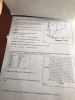 Part I1 short qaestioes) 27 points (Write your answers clearty) I. Answer the following questions based on the phase diagram of a pure substance given in Fig. 1. A, B and C are three physical states O 2pt) Which of the following statements is/are correct? Statement E: The density of solid is greater than the density of liquid. Statemeat IH: By applying pressure, solid can be transformed into liquid a)Ib) eandII mone of the above. Temperature (i) Cpt) Which of...
Part II: Short Essay Questions (25 points). Please choose and answer only and only 5 questions....
 Part II: Short Essay Questions (25 points). Please choose and answer only and only 5 questions. 1. Carbon dioxide is the largest greenhouse gas emitted to the atmosphere due to the use of fossil fuel energy for different human uses. What mass of carbon dioxide would be produced when 50 kg of butane (C4H is used for cooking and completely oxidized to carbon dioxide and water? (5 points) NB: molecular weight of butane (C4Hio) is 58 g. 2. The effect...
PART A 21 MARKS SHORT ANSWER QUESTIONS Answer ALL questions from this part. Write your answers...
 PART A 21 MARKS
SHORT ANSWER QUESTIONS Answer ALL questions from this part. Write
your answers in the Examination Answer Booklet. Each question is
worth 1.5 marks (14 x 1.5 = 21 marks).
Question 1
An organisation has been granted a block of addresses with the mask
/22. If the organisation creates 8 equal-sized subnets, how many
addresses (including the special addresses) are available in each
subnet? Show your calculations.
Question 2
Give an example of a valid classful address...
PART A 21 MARKS
SHORT ANSWER QUESTIONS Answer ALL questions from this part. Write
your answers in the Examination Answer Booklet. Each question is
worth 1.5 marks (14 x 1.5 = 21 marks).
Question 1
An organisation has been granted a block of addresses with the mask
/22. If the organisation creates 8 equal-sized subnets, how many
addresses (including the special addresses) are available in each
subnet? Show your calculations.
Question 2
Give an example of a valid classful address...
Part II: Short answer (5 pts. each) Give a short answer to the following questions (1-3 sentences and/or a brief sketch) Make a crude sketch of the world line of a particle initially at rest which th...
 Part II: Short answer (5 pts. each) Give a short answer to the following questions (1-3 sentences and/or a brief sketch) Make a crude sketch of the world line of a particle initially at rest which then accelerates in the-x direction for a short time, then travels at constant velocity. 1. What is the relation between decay constant and half-life? Prove this relation with a few lines of algebra. If needed, start with the formula mentioned in Essay #1, below....
Problem 1 part II and Problem 2 part I and II Problem 1: (Short Answer) 6 pts] The region R is bounded by y 0, 0,...
 Problem 1 part II and Problem 2 part I and II
Problem 1: (Short Answer) 6 pts] The region R is bounded by y 0, 0, 2, and y- 2 4 1, 3 pts] If R is revolved about the line x = 5. If an integral or sunn of integrals with respect to z is used to calculate the volume, explain whether the washer or shell method should be used II. 3 pts) Suppose that R is the base...
Problem 1 part II and Problem 2 part I and II
Problem 1: (Short Answer) 6 pts] The region R is bounded by y 0, 0, 2, and y- 2 4 1, 3 pts] If R is revolved about the line x = 5. If an integral or sunn of integrals with respect to z is used to calculate the volume, explain whether the washer or shell method should be used II. 3 pts) Suppose that R is the base...
Short Answer: The following 8 questions are worth 5 points each. Please provide your answers in...
 Short Answer: The following 8 questions are worth 5 points each. Please provide your answers in the form of few brief sentences, solved equations, or graphs / diagrams. (16) The snapshot graph shown below was taken at t = 0s. Determine: i. The frequency of the wave. y (cm) ii. The phase constant of the wave. 24 m/s -x (m) 8 12 16 20 -2 Computational questions: The following 4 questions are worth 7.5 points each. Please provide your answers...
 Part II. For each of the following questions, write the answer in the space provided. 1. Draw a reasonable mechanism for each of the following reactions. (4x4 = 16 pts) MeOH HO LOH [H] OH - H20 NO2 HNO3 H2SO4 NO, ich Hoo You Hoh
 II. SHORT ANSWER QUESTIONS. (10, 2 POINTS FOR EACH QUESTION) 1. What will the following loop display? int x = 0; while (x <5) cout<<x << endl;
 Answer # 1 & 4
Section II, Short Answer Write your final answer in the space provided to the right. 1. Using a calculator, you find the probability of an event to be 7.7843243E-4. Express the probability in 1 decimal form rounded to the first nonzero digit. 2. For a data set, Q 42 and a Q, 70, find the value of the upper fence. 2411.5 3. Samantha took 2 classes last semester. In her 4-unit class she earned an...
Answer # 1 & 4
Section II, Short Answer Write your final answer in the space provided to the right. 1. Using a calculator, you find the probability of an event to be 7.7843243E-4. Express the probability in 1 decimal form rounded to the first nonzero digit. 2. For a data set, Q 42 and a Q, 70, find the value of the upper fence. 2411.5 3. Samantha took 2 classes last semester. In her 4-unit class she earned an...
 both a&b plz
Part II. Short answer questions (80) Question 1. Provide an IUPAC name for each of the following compounds. (15) NO2 ntt ben2ovaci a.
both a&b plz
Part II. Short answer questions (80) Question 1. Provide an IUPAC name for each of the following compounds. (15) NO2 ntt ben2ovaci a.
 Part I1 short qaestioes) 27 points (Write your answers clearty) I. Answer the following questions based on the phase diagram of a pure substance given in Fig. 1. A, B and C are three physical states O 2pt) Which of the following statements is/are correct? Statement E: The density of solid is greater than the density of liquid. Statemeat IH: By applying pressure, solid can be transformed into liquid a)Ib) eandII mone of the above. Temperature (i) Cpt) Which of...
 Part II: Short Essay Questions (25 points). Please choose and answer only and only 5 questions. 1. Carbon dioxide is the largest greenhouse gas emitted to the atmosphere due to the use of fossil fuel energy for different human uses. What mass of carbon dioxide would be produced when 50 kg of butane (C4H is used for cooking and completely oxidized to carbon dioxide and water? (5 points) NB: molecular weight of butane (C4Hio) is 58 g. 2. The effect...
 PART A 21 MARKS
SHORT ANSWER QUESTIONS Answer ALL questions from this part. Write
your answers in the Examination Answer Booklet. Each question is
worth 1.5 marks (14 x 1.5 = 21 marks).
Question 1
An organisation has been granted a block of addresses with the mask
/22. If the organisation creates 8 equal-sized subnets, how many
addresses (including the special addresses) are available in each
subnet? Show your calculations.
Question 2
Give an example of a valid classful address...
PART A 21 MARKS
SHORT ANSWER QUESTIONS Answer ALL questions from this part. Write
your answers in the Examination Answer Booklet. Each question is
worth 1.5 marks (14 x 1.5 = 21 marks).
Question 1
An organisation has been granted a block of addresses with the mask
/22. If the organisation creates 8 equal-sized subnets, how many
addresses (including the special addresses) are available in each
subnet? Show your calculations.
Question 2
Give an example of a valid classful address...
 Part II: Short answer (5 pts. each) Give a short answer to the following questions (1-3 sentences and/or a brief sketch) Make a crude sketch of the world line of a particle initially at rest which then accelerates in the-x direction for a short time, then travels at constant velocity. 1. What is the relation between decay constant and half-life? Prove this relation with a few lines of algebra. If needed, start with the formula mentioned in Essay #1, below....
 Problem 1 part II and Problem 2 part I and II
Problem 1: (Short Answer) 6 pts] The region R is bounded by y 0, 0, 2, and y- 2 4 1, 3 pts] If R is revolved about the line x = 5. If an integral or sunn of integrals with respect to z is used to calculate the volume, explain whether the washer or shell method should be used II. 3 pts) Suppose that R is the base...
Problem 1 part II and Problem 2 part I and II
Problem 1: (Short Answer) 6 pts] The region R is bounded by y 0, 0, 2, and y- 2 4 1, 3 pts] If R is revolved about the line x = 5. If an integral or sunn of integrals with respect to z is used to calculate the volume, explain whether the washer or shell method should be used II. 3 pts) Suppose that R is the base...
 Short Answer: The following 8 questions are worth 5 points each. Please provide your answers in the form of few brief sentences, solved equations, or graphs / diagrams. (16) The snapshot graph shown below was taken at t = 0s. Determine: i. The frequency of the wave. y (cm) ii. The phase constant of the wave. 24 m/s -x (m) 8 12 16 20 -2 Computational questions: The following 4 questions are worth 7.5 points each. Please provide your answers...
Most questions answered within 3 hours.
-
Where is the error in this code sequence?
String s1 = "Hello";
String s2 = "ello";...
asked 11 months ago -
Financial data for Joel de Paris, Inc., for last year
follow:
Joel de Paris, Inc.
Balance...
asked 11 months ago -
Consider this reaction:
Al2(SO4)3 (aq)+ BaCl3
(aq) Al2Cl6 (aq)- +
3BaSO4(s) . What is the...
asked 11 months ago -
Suppose that Savneet is considering increasing her
recent random sample from 20 car rentals to 40...
asked 11 months ago -
Trucks arrive at an unloading terminal at an average rate of 120
per hour.
Trucks arrive...
asked 11 months ago -
Why are methanol and ethanol completely soluble in water while
octanol is not very little soluble....
asked 11 months ago -
A facilities manager at a university reads in a research report
that the mean amount of...
asked 11 months ago -
When the CuSO4 is rehydrated by adding water to the anhydrous
compound, is this an endothermic...
asked 11 months ago -
A ray of sunlight is passing from diamond into crown glass; the
angle of incidence is...
asked 11 months ago -
A block of mass 0.249 kg is placed on top of a light, vertical
spring of...
asked 11 months ago -
how do the kidneys compensate in the presences of acidosis
a) trigger hyperventilate
b) reserve acid...
asked 11 months ago -
Question 501 pts
The rental rate of capital to the firm increases. Which of the
following...
asked 11 months ago