Three protons, each of mass m and charge +e, are initially held at the corners of...
Three protons, each of mass m and charge +e, are initially held at the corners of an equilateral triangle that is d on a side. They are then released from rest. What is the kinetic energy of each proton when the protons are very far apart?
Homework Answers
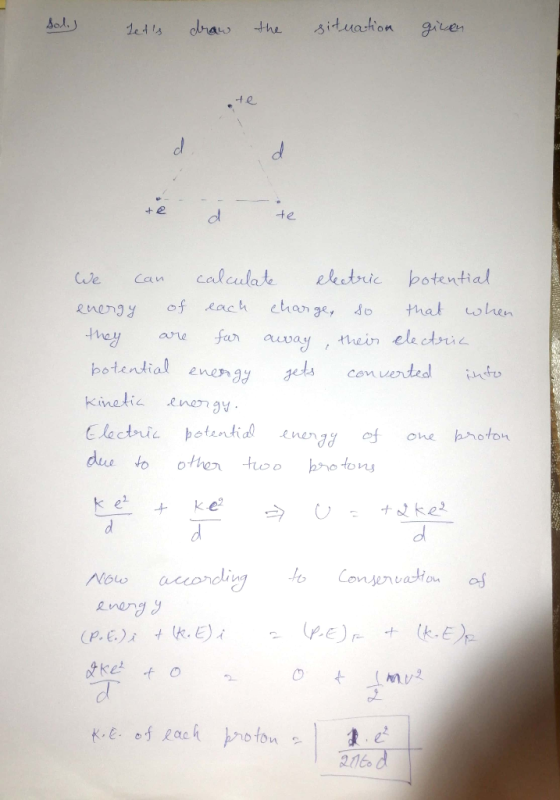
Hope it helps you...
Please give me a thumbs up...
And comment for further assistance...
Add Answer to:
Three protons, each of mass m and charge +e, are initially held
at the corners of...
Three identical particles of charge 1.5 mC and mass 250 g are held in place at...
Three identical particles of charge 1.5 mC and mass 250 g are held in place at the corners of an equilateral triangle of side 15 cm. They are then released simultaneously and fly apart. What are their velocities at the instant they are 60 cm from one another?
This is a challenging multi-step problem. Solve it on paper, writing out each step carefully. When...
This is a challenging multi-step problem. Solve it on paper, writing out each step carefully. When doing calculations, do not round intermediate values. Note: If you have approached the problem in a principled way, do not abandon your approach if your numerical answer is not accepted; check your calculations and make sure you have entered your answer correctly. Four protons (each with mass 1.7*10^-27 kg and charge 1.6*10^-19 C) are initially held at the corners of a square that is...
Three identical masses (m = 3.25 x 10^8 kg) are held at the corners of an...
Three identical masses (m = 3.25 x 10^8 kg) are held at the corners of an equilateral triangle, d = 0.3m on each side. What is the magnitude of force exerted on the top mass by two other masses?
15. Three point charges, which initially are infinitely far apart, are place at the corners of...
15. Three point charges, which initially are infinitely far apart, are place at the corners of an equilateral with sides d. Two of the point charges are identical and have a charge q. If zero net work is required to place the three charges on the corners of the triangle, what must the value of the third charge be?
points Three point charges all of the same charge (-9) and same mass m are placed...
 points Three point charges all of the same charge (-9) and same mass m are placed at triangle of side length d. a. Draw a figure showing this set up and label d b. If you release all 3 at the same time from rest, how fast will they be movine whan. (Note: Your final answer must ONLY be in terms of known/given quantities, that is, q.m.dand constants of nature not all of which may be necessary) Jaced at the...
Two identical spheres each having charge Q =-11 nC and mass mOF 10 milligrams are held...
 Two identical spheres each having charge Q =-11 nC and mass mOF 10 milligrams are held fixed at their positions 5.0 cm apart. A particle with charge q-+1.0 nC and mass mo-0.40 milligrams is released from rest at a position 5.0 cm from each sphere (so initially the particle and the spheres form an equilateral triangle). Find the speed of the positively charged particle when it passes a point exactly in between the two spheres. (k - 9.0 x 10⁹...
Three uniform spheres are located at the corners of an equilateral triangle. Each side of the...
Three uniform spheres are located at the corners of an equilateral triangle. Each side of the triangle has a length of 3.70 m. Two of the spheres have a mass of 4.00 kg each. The third sphere (mass unknown) is released from rest. Considering only the gravitational forces that the spheres exert on each other, what is the magnitude of the initial acceleration of the third sphere? m/s2
Three uniform spheres are located at the corners of an equilateral triangle. Each side of the...
Three uniform spheres are located at the corners of an equilateral triangle. Each side of the triangle has a length of 1.31 m. Two of the spheres have a mass of 2.77 kg each. The third sphere (mass unknown) is released from rest. Considering only the gravitational forces that the spheres exert on each other, what is the magnitude of the initial acceleration of the third sphere?
Three uniform spheres are located at the corners of an equilateral triangle. Each side of the...
Three uniform spheres are located at the corners of an equilateral triangle. Each side of the triangle has a length of 1.39 m. Two of the spheres have a mass of 2.73 kg each. The third sphere (mass unknown) is released from rest. Considering only the gravitational forces that the spheres exert on each other, what is the magnitude of the initial acceleration of the third sphere?
Three uniform spheres are located at the corners of an equilateral triangle. Each side of the...
Three uniform spheres are located at the corners of an equilateral triangle. Each side of the triangle has a length of 1.07 m. Two of the spheres have a mass of 3.00 kg each. The third sphere (mass unknown) is released from rest. Considering only the gravitational forces that the spheres exert on each other, what is the magnitude of the initial acceleration of the third sphere?
 points Three point charges all of the same charge (-9) and same mass m are placed at triangle of side length d. a. Draw a figure showing this set up and label d b. If you release all 3 at the same time from rest, how fast will they be movine whan. (Note: Your final answer must ONLY be in terms of known/given quantities, that is, q.m.dand constants of nature not all of which may be necessary) Jaced at the...
 Two identical spheres each having charge Q =-11 nC and mass mOF 10 milligrams are held fixed at their positions 5.0 cm apart. A particle with charge q-+1.0 nC and mass mo-0.40 milligrams is released from rest at a position 5.0 cm from each sphere (so initially the particle and the spheres form an equilateral triangle). Find the speed of the positively charged particle when it passes a point exactly in between the two spheres. (k - 9.0 x 10⁹...
Most questions answered within 3 hours.
-
Where is the error in this code sequence?
String s1 = "Hello";
String s2 = "ello";...
asked 10 months ago -
Financial data for Joel de Paris, Inc., for last year
follow:
Joel de Paris, Inc.
Balance...
asked 10 months ago -
Consider this reaction:
Al2(SO4)3 (aq)+ BaCl3
(aq) Al2Cl6 (aq)- +
3BaSO4(s) . What is the...
asked 10 months ago -
Suppose that Savneet is considering increasing her
recent random sample from 20 car rentals to 40...
asked 10 months ago -
Trucks arrive at an unloading terminal at an average rate of 120
per hour.
Trucks arrive...
asked 10 months ago -
Why are methanol and ethanol completely soluble in water while
octanol is not very little soluble....
asked 10 months ago -
A facilities manager at a university reads in a research report
that the mean amount of...
asked 10 months ago -
When the CuSO4 is rehydrated by adding water to the anhydrous
compound, is this an endothermic...
asked 10 months ago -
A ray of sunlight is passing from diamond into crown glass; the
angle of incidence is...
asked 10 months ago -
A block of mass 0.249 kg is placed on top of a light, vertical
spring of...
asked 10 months ago -
how do the kidneys compensate in the presences of acidosis
a) trigger hyperventilate
b) reserve acid...
asked 10 months ago -
Question 501 pts
The rental rate of capital to the firm increases. Which of the
following...
asked 10 months ago