A grasshopper makes four jumps. The displacement vectors are (1) 39.0 cm, due west; (2) 34.0...
A grasshopper makes four jumps. The displacement vectors are (1) 39.0 cm, due west; (2) 34.0 cm, 37.0 ° south of west; (3) 24.0 cm, 56.0 ° south of east; and (4) 19.0 cm, 73.0 ° north of east. Find (a) the magnitude and (b) direction of the resultant displacement. Express the direction as a positive angle with respect to due west.
Homework Answers
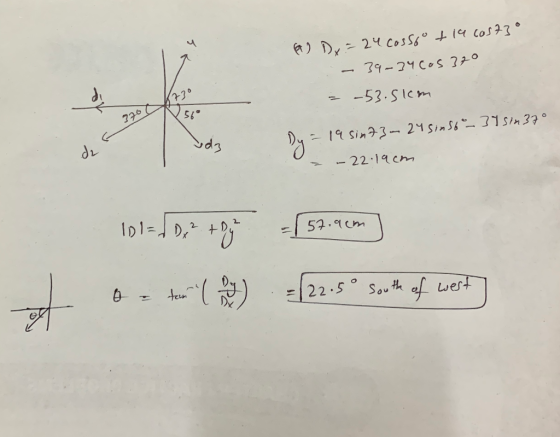
Kindly upvote:)
EDIT:
There is calculation mistake for Dx.
It will be: Dx = -47.18 cm
Thus (a) |D| = 52.1 cm
and, angle = 25.2 degrees south of west
Add Answer to:
A grasshopper makes four jumps. The displacement vectors are (1)
39.0 cm, due west; (2) 34.0...
A grasshopper makes four jumps. The displacement vectors are (1) 35.0 cm, due west; (2) 25.0...
A grasshopper makes four jumps. The displacement vectors are (1) 35.0 cm, due west; (2) 25.0 cm, 34.0 ° south of west; (3) 21.0 cm, 61.0 ° south of east; and (4) 18.0 cm, 55.0 ° north of east. Find (a) the magnitude and (b) direction of the resultant displacement. Express the direction as a positive angle with respect to due west.
A grasshopper makes four jumps. The displacement vectors are (1) 29.1 cm, due west; (2) 23.7...
A grasshopper makes four jumps. The displacement vectors are (1) 29.1 cm, due west; (2) 23.7 cm, 23.7 degrees south of west; (3) 28.4 cm, 28.4 degrees south of east; and (4) 34.8 cm, 64.4 degrees north of east. Calculate the magnitude of the resultant displacement. Take due east and due north as the positive directions.
A grasshopper makes four jumps. The displacement vectors are (1) 28.5 cm, due west; (2) 23.4...
 A grasshopper makes four jumps. The displacement vectors are (1) 28.5 cm, due west; (2) 23.4 cm, 23.6 degrees south of west; (3) 28.6 cm, 28.7 degrees south of east; and (4) 34.9 cm, 64.4 degrees north of east. Calculate the magnitude of the resultant displacement. Take due east and due north as the positive directions.
A grasshopper makes four jumps. The displacement vectors are (1) 28 cm, due west; (2) 23.7...
A grasshopper makes four jumps. The displacement vectors are (1) 28 cm, due west; (2) 23.7 cm, 23.8 degrees south of west; (3) 28.5 cm, 29.3 degrees south of east; and (4) 35 cm, 64.3 degrees north of east. Calculate the magnitude of the resultant displacement. Take due east and due north as the positive directions. PLEASE SHOW WORK. I keep coming up different values
Multiple Concept Example 9 deals with the concepts that are important in this problem. A grasshopper...
 Multiple Concept Example 9 deals with the concepts that are important in this problem. A grasshopper makes four jumps. The displacement vectors are (1) 37.0 cm, due west;(2) 30.0 cm, 25.0° south of west;(3) 19.0 cm, 70.0° south of east; and (4) 15.0 cm, 79.0 north of east. Find (a) the magnitude and (b) direction of the resultant displacement. Express the direction as a positive angle with respect to due west. Start N W E 15
A frog makes four jumps in a row. The displacement vectors for the four jumps are:...
A frog makes four jumps in a row. The displacement vectors for the four jumps are: (1) 25.5 cm, due west; (2) 23.0 cm, 65.0° south of west; (3) 24.5 cm, 63.0° south of east; and (4) 32.0 cm, 42.0° north of east. What is the magnitude, in centimeters, and what is the direction of the frog's displacement from its starting point? Express the direction as an angle measured counterclockwise from due east.
Displacement vector points due east and has a magnitude of 3.18 km. Displacement vector points due...
Displacement vector points due east and has a magnitude of 3.18 km. Displacement vector points due north and has a magnitude of 9.11 km. Displacement vector points due west and has a magnitude of 6.21 km. Displacement vector points due south and has a magnitude of 2.86 km. Find (a) the magnitude of the resultant vector + + + , and (b) its direction as a positive angle relative to due west.
Chapter 01, Problem 49 Displacement vector A points due east and has a magnitude of 2.18...
 Chapter 01, Problem 49 Displacement vector A points due east and has a magnitude of 2.18 km. Displacement vector B points due north and has a magnitude of 9.98 km. Displacement vector C points due west and has a magnitude of 9.80 km. Displacement vector D points due south and has a magnitude of 2.61 km. Find (a) the magnitude of the resultant vector A BC D, and (b) its direction as a positive angle relative to due west. (a)...
The route followed by a hiker consists of three displacement vectors , , and . Vector...
The route followed by a hiker consists of three displacement vectors , , and . Vector is along a measured trail and is 1710 m in a direction 40.0 ° north of east. Vector is not along a measured trail, but the hiker uses a compass and knows that the direction is 24.0 ° east of south. Similarly, the direction of vector is 43.0 ° north of west. The hiker ends up back where she started, so the resultant displacement...
Displacement vector A points due east and has a magnitude of 2.98 km. Displacement vector B...
 Displacement vector A points due east and has a magnitude of 2.98 km. Displacement vector B points due north and has a magnitude of 1.54 km. Displacement vector C boints due west and has a magnitude of 1 km. Displacement vector D points due south and has a magnitude of 1.4 km. Find the magnitude and direction (relative to due east) of the resultant vector A +B+C+D. magnitude direction km ocounterdlockwise from due east Additional Materials section 1 8
 A grasshopper makes four jumps. The displacement vectors are (1) 28.5 cm, due west; (2) 23.4 cm, 23.6 degrees south of west; (3) 28.6 cm, 28.7 degrees south of east; and (4) 34.9 cm, 64.4 degrees north of east. Calculate the magnitude of the resultant displacement. Take due east and due north as the positive directions.
 Multiple Concept Example 9 deals with the concepts that are important in this problem. A grasshopper makes four jumps. The displacement vectors are (1) 37.0 cm, due west;(2) 30.0 cm, 25.0° south of west;(3) 19.0 cm, 70.0° south of east; and (4) 15.0 cm, 79.0 north of east. Find (a) the magnitude and (b) direction of the resultant displacement. Express the direction as a positive angle with respect to due west. Start N W E 15
 Chapter 01, Problem 49 Displacement vector A points due east and has a magnitude of 2.18 km. Displacement vector B points due north and has a magnitude of 9.98 km. Displacement vector C points due west and has a magnitude of 9.80 km. Displacement vector D points due south and has a magnitude of 2.61 km. Find (a) the magnitude of the resultant vector A BC D, and (b) its direction as a positive angle relative to due west. (a)...
 Displacement vector A points due east and has a magnitude of 2.98 km. Displacement vector B points due north and has a magnitude of 1.54 km. Displacement vector C boints due west and has a magnitude of 1 km. Displacement vector D points due south and has a magnitude of 1.4 km. Find the magnitude and direction (relative to due east) of the resultant vector A +B+C+D. magnitude direction km ocounterdlockwise from due east Additional Materials section 1 8
Most questions answered within 3 hours.
-
Where is the error in this code sequence?
String s1 = "Hello";
String s2 = "ello";...
asked 10 months ago -
Financial data for Joel de Paris, Inc., for last year
follow:
Joel de Paris, Inc.
Balance...
asked 10 months ago -
Consider this reaction:
Al2(SO4)3 (aq)+ BaCl3
(aq) Al2Cl6 (aq)- +
3BaSO4(s) . What is the...
asked 10 months ago -
Suppose that Savneet is considering increasing her
recent random sample from 20 car rentals to 40...
asked 10 months ago -
Trucks arrive at an unloading terminal at an average rate of 120
per hour.
Trucks arrive...
asked 10 months ago -
Why are methanol and ethanol completely soluble in water while
octanol is not very little soluble....
asked 10 months ago -
A facilities manager at a university reads in a research report
that the mean amount of...
asked 10 months ago -
When the CuSO4 is rehydrated by adding water to the anhydrous
compound, is this an endothermic...
asked 10 months ago -
A ray of sunlight is passing from diamond into crown glass; the
angle of incidence is...
asked 10 months ago -
A block of mass 0.249 kg is placed on top of a light, vertical
spring of...
asked 10 months ago -
how do the kidneys compensate in the presences of acidosis
a) trigger hyperventilate
b) reserve acid...
asked 10 months ago -
Question 501 pts
The rental rate of capital to the firm increases. Which of the
following...
asked 10 months ago