I is a catalyst for the decomposition of H2O2 studied in this experiment. Explain how/why a...
I is a catalyst for the decomposition of H2O2 studied in this experiment. Explain how/why a catalyst increases the rate of a chemical reaction?
Homework Answers

Add Answer to:
I is a catalyst for the decomposition of H2O2 studied in this
experiment. Explain how/why a...
The reaction mechanism that has been proposed for the decomposition of H2O2 by iodide ion is:...
The reaction mechanism that has been proposed for the decomposition of H2O2 by iodide ion is: H2O2 + I- → H2O + IO- (slow) H2O2 + IO- → H2O + O2 + I- (fast) Which one of the following statements is true? Select one: a. The reaction is second order with respect to I-. b. I- is an intermediate. c. The reaction is first order with respect to I-. d. IO- is a catalyst. e. The reaction is zero order...
The decomposition of hydrogen peroxide (H2O2(aq)) is proposed to follow a reaction mechanism of Step 1:...
 The decomposition of hydrogen peroxide (H2O2(aq)) is proposed to follow a reaction mechanism of Step 1: H2O2(aq) + Br(aq)-H2O(l) + BrO (aq) Step 2: Bro (aq) + H2O2(aq),H2O(l) + O2(g) + Br(aq) What is the catalyst, and what is the effect of having a catalyst present? Periodic Table and Datasheet Br is the catalyst, and the reaction follows a faster pathway with Br than without BrO is the catalyst, and the reaction follows a faster pathway with Bro-than without Bro...
How does a positive catalyst generally affect a chemical reaction? A catalyst increases the temperature of...
How does a positive catalyst generally affect a chemical reaction? A catalyst increases the temperature of the reaction which speeds the reaction rate. A catalyst reduces the frequency factor which speeds the reaction rate. A catalyst reduces the amount of solvent required which slows the reaction rate. A catalyst reduces activation energy which speeds the reaction rate.
Question 8 Select the situation involving a heterogeneous catalyst. the decomposition of O3(g) in the presence...
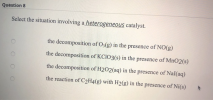 Question 8 Select the situation involving a heterogeneous catalyst. the decomposition of O3(g) in the presence of NO(g) the decomposition of KClO3(s) in the presence of MnO2(s) the decomposition of H2O2(aq) in the presence of Nal(aq) the reaction of C2H4(g) with H2(g) in the presence of Ni(s)
2) 20 points in the lab you studied the decomposition of peroxide in ACIDIC solution If...
 2) 20 points in the lab you studied the decomposition of peroxide in ACIDIC solution If the reaction is run under BASIC conditions a different result is obtained. 2 H2O2(aq) + 2 H2O(l) + O2(g) The rate of reaction can be determined by measuring the rate at which the volume of O2 increases at a pressure of latm. Use the data below to determine the rate law including! the value of the rate constant, “rate =k [H2021 [ITY". Show your...
The following chemical equation represents the decomposition of hydrogen peroxide, H2O2. 2H2O2 --> O2 + 2H2O...
The following chemical equation represents the decomposition of hydrogen peroxide, H2O2. 2H2O2 --> O2 + 2H2O If the reaction started with 8.67 g of pure H2O2 and produced 3.74 g of O2, what is the extent of reaction, E, and what percentage of the H2O2 reacted?
8. The rate law for the reaction H2O2 + 2H+212 + 2H2O is rate-k[H202][1]. The following...
 8. The rate law for the reaction H2O2 + 2H+212 + 2H2O is rate-k[H202][1]. The following mechanism has been suggested. H2O2+1 - HOI + OH - slow OH + H H20 fast HỘI + H+ + + I2 + H2O fast Identify all intermediates included in this mechanism. A) H and I D) Honly B) H and HOI E) H20 and OH C) HOI and OH 9. Which of the following statements is false? A) A catalyst increases the rate...
6. The decomposition of ozone in the upper atmosphere is catalyzed by NO. The overall reaction...
 6. The decomposition of ozone in the upper atmosphere is catalyzed by NO. The overall reaction and rate law are: O:(g) + O(g) →202(g): rate = k[O][NOJ Write a possible mechanism that is consistent with rate law and identify an intermediate in the reaction. 7. A possible mechanism for the iodide ion catalyzed decomposition of hydrogen peroxide in aqueous solution is: H2O2(aq) + I'(aq) → H2O(l) + Of(aq) ---...-slow H2O2(aq) + Or(aq) → H2O(0) + O2(g) + I'(aq) -----fast What...
The decomposition of hydrogen peroxide in dilute sodium hydroxide at 20 °C H2O2(aq)->H2O(1) + 12 02(g)...
 The decomposition of hydrogen peroxide in dilute sodium hydroxide at 20 °C H2O2(aq)->H2O(1) + 12 02(g) is first order in H2O2- During one experiment it was found that when the initial concentration of 1,0, was 3.16x10⁻² M, the concentration of H2O2 dropped to 8.09x10⁻³ M after 945 min had passed. Based on this experiment, the rate constant for the reaction is nin-1
A mechanism for the catalyzed decomposition of H2O2 is given below: step 1: H2O2(aq) + I−(aq)...
A mechanism for the catalyzed decomposition of H2O2 is given below: step 1: H2O2(aq) + I−(aq) ➝ H2O(ℓ) + IO−(aq) step 2: IO−(aq) + H2O2(aq) ➝ H2O(ℓ) + O2(g) + I−(aq) Which species is the intermediate?
 The decomposition of hydrogen peroxide (H2O2(aq)) is proposed to follow a reaction mechanism of Step 1: H2O2(aq) + Br(aq)-H2O(l) + BrO (aq) Step 2: Bro (aq) + H2O2(aq),H2O(l) + O2(g) + Br(aq) What is the catalyst, and what is the effect of having a catalyst present? Periodic Table and Datasheet Br is the catalyst, and the reaction follows a faster pathway with Br than without BrO is the catalyst, and the reaction follows a faster pathway with Bro-than without Bro...
 Question 8 Select the situation involving a heterogeneous catalyst. the decomposition of O3(g) in the presence of NO(g) the decomposition of KClO3(s) in the presence of MnO2(s) the decomposition of H2O2(aq) in the presence of Nal(aq) the reaction of C2H4(g) with H2(g) in the presence of Ni(s)
 2) 20 points in the lab you studied the decomposition of peroxide in ACIDIC solution If the reaction is run under BASIC conditions a different result is obtained. 2 H2O2(aq) + 2 H2O(l) + O2(g) The rate of reaction can be determined by measuring the rate at which the volume of O2 increases at a pressure of latm. Use the data below to determine the rate law including! the value of the rate constant, “rate =k [H2021 [ITY". Show your...
 8. The rate law for the reaction H2O2 + 2H+212 + 2H2O is rate-k[H202][1]. The following mechanism has been suggested. H2O2+1 - HOI + OH - slow OH + H H20 fast HỘI + H+ + + I2 + H2O fast Identify all intermediates included in this mechanism. A) H and I D) Honly B) H and HOI E) H20 and OH C) HOI and OH 9. Which of the following statements is false? A) A catalyst increases the rate...
 6. The decomposition of ozone in the upper atmosphere is catalyzed by NO. The overall reaction and rate law are: O:(g) + O(g) →202(g): rate = k[O][NOJ Write a possible mechanism that is consistent with rate law and identify an intermediate in the reaction. 7. A possible mechanism for the iodide ion catalyzed decomposition of hydrogen peroxide in aqueous solution is: H2O2(aq) + I'(aq) → H2O(l) + Of(aq) ---...-slow H2O2(aq) + Or(aq) → H2O(0) + O2(g) + I'(aq) -----fast What...
 The decomposition of hydrogen peroxide in dilute sodium hydroxide at 20 °C H2O2(aq)->H2O(1) + 12 02(g) is first order in H2O2- During one experiment it was found that when the initial concentration of 1,0, was 3.16x10⁻² M, the concentration of H2O2 dropped to 8.09x10⁻³ M after 945 min had passed. Based on this experiment, the rate constant for the reaction is nin-1
Most questions answered within 3 hours.
-
Where is the error in this code sequence?
String s1 = "Hello";
String s2 = "ello";...
asked 10 months ago -
Financial data for Joel de Paris, Inc., for last year
follow:
Joel de Paris, Inc.
Balance...
asked 10 months ago -
Consider this reaction:
Al2(SO4)3 (aq)+ BaCl3
(aq) Al2Cl6 (aq)- +
3BaSO4(s) . What is the...
asked 10 months ago -
Suppose that Savneet is considering increasing her
recent random sample from 20 car rentals to 40...
asked 10 months ago -
Trucks arrive at an unloading terminal at an average rate of 120
per hour.
Trucks arrive...
asked 10 months ago -
Why are methanol and ethanol completely soluble in water while
octanol is not very little soluble....
asked 10 months ago -
A facilities manager at a university reads in a research report
that the mean amount of...
asked 10 months ago -
When the CuSO4 is rehydrated by adding water to the anhydrous
compound, is this an endothermic...
asked 10 months ago -
A ray of sunlight is passing from diamond into crown glass; the
angle of incidence is...
asked 10 months ago -
A block of mass 0.249 kg is placed on top of a light, vertical
spring of...
asked 10 months ago -
how do the kidneys compensate in the presences of acidosis
a) trigger hyperventilate
b) reserve acid...
asked 10 months ago -
Question 501 pts
The rental rate of capital to the firm increases. Which of the
following...
asked 10 months ago