Your friend and chair have a combined constant moment of inertia of 5.2 kg m2, and...
Your friend and chair have a combined constant moment of inertia of 5.2 kg m2, and the chair can freely rotate. Now your friend picks up two solid bricks (each of mass 1.9 kg) they accidentally collected from one of the campus buildings, and experiment with rotational kinematics. Supposing they hold the masses in each hand, arms outstretched, at distance of 0.6 m from their axis of rotation, and have an initial angular speed of 2.7 revs/s. (a) Calculate the distance in m of each brick from your friend’s axis of rotation if they pull the bricks inward such that their rotational speed has increased to 3.1 revs/s. (b) What is the initial rotational kinetic energy of the system? (c) What is the final rotational kinetic energy of the system?
Homework Answers
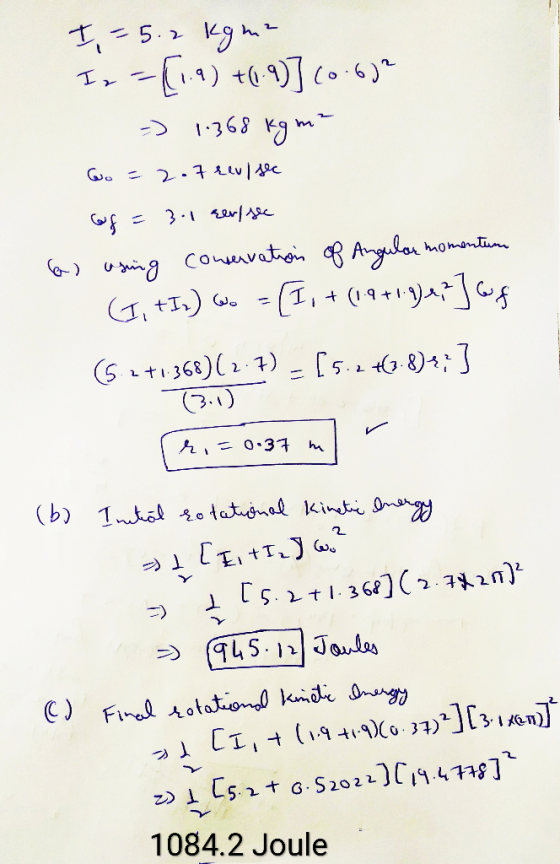
Please ask your doubts or queries in the comment section below.
Please kindly upvote if you are satisfied with the solution.
Thank you.
Add Answer to:
Your friend and chair have a combined constant moment of inertia
of 5.2 kg m2, and...
Suppose a friend is completing another physics assignment in their chair at their desk and you...
Suppose a friend is completing another physics assignment in their chair at their desk and you take the opportunity to turn this scenario into the physics question you now must complete. Your friend and chair have a combined constant moment of inertia of 5.2 kg m2, and the chair can freely rotate. Now your friend picks up two solid bricks (each of mass 1.2 kg) they accidentally collected from one of the campus buildings, and experiment with rotational kinematics. Supposing...
A man stands on a platform that is rotating (without friction) with an angular speed of...
 A man stands on a platform that is rotating (without friction) with an angular speed of 1.29 rev/s; his arms are outstretched and he holds a brick in each hand. The rotational inertia of the system consisting of the man, bricks, and platform about the central axis is 4.66 kg.m^2. If by moving the bricks the man decreases the rotational inertia of the system to 1.03 kg-m^2, (a) what is the resulting angular speed of the platform and (b) what...
1) A student sitting on a chair on a circular platform of negligible mass rotates freely...
1) A student sitting on a chair on a circular platform of negligible mass rotates freely on an air table at initial rotational speed 2.3 rad/s. The student's arms are initially extended with 6.0-kg dumbbells in each hand. As the student pulls her arms in toward her body, the dumbbells move from a distance of 0.80 m to 0.10 m from the axis of rotation. The initial rotational inertia of the student's body (not including the dumbbells) with arms extended...
A man stands on a platform that is rotating (without friction) with an angular speed of...
A man stands on a platform that is rotating (without friction) with an angular speed of 1.76 rev/s; his arms are outstretched and he holds a brick in each hand. The rotational inertia of the system consisting of the man, bricks, and platform about the central axis is 7.65 kg·m2. If by moving the bricks the man decreases the rotational inertia of the system to 2.27 kg·m2, (a) what is the resulting angular speed of the platform and (b) what...
A man stands on a platform that is rotating (without friction) with an angular speed of...
A man stands on a platform that is rotating (without friction) with an angular speed of 1.30 rev/s; his arms are outstretched and he holds a brick in each hand. The rotational inertia of the system consisting of the man, bricks, and platform about the central axis is 4.34 kg·m2. If by moving the bricks the man decreases the rotational inertia of the system to 2.26 kg·m2, (a) what is the resulting angular speed of the platform and (b) what...
A man stands on a platform that is rotating (without friction) with an angular speed of...
A man stands on a platform that is rotating (without friction) with an angular speed of 1.61 rev/s; his arms are outstretched and he holds a brick in each hand. The rotational inertia of the system consisting of the man, bricks, and platform about the central axis is 7.06 kg·m2. If by moving the bricks the man decreases the rotational inertia of the system to 1.96 kg·m2, (a) what is the resulting angular speed of the platform and (b) what...
A student on a piano stool rotates freely with an angular speed of 3.05 rev/s ....
A student on a piano stool rotates freely with an angular speed of 3.05 rev/s . The student holds a 1.35 kg mass in each outstretched arm, 0.789 m from the axis of rotation. The combined moment of inertia of the student and the stool, ignoring the two masses, is 5.43 kg⋅m2 , a value that remains constant. a) As the student pulls his arms inward, his angular speed increases to 3.73 rev/s . How far are the masses from...
student on a piano stool rotates freely with an angular speed of 2.85 rev/s . The...
student on a piano stool rotates freely with an angular speed of 2.85 rev/s . The student holds a 1.25 kg mass in each outstretched arm, 0.739 m from the axis of rotation. The combined moment of inertia of the student and the stool, ignoring the two masses, is 5.53 kg⋅m2 , a value that remains constant. As the student pulls his arms inward, his angular speed increases to 3.41 rev/s . How far are the masses from the axis...
A student on a piano stool rotates freely with an angular speed of 3.07 rev/s. The...
A student on a piano stool rotates freely with an angular speed of 3.07 rev/s. The student holds a 1.27-kg mass in each outstretched arm, 0.766 m from the axis of rotation. The combined moment of inertia of the student and the stool, ignoring the two masses, is 5.50 kg*m2, a value that remains constant. As the student pulls his arms inward, his angular speed increases to 3.40 rev/s. How far are the masses from the axis of rotation at...
A student on a piano stool rotates freely with an angular speed of 3.05 rev/s ....
A student on a piano stool rotates freely with an angular speed of 3.05 rev/s . The student holds a 1.45 kg mass in each outstretched arm, 0.769 m from the axis of rotation. The combined moment of inertia of the student and the stool, ignoring the two masses, is 5.53 kg⋅m2 , a value that remains constant. PART A) As the student pulls his arms inward, his angular speed increases to 3.78 rev/s . How far are the masses...
 A man stands on a platform that is rotating (without friction) with an angular speed of 1.29 rev/s; his arms are outstretched and he holds a brick in each hand. The rotational inertia of the system consisting of the man, bricks, and platform about the central axis is 4.66 kg.m^2. If by moving the bricks the man decreases the rotational inertia of the system to 1.03 kg-m^2, (a) what is the resulting angular speed of the platform and (b) what...
Most questions answered within 3 hours.
-
Where is the error in this code sequence?
String s1 = "Hello";
String s2 = "ello";...
asked 11 months ago -
Financial data for Joel de Paris, Inc., for last year
follow:
Joel de Paris, Inc.
Balance...
asked 11 months ago -
Consider this reaction:
Al2(SO4)3 (aq)+ BaCl3
(aq) Al2Cl6 (aq)- +
3BaSO4(s) . What is the...
asked 11 months ago -
Suppose that Savneet is considering increasing her
recent random sample from 20 car rentals to 40...
asked 11 months ago -
Trucks arrive at an unloading terminal at an average rate of 120
per hour.
Trucks arrive...
asked 11 months ago -
Why are methanol and ethanol completely soluble in water while
octanol is not very little soluble....
asked 11 months ago -
A facilities manager at a university reads in a research report
that the mean amount of...
asked 11 months ago -
When the CuSO4 is rehydrated by adding water to the anhydrous
compound, is this an endothermic...
asked 11 months ago -
A ray of sunlight is passing from diamond into crown glass; the
angle of incidence is...
asked 11 months ago -
A block of mass 0.249 kg is placed on top of a light, vertical
spring of...
asked 11 months ago -
how do the kidneys compensate in the presences of acidosis
a) trigger hyperventilate
b) reserve acid...
asked 11 months ago -
Question 501 pts
The rental rate of capital to the firm increases. Which of the
following...
asked 11 months ago