Consider N users who share a communication link. Suppose each user transmits a fraction p of...
Consider N users who share a communication link. Suppose each
user transmits a fraction p of the time, i.e., at any time instant, each user is transmitting with probability p.

The probability that at any time instant, n users are transmitting is given by the Binomial distribution:
 C(N,n) = N!/[n!(N-n)!]

i.   What is the probability of more than 12 users transmitting
     at the same time?  ( 10 pts)

ii.  What is the probability of less than 5 users transmitting
     at the same time?  (20 pts)

iii. Suppose p = 0.15 and N = 35.  Calculate the numerical values
     of the probabilities in parts i. and ii.  (20 pts)
     (You might need to write a small program to do this.) .
where C(N,n) = N!/[n!(N-n)!]. C(N,n) means the number of combinations of N items taken n at a time. See a tutorial on elementary probability if you do not remember this from mathematics
Homework Answers
Total number of users = N
(i) Now we want to calculate the probability that more than n = 12 users are transmitting at the same time.
Let P(i) be the probability that i users are transmitting at the same time.
P(i) = 
So the probability that more than 12 users are transmitting at
the same time = 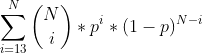
(ii) The probability that less than 5 users are
transmitting at the same time = 
(iii) Now, p = 0.15 and N = 35. Using MATLAB , we write the code for calculating the above probabilities
----------------------------------------------
% Matlab Code below
N = 35;
p = 0.15;
pAns = prob(p,N,4);
fprintf('The probability of less than 5 users transmitting is
%f\n',pAns);
pAns = 1.0-prob(p,N,12);
fprintf('The probability of more than 12 users transmitting is
%f\n',pAns);
function ans = prob(p,N,k)
pans = 0.0;
for i = 0:k
comb = nchoosek(N,i);
bernp = comb*(p.^i)*((1-p).^(N-i));
pans = pans + bernp;
end
ans = pans;
end
----------------------------------------------
Answer for part(i) which is probability of more than 12 users transmitting at the same time = 0.001098
Answer for part(ii) which is probability of less than 5 users transmitting at the same time = 0.380749
Add Answer to:
Consider
N users who share a communication link. Suppose each
user transmits a fraction p of...
Suppose users share a 1 Mbps link. Also suppose each user requires 100kbps when transmitting, but...
 Suppose users share a 1 Mbps link. Also suppose each user requires 100kbps when transmitting, but each user transmits only 10 percent of the time. a. When circuit switching is used, how many users can be supported? b. For the remainder of this problem, suppose packet switching is used. Find the probability that a given user is transmitting. c. Suppose there are 40 users. Find the probability that at any given time, exactly n users are transmitting simultaneously. d. Find...
19. Suppose users share a 3 Mbps link. Also suppose each user requires 150 kbps when transmitting, but each user transmi...
19. Suppose users share a 3 Mbps link. Also suppose each user requires 150 kbps when transmitting, but each user transmits only 20 percent of the time, suppose packet switching is used and there are 225 users. Note: As we did in class use the Binomial to Normal distribution approximations (and the empirical rules µ±1σ =0.6826, µ ±2σ =0.9544, µ ±3σ =0.9973) to approximate your answer. (Always draw the sketch of the normal distribution with the µ and σ) Find...
Problem 3 Suppose users share a 9 Mbps link. Each user consumes 1.5 Mbps when transmitting,...
 Problem 3 Suppose users share a 9 Mbps link. Each user consumes 1.5 Mbps when transmitting, and only transmits with probability 0.2 How many users can be supported using circuit switching? Assume packet switching for the rest of the problem. What is the probability that 7 out of 10 users are transmitting? What is the maximum number of users, such that the probability of exceeding the link capacity is no more than 0.01? Hint: Gradually increase the number of users...
A company has a dedicated link of 100 Mbps. Each employee, when online, transmits continuously at...
A company has a dedicated link of 100 Mbps. Each employee, when online, transmits continuously at 12 Mbps when active, but each user is active only 20 percent of the time. Assume packet switching is used. (a) What is the probability that more than 2 users are transmitting at the same time? (b) Suppose that the system will drop any packets if it's utilized at 100% capacity without queuing them. If we need to guarantee a probability of at most...
8- Consider an ALOHA system with 10 users, where each user transmits with probability pt =...
 8- Consider an ALOHA system with 10 users, where each user transmits with probability pt = 25%. a) What is the success probability for user #1 [5 pts] b) What is the success probability for any user (u1,u2,....u10) no matter which one: (10 pts] c) In order to increase the success probability would you recommend increasing or decreasing the transmission probability Pt [5 pts] 9-Answer question 8 for a slotted ALOHA system. [20 pts] Slotted Aloha efficiency Let us assume...
A company has a dedicated link of 100 Mbps. Each employee, when online, transmits continuously at...
A company has a dedicated link of 100 Mbps. Each employee, when online, transmits continuously at 12 Mbps when active, but each user is active only 20 percent of the time. How many users can the link support when circuit switching is used? For the remainder of this problem, suppose packet switching is used. What is the probability that more than 2 users are transmitting at the same time? Now suppose that the system will drop any packets if it...
Networking
R15. Suppose users share a 2Mbps link. Also suppose each user transmits continuously at 1Mbps when transmitting, but each user transmits only 20 percent of thetime.a. When circuit switching is used, how many users can be supported?b. For the remainder of this problem, suppose packet switching is used. Why there be essentially no queuing delay before the link if two or fewer users transmit at thesame time? Why will there be a queuing delay if three users transmit at the...
Suppose that multiple users share a 1 Mbps link. Each user has a data rate of 200 b) kbps when "active", and ea...
 Suppose that multiple users share a 1 Mbps link. Each user has a data rate of 200 b) kbps when "active", and each user is active 10% of the time. When circuit switching is used to allocate resources on the shared link, how (2) (i) many users can be supported? When packet switching is used and the total number of users is 20, what is (ii) the probability that more than 5 users are active simultaneously? (3) What are the...
Suppose that multiple users share a 1 Mbps link. Each user has a data rate of 200 b) kbps when "active", and ea...
 Suppose that multiple users share a 1 Mbps link. Each user has a data rate of 200 b) kbps when "active", and each user is active 10% of the time. When circuit switching is used to allocate resources on the shared link, how (2) (i) many users can be supported? When packet switching is used and the total number of users is 20, what is (ii) the probability that more than 5 users are active simultaneously? (3) What are the...
Suppose that multiple users share a 1 Mbps link. Each user has a data rate of 200 b) kbps when "active", and ea...
 Suppose that multiple users share a 1 Mbps link. Each user has a data rate of 200 b) kbps when "active", and each user is active 10% of the time. When circuit switching is used to allocate resources on the shared link, how (2) (i) many users can be supported? When packet switching is used and the total number of users is 20, what is (ii) the probability that more than 5 users are active simultaneously? (3) What are the...
 Suppose users share a 1 Mbps link. Also suppose each user requires 100kbps when transmitting, but each user transmits only 10 percent of the time. a. When circuit switching is used, how many users can be supported? b. For the remainder of this problem, suppose packet switching is used. Find the probability that a given user is transmitting. c. Suppose there are 40 users. Find the probability that at any given time, exactly n users are transmitting simultaneously. d. Find...
 Problem 3 Suppose users share a 9 Mbps link. Each user consumes 1.5 Mbps when transmitting, and only transmits with probability 0.2 How many users can be supported using circuit switching? Assume packet switching for the rest of the problem. What is the probability that 7 out of 10 users are transmitting? What is the maximum number of users, such that the probability of exceeding the link capacity is no more than 0.01? Hint: Gradually increase the number of users...
 8- Consider an ALOHA system with 10 users, where each user transmits with probability pt = 25%. a) What is the success probability for user #1 [5 pts] b) What is the success probability for any user (u1,u2,....u10) no matter which one: (10 pts] c) In order to increase the success probability would you recommend increasing or decreasing the transmission probability Pt [5 pts] 9-Answer question 8 for a slotted ALOHA system. [20 pts] Slotted Aloha efficiency Let us assume...
 Suppose that multiple users share a 1 Mbps link. Each user has a data rate of 200 b) kbps when "active", and each user is active 10% of the time. When circuit switching is used to allocate resources on the shared link, how (2) (i) many users can be supported? When packet switching is used and the total number of users is 20, what is (ii) the probability that more than 5 users are active simultaneously? (3) What are the...
 Suppose that multiple users share a 1 Mbps link. Each user has a data rate of 200 b) kbps when "active", and each user is active 10% of the time. When circuit switching is used to allocate resources on the shared link, how (2) (i) many users can be supported? When packet switching is used and the total number of users is 20, what is (ii) the probability that more than 5 users are active simultaneously? (3) What are the...
 Suppose that multiple users share a 1 Mbps link. Each user has a data rate of 200 b) kbps when "active", and each user is active 10% of the time. When circuit switching is used to allocate resources on the shared link, how (2) (i) many users can be supported? When packet switching is used and the total number of users is 20, what is (ii) the probability that more than 5 users are active simultaneously? (3) What are the...
Most questions answered within 3 hours.
-
Where is the error in this code sequence?
String s1 = "Hello";
String s2 = "ello";...
asked 10 months ago -
Financial data for Joel de Paris, Inc., for last year
follow:
Joel de Paris, Inc.
Balance...
asked 10 months ago -
Consider this reaction:
Al2(SO4)3 (aq)+ BaCl3
(aq) Al2Cl6 (aq)- +
3BaSO4(s) . What is the...
asked 10 months ago -
Suppose that Savneet is considering increasing her
recent random sample from 20 car rentals to 40...
asked 10 months ago -
Trucks arrive at an unloading terminal at an average rate of 120
per hour.
Trucks arrive...
asked 10 months ago -
Why are methanol and ethanol completely soluble in water while
octanol is not very little soluble....
asked 10 months ago -
A facilities manager at a university reads in a research report
that the mean amount of...
asked 10 months ago -
When the CuSO4 is rehydrated by adding water to the anhydrous
compound, is this an endothermic...
asked 10 months ago -
A ray of sunlight is passing from diamond into crown glass; the
angle of incidence is...
asked 10 months ago -
A block of mass 0.249 kg is placed on top of a light, vertical
spring of...
asked 10 months ago -
how do the kidneys compensate in the presences of acidosis
a) trigger hyperventilate
b) reserve acid...
asked 10 months ago -
Question 501 pts
The rental rate of capital to the firm increases. Which of the
following...
asked 10 months ago