The balanced equation for this reaction is shown below: 3 NaHCO3(aq) + H3C3H5O7(aq) → Na3C3H5O7(aq)+ 3...
The balanced equation for this reaction is shown below:
3 NaHCO3(aq) + H3C3H5O7(aq) → Na3C3H5O7(aq)+ 3 CO2(g) + 3 H20(l)
Devise an experiment to determine the overall order of reaction (be specific in your answer).
Homework Answers

Add Answer to:
The balanced equation for this reaction is shown below:
3 NaHCO3(aq) +
H3C3H5O7(aq) →
Na3C3H5O7(aq)+ 3...
The reaction of NaHCO3 and HCl produces NaCl, H2O and CO2. The balanced equation is: NaHCO3...
The reaction of NaHCO3 and HCl produces NaCl, H2O and CO2. The balanced equation is: NaHCO3 + HCl = NaCl + H2O + CO2 You combine 5.0 g of NaHCO3 and 5.0 g of HCl. Determine the limiting reagent. Determine the amount of NaCl formed in the reaction based on these quantities of reactants. How much of the excess reactant remains? Thank you in advance!
Write a balanced equation for each reaction a. HBr(aq) + KOH(aq) → b. HCl(aq) + NaHCO3(aq)...
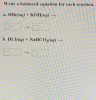 Write a balanced equation for each reaction a. HBr(aq) + KOH(aq) → b. HCl(aq) + NaHCO3(aq) →
Given the following balanced chemical reaction answer questions a-c below. Cr2(SO4)3 (aq) + 3 (NH4)2CO3 (aq)...
Given the following balanced chemical reaction answer questions a-c below. Cr2(SO4)3 (aq) + 3 (NH4)2CO3 (aq) -> Cr2CO3 (s) + 3 (NH4)2 SO4 (aq) Write the overall ionic balanced chemical equation. Write the net ionic balanced chemical equation. List the spectator ion(s). Given the following balanced chemical reaction answer questions a-c below. Ca(OH)2 (aq) + 2 HClO4 (aq) -> 2 H2O (l) + Ca(ClO4)2 (aq) Write the overall ionic balanced chemical equation. Write the net ionic balanced chemical equation. List...
Br2(l) + 2e-2Br-(aq) Co(s)Co2+(aq) + 2e- Write a balanced equation for the overall redox reaction. Use...
Br2(l) + 2e-2Br-(aq) Co(s)Co2+(aq) + 2e- Write a balanced equation for the overall redox reaction. Use smallest possible integer coefficients. ________(aq)(s)(l)(g) + ________(aq)(s)(l)(g) __________(aq)(s)(l)(g) + ____________(aq)(s)(l)(g)
Consider the balanced chemical equation shown below: Co(s) + BrO-(aq) + H2O(l) → Br-(aq) + Co2+(aq)...
Consider the balanced chemical equation shown below: Co(s) + BrO-(aq) + H2O(l) → Br-(aq) + Co2+(aq) + 2 OH-(aq) ΔH°rxn = -259.87 kJ/mol Which of the following statements must be true about this chemical reaction? Circle all that apply. A. The reaction is fast. B. The reaction is product-favored. C. The entropy change for this reaction is positive. D. Increasing the temp will drive the reaction towards the products. E. The reaction is endothermic. F. The reaction is spontaneous. G....
a Nitrous acid and sodium hydrogen carbonate, NaHCO3, are mixed in water. Choose a balanced net...
 a Nitrous acid and sodium hydrogen carbonate, NaHCO3, are mixed in water. Choose a balanced net ionic equation for the acid-base reaction that could, in principle, occur. HNO2() + NaHCO3(s) + H2O(l) Na+ (aq) + HCO3(aq) + NO3- (aq) + H+ (aq) HNO2 (aq) + NaHCO3(aq) = NaNO2 (aq) + H2CO3(aq) HNO2 (aq) + HCO3- (aq) = NO2 (aq) + H2CO3(aq) HNO2 (aq) + NaHCO3(aq) = NaNO2 (aq) + H2O() + CO2(g)
Baking soda (NaHCO3) can be made by the following reaction: NaCl (aq) + NH3 (aq) +...
Baking soda (NaHCO3) can be made by the following reaction: NaCl (aq) + NH3 (aq) + CO2 (aq) + H2O (l) → NaHCO3 (s) + NH4Cl (aq) If 7.77 g of baking soda are isolated after 11.7 g of NaCl reacts with 2.55 g of NH3, 0.300 mol of CO2, and 0.500 L of H2O, what is the percent yield of the reaction?
1. Consider the reaction: NaHCO3(aq) + HCl(aq) → NaCl(aq) + CO2(g) + H2O(l) Question: 0.056 moles...
1. Consider the reaction: NaHCO3(aq) + HCl(aq) → NaCl(aq) + CO2(g) + H2O(l) Question: 0.056 moles of NaHCO3 are reacted with excess HCl. 2.267 g of CO2 were produced. What is the percent yield of CO2?
Reaction 1: Vinegar (acetic acid) and sodium bicarbonate CH3COOH(aq) + NaHCO3(s) -- CH3COONa (aq) + H2O(l)...
 Reaction 1: Vinegar (acetic acid) and sodium bicarbonate CH3COOH(aq) + NaHCO3(s) -- CH3COONa (aq) + H2O(l) + CO2(g) Reaction 2: Vinegar (acetic acid) and ammonia CH3C02H(aq) + NH3(aq)-> CH3CO2NH4(aq) Observe the following reaction: N2(g) + O2(g) XX2NO(g) (reaction 4) Reaction 5: Dissolution of ammonium chloride: NH,Cl(s)-- NH (aq) + Cl(aq) AH = 14.4 kJ/mol (reaction 5) The following endothermic reaction does not occur: CO2(g) + H20(L) X H2CO3(aq) (reaction 6) 2N205(g)-→ 4NO2(g) + O2(g) AH = +13.1 kcal (reaction 7)...
Resources Hint Check Answer Question 2 of 3 > The balanced equation for the reaction of aqueous Pb(CIO), with aq...
 Resources Hint Check Answer Question 2 of 3 > The balanced equation for the reaction of aqueous Pb(CIO), with aqueous Nal is shown below. Pb(CIO),(aq) + 2 Nal(aq) PbL,(s) + 2 Nacio, (aq) What mass of precipitate will form if 1.50 L of excess Pb(CIO), is mixed with 0.250 L of 0.190 M Nal? Assume 100% yield and neglect the slight solubility of Pblz. mass:
 Write a balanced equation for each reaction a. HBr(aq) + KOH(aq) → b. HCl(aq) + NaHCO3(aq) →
 a Nitrous acid and sodium hydrogen carbonate, NaHCO3, are mixed in water. Choose a balanced net ionic equation for the acid-base reaction that could, in principle, occur. HNO2() + NaHCO3(s) + H2O(l) Na+ (aq) + HCO3(aq) + NO3- (aq) + H+ (aq) HNO2 (aq) + NaHCO3(aq) = NaNO2 (aq) + H2CO3(aq) HNO2 (aq) + HCO3- (aq) = NO2 (aq) + H2CO3(aq) HNO2 (aq) + NaHCO3(aq) = NaNO2 (aq) + H2O() + CO2(g)
 Reaction 1: Vinegar (acetic acid) and sodium bicarbonate CH3COOH(aq) + NaHCO3(s) -- CH3COONa (aq) + H2O(l) + CO2(g) Reaction 2: Vinegar (acetic acid) and ammonia CH3C02H(aq) + NH3(aq)-> CH3CO2NH4(aq) Observe the following reaction: N2(g) + O2(g) XX2NO(g) (reaction 4) Reaction 5: Dissolution of ammonium chloride: NH,Cl(s)-- NH (aq) + Cl(aq) AH = 14.4 kJ/mol (reaction 5) The following endothermic reaction does not occur: CO2(g) + H20(L) X H2CO3(aq) (reaction 6) 2N205(g)-→ 4NO2(g) + O2(g) AH = +13.1 kcal (reaction 7)...
 Resources Hint Check Answer Question 2 of 3 > The balanced equation for the reaction of aqueous Pb(CIO), with aqueous Nal is shown below. Pb(CIO),(aq) + 2 Nal(aq) PbL,(s) + 2 Nacio, (aq) What mass of precipitate will form if 1.50 L of excess Pb(CIO), is mixed with 0.250 L of 0.190 M Nal? Assume 100% yield and neglect the slight solubility of Pblz. mass:
Most questions answered within 3 hours.
-
Where is the error in this code sequence?
String s1 = "Hello";
String s2 = "ello";...
asked 10 months ago -
Financial data for Joel de Paris, Inc., for last year
follow:
Joel de Paris, Inc.
Balance...
asked 10 months ago -
Consider this reaction:
Al2(SO4)3 (aq)+ BaCl3
(aq) Al2Cl6 (aq)- +
3BaSO4(s) . What is the...
asked 10 months ago -
Suppose that Savneet is considering increasing her
recent random sample from 20 car rentals to 40...
asked 10 months ago -
Trucks arrive at an unloading terminal at an average rate of 120
per hour.
Trucks arrive...
asked 10 months ago -
Why are methanol and ethanol completely soluble in water while
octanol is not very little soluble....
asked 10 months ago -
A facilities manager at a university reads in a research report
that the mean amount of...
asked 10 months ago -
When the CuSO4 is rehydrated by adding water to the anhydrous
compound, is this an endothermic...
asked 10 months ago -
A ray of sunlight is passing from diamond into crown glass; the
angle of incidence is...
asked 10 months ago -
A block of mass 0.249 kg is placed on top of a light, vertical
spring of...
asked 10 months ago -
how do the kidneys compensate in the presences of acidosis
a) trigger hyperventilate
b) reserve acid...
asked 10 months ago -
Question 501 pts
The rental rate of capital to the firm increases. Which of the
following...
asked 10 months ago