Represent -1.25e2 in IEEE-754 32-bit floating-point form, where the exponent is 8bit and the bias is...
Represent -1.25e2 in IEEE-754 32-bit floating-point form, where the exponent is 8bit and the bias is 127. Give the answer as a 32-bit binary number, without any space between the bits.
Homework Answers
|
Sign 1 Bit |
Exponent(8 bits) |
Mantissa(23 bits) |
IEEE-754 32-bit floating-point form
Given -1.25e2 to be represented in IEEE-754 32-bit floating-point form
-1.25e2 = -125
Now we convert -125 to binary, here I am using successive division method
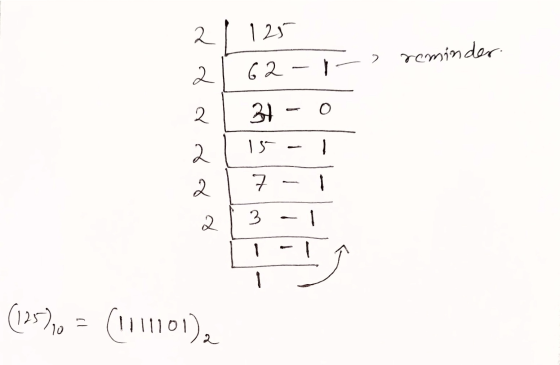
(-125)10 = (-1111101)2
(-1111101)2 = - 1.111101 X 26
Since the number is negative sign bit must be set to 1
Mantissa = 111101000000000000000000
Exponent is actually biased so we add 127 to get the value so exponent 127+6 = (133)10
Again using successive division method
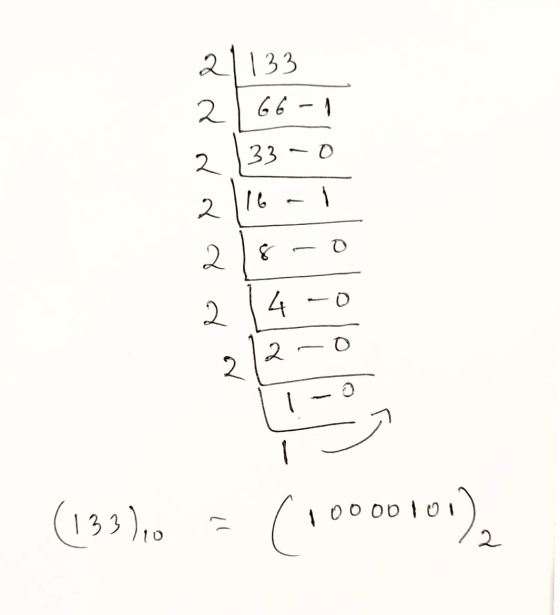
So exponent is 10000101
So the answer is
Sign Exponent Mantissa
|
1 |
10000101 |
111101000000000000000000 |
Add Answer to:
Represent -1.25e2 in IEEE-754 32-bit floating-point form, where
the exponent is 8bit and the bias is...
2. Represent 25.28255 in 32 bit IEEE-754 floating point format as shown in the following format...
 2. Represent 25.28255 in 32 bit IEEE-754 floating point format as shown in the following format discussed in class. Sign Bit BIT 31 Exponent BITS 30:23 Mantissa BITS 22:0 BYTE 3+1 bit 7 Bits BYTE 1 BYTE O
Watching a YouTube tutorial on how to convert decimal to floating point numbers (IEEE 754) and...
 Watching a YouTube tutorial on how to convert decimal to
floating point numbers (IEEE 754) and normalisation may prove to be
beneficial.
Watching a YouTube tutorial on how to convert decimal to floating point numbers (IEEE 754) may prove to be beneficial Convert the decimal number to 32 bits I Decimal number 18 to its binary equivalent I. 18 normalized in binary: 1.-2刈2n) II Biased exponent: 10 IV. Conversion to EE 754 16 I: 10, For ii please normalize the...
Watching a YouTube tutorial on how to convert decimal to
floating point numbers (IEEE 754) and normalisation may prove to be
beneficial.
Watching a YouTube tutorial on how to convert decimal to floating point numbers (IEEE 754) may prove to be beneficial Convert the decimal number to 32 bits I Decimal number 18 to its binary equivalent I. 18 normalized in binary: 1.-2刈2n) II Biased exponent: 10 IV. Conversion to EE 754 16 I: 10, For ii please normalize the...
Convert from 32-bit IEEE 754 Floating Point Standard (in hexadecimal) to decimal: 410C0000, with the following...
Convert from 32-bit IEEE 754 Floating Point Standard (in hexadecimal) to decimal: 410C0000, with the following layout: first bit is sign bit, next 8 bits is exponent field, and remaining 23 bits is mantissa field; result is to be rounded up if needed. answer choices 9.125 8.75 7.75 4.625 6.3125
Convert the decimal real number -100.756 to IEEE 754 single precision (32 bit) floating point in...
Convert the decimal real number -100.756 to IEEE 754 single precision (32 bit) floating point in hexadecimal representation of the binary value (Hint: consider the field or bit-by-bit structure of an IEEE 754 value to decide which of the choices is correct, without necessarily constructing the full encoding of the value.) 32C98312 42C98312 C2C98312 52C98313
If we use the IEEE standard floating-point single-precision representation (1 sign bit, 8 bit exponent bits...
 If we use the IEEE standard floating-point single-precision representation (1 sign bit, 8 bit exponent bits using excess-127 representation, 23 significand bits with implied bit), then which of the following hexadecimal number is equal to the decimal value 3.875? C0780000 40007800 Oo 40780000 40A80010 The binary string 01001001110000 is a floating-point number expressed using a simplified 14-bit floating-point representation format (1 sign bit, 5 exponent bits using excess-15 representation, and 8 significand bits with no implied bit). What is its...
Inspired of the IEEE 754 standard, a floating point format that is only 10 bits wide is defined f...
Inspired of the IEEE 754 standard, a floating point format that is only 10 bits wide is defined for a special computer. The leftmost bit is still the sign bit, the exponent is 5 bits wide and has a bias of 15, and the fractions is 4 bits long. A hidden 1 is assumed for the normal number, but not for the denormalized number. c) Construct a case to show that floating point addition is not associative
IEEE 754-2008 contains a half precision that is only 16 bits wide. The leftmost bit is...
IEEE 754-2008 contains a half precision that is only 16 bits wide. The leftmost bit is still the sign bit, the exponent is 5 bits wide and has a bias of 15, and the mantissa is 10 bits long. A hidden 1 is assumed. Write down the bit pattern to represent -1.6875 X 100 assuming a version of this format, which uses an excess-16 format to store the exponent. Comment on how the range and accuracy of this 16-bit floating...
1 please IEEE-754 Floating point conversions problems (assume 32 bit machine): 1. For IEEE 754 single-precision...
 1 please
IEEE-754 Floating point conversions problems (assume 32 bit machine): 1. For IEEE 754 single-precision floating point, write the hexadecimal representation for the following decimal values: a. 27.1015625 b.-1 2. For IEEE 754 single-precision floating point, what is the decimal number, whose hexadecimal representation is the following? a. 4280 0000 b. 7FE4 0000 c. 0061 0000 3. For IEEE-754 single-precision floating point practice the following problem: Suppose X and Y are representing single precision numbers as follows: X 0100...
1 please
IEEE-754 Floating point conversions problems (assume 32 bit machine): 1. For IEEE 754 single-precision floating point, write the hexadecimal representation for the following decimal values: a. 27.1015625 b.-1 2. For IEEE 754 single-precision floating point, what is the decimal number, whose hexadecimal representation is the following? a. 4280 0000 b. 7FE4 0000 c. 0061 0000 3. For IEEE-754 single-precision floating point practice the following problem: Suppose X and Y are representing single precision numbers as follows: X 0100...
Thebinary16format in the IEEE 754-2008 standard uses an 11-bitmantissa and 5-bit exponent with a bias of...
Thebinary16format in the IEEE 754-2008 standard uses an 11-bitmantissa and 5-bit exponent with a bias of 24−1. What is the closestvalue forπthat this format could represent?
FPN-Decimal What number is represented by the 32-bit (IEEE 754 - single precision, with bias 127) floating point number: 1 10000010 00100000000000000000000 (a) -19 (b) -9 (c) -89 (d) -29 (e) None of t...
FPN-Decimal What number is represented by the 32-bit (IEEE 754 - single precision, with bias 127) floating point number: 1 10000010 00100000000000000000000 (a) -19 (b) -9 (c) -89 (d) -29 (e) None of the above FPN = (-1)^s x (1 + significant) x 2^E-127
 2. Represent 25.28255 in 32 bit IEEE-754 floating point format as shown in the following format discussed in class. Sign Bit BIT 31 Exponent BITS 30:23 Mantissa BITS 22:0 BYTE 3+1 bit 7 Bits BYTE 1 BYTE O
 Watching a YouTube tutorial on how to convert decimal to
floating point numbers (IEEE 754) and normalisation may prove to be
beneficial.
Watching a YouTube tutorial on how to convert decimal to floating point numbers (IEEE 754) may prove to be beneficial Convert the decimal number to 32 bits I Decimal number 18 to its binary equivalent I. 18 normalized in binary: 1.-2刈2n) II Biased exponent: 10 IV. Conversion to EE 754 16 I: 10, For ii please normalize the...
Watching a YouTube tutorial on how to convert decimal to
floating point numbers (IEEE 754) and normalisation may prove to be
beneficial.
Watching a YouTube tutorial on how to convert decimal to floating point numbers (IEEE 754) may prove to be beneficial Convert the decimal number to 32 bits I Decimal number 18 to its binary equivalent I. 18 normalized in binary: 1.-2刈2n) II Biased exponent: 10 IV. Conversion to EE 754 16 I: 10, For ii please normalize the...
 If we use the IEEE standard floating-point single-precision representation (1 sign bit, 8 bit exponent bits using excess-127 representation, 23 significand bits with implied bit), then which of the following hexadecimal number is equal to the decimal value 3.875? C0780000 40007800 Oo 40780000 40A80010 The binary string 01001001110000 is a floating-point number expressed using a simplified 14-bit floating-point representation format (1 sign bit, 5 exponent bits using excess-15 representation, and 8 significand bits with no implied bit). What is its...
 1 please
IEEE-754 Floating point conversions problems (assume 32 bit machine): 1. For IEEE 754 single-precision floating point, write the hexadecimal representation for the following decimal values: a. 27.1015625 b.-1 2. For IEEE 754 single-precision floating point, what is the decimal number, whose hexadecimal representation is the following? a. 4280 0000 b. 7FE4 0000 c. 0061 0000 3. For IEEE-754 single-precision floating point practice the following problem: Suppose X and Y are representing single precision numbers as follows: X 0100...
1 please
IEEE-754 Floating point conversions problems (assume 32 bit machine): 1. For IEEE 754 single-precision floating point, write the hexadecimal representation for the following decimal values: a. 27.1015625 b.-1 2. For IEEE 754 single-precision floating point, what is the decimal number, whose hexadecimal representation is the following? a. 4280 0000 b. 7FE4 0000 c. 0061 0000 3. For IEEE-754 single-precision floating point practice the following problem: Suppose X and Y are representing single precision numbers as follows: X 0100...
Most questions answered within 3 hours.
-
Where is the error in this code sequence?
String s1 = "Hello";
String s2 = "ello";...
asked 10 months ago -
Financial data for Joel de Paris, Inc., for last year
follow:
Joel de Paris, Inc.
Balance...
asked 10 months ago -
Consider this reaction:
Al2(SO4)3 (aq)+ BaCl3
(aq) Al2Cl6 (aq)- +
3BaSO4(s) . What is the...
asked 10 months ago -
Suppose that Savneet is considering increasing her
recent random sample from 20 car rentals to 40...
asked 10 months ago -
Trucks arrive at an unloading terminal at an average rate of 120
per hour.
Trucks arrive...
asked 10 months ago -
Why are methanol and ethanol completely soluble in water while
octanol is not very little soluble....
asked 10 months ago -
A facilities manager at a university reads in a research report
that the mean amount of...
asked 10 months ago -
When the CuSO4 is rehydrated by adding water to the anhydrous
compound, is this an endothermic...
asked 10 months ago -
A ray of sunlight is passing from diamond into crown glass; the
angle of incidence is...
asked 10 months ago -
A block of mass 0.249 kg is placed on top of a light, vertical
spring of...
asked 10 months ago -
how do the kidneys compensate in the presences of acidosis
a) trigger hyperventilate
b) reserve acid...
asked 10 months ago -
Question 501 pts
The rental rate of capital to the firm increases. Which of the
following...
asked 10 months ago