A jet plane is coming in for a landing at 90.0 m/s. The wheels and the...
A jet plane is coming in for a landing at 90.0 m/s. The wheels and the engines combined are able to decelerate the plane at a constant 1.85 m/s^2. How long of a runway does the plane require to come to a complete stop?
Homework Answers
Initial speed, u = 90 m/s
acceleration, a = -1.85 m/s2 ( Negative sign is indicating that the plane is decelerating)
Final speed, v = 0 m/s
Distance covered, s = ?
We use the equation of motion
v2 - u2 = 2as
s = v2 - u2 / 2a = 02 - 902 / 2 (-1.85) m = 2189.2 m
Hence, the plane will run for 2189.2 m before stopping.
Add Answer to:
A jet plane is coming in for a landing at 90.0 m/s. The wheels
and the...
1) A jet lands at 78.8 m/s, the pilot applying the brakes 2.09s after landing. Find...
1) A jet lands at 78.8 m/s, the pilot applying the brakes 2.09s after landing. Find the acceleration needed to stop the jet within 5.77 x 10^2m after touchdown. ______m/s^2 2) A typical jetliner lands at a speed of 140 mi/h and decelerates at the rate to (10.5 mi/h)/s. if the jetliner travels at a constant speed of 140 mi/h for 1.2s after landing before applying the brakes, what is the total displacement of the jetliner between touchdown on the...
1. A jet plane has a takeoff speed of ? = 75 m/s and can move...
1. A jet plane has a takeoff speed of ? = 75 m/s and can move along the runway at an average acceleration of 1.3 m/s2. If the length of the runway is 2.5 km, will the plane be able to use this runway safely? Defend your answer. 2. A person takes a trip, driving with a constant speed of 89.5 km/h, except for a 22.0 min rest stop. If the person’s average speed is 77.8 km/h, (a) how much...
We investigated a jet landing on an aircraft carrier. In a later maneuver, the jet comes...
We investigated a jet landing on an aircraft carrier. In a later maneuver, the jet comes in for a landing on solid ground with a speed of 95 m/s, and its acceleration can have a maximum magnitude of 5.72 m/s2 as it comes to rest. (a) From the instant the jet touches the runway, what is the minimum time interval needed before it can come to rest? s (b) Can this jet land on a small tropical island airport where...
A jetliner, traveling northward, is landing with a speed of 64.6 m/s. Once the jet touches...
A jetliner, traveling northward, is landing with a speed of 64.6 m/s. Once the jet touches down, it has 768 m of runway in which to reduce its speed to 14.6 m/s. Compute the average acceleration (magnitude and direction) of the plane during landing (take the direction of the plane's motion as positive).
A jetliner, traveling northward, is landing with a speed of 59.5 m/s. Once the jet touches...
A jetliner, traveling northward, is landing with a speed of 59.5 m/s. Once the jet touches down, it has 787 m of runway in which to reduce its speed to 5.75 m/s. Compute the average acceleration (magnitude and direction) of the plane during landing (take the direction of the plane's motion as positive).
A jetliner, traveling northward, is landing with a speed of 62.9 m/s. Once the jet touches...
A jetliner, traveling northward, is landing with a speed of 62.9 m/s. Once the jet touches down, it has 736 m of runway in which to reduce its speed to 11.1 m/s. Compute the average acceleration (magnitude and direction) of the plane during landing (take the direction of the plane's motion as positive).
15. After landing, a jet airliner on a straight runway taxis to a stop with an...
 15. After landing, a jet airliner on a straight runway taxis to a stop with an average velocity of 3.0 1. If the plane takes 7.00s to come to a stop, what was the planes initial velocity and what was we acceleration during the stopping? [-19.4ms!, 2.78ms) 16. A drag racer travelling at 240kmh on a straight track deploys a parachute that provides a uniform acceleration that slows the racer to 20kmh in 12s. a) What is the racer's acceleration?...
A jet plane lands with a speed of 112 m/s and can accelerate at a maximum...
A jet plane lands with a speed of 112 m/s and can accelerate at a maximum rate of −5.50 m/s2 as it comes to rest. (a) From the instant the plane touches the runway, what is the minimum time needed before it can come to rest? s (b) Can this plane land on a small tropical island airport where the runway is 0.800 km long? Yes No
A jet plane lands with a speed of 116 m/s and can accelerate at a maximum...
A jet plane lands with a speed of 116 m/s and can accelerate at a maximum rate of −4.20 m/s2 as it comes to rest. (a) From the instant, the plane touches the runway, what is the minimum time needed before it can come to rest? (b) Can this plane land on a small tropical island airport where the runway is 0.800 km long? Yes No
PE 1.pdf The motion of a jet plane just after landing on a runway is described...
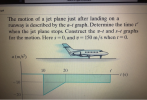 PE 1.pdf The motion of a jet plane just after landing on a runway is described by the a-t graph. Determine the time t' when the jet plane stops. Construct the v-t and s-t graphs for the motion. Here s=0, and v= 150 m/s when t=0. DODDDDDDD a (m/s²) 10 20 ť 1 (S) --10 -20
 15. After landing, a jet airliner on a straight runway taxis to a stop with an average velocity of 3.0 1. If the plane takes 7.00s to come to a stop, what was the planes initial velocity and what was we acceleration during the stopping? [-19.4ms!, 2.78ms) 16. A drag racer travelling at 240kmh on a straight track deploys a parachute that provides a uniform acceleration that slows the racer to 20kmh in 12s. a) What is the racer's acceleration?...
 PE 1.pdf The motion of a jet plane just after landing on a runway is described by the a-t graph. Determine the time t' when the jet plane stops. Construct the v-t and s-t graphs for the motion. Here s=0, and v= 150 m/s when t=0. DODDDDDDD a (m/s²) 10 20 ť 1 (S) --10 -20
Most questions answered within 3 hours.
-
Where is the error in this code sequence?
String s1 = "Hello";
String s2 = "ello";...
asked 11 months ago -
Financial data for Joel de Paris, Inc., for last year
follow:
Joel de Paris, Inc.
Balance...
asked 11 months ago -
Consider this reaction:
Al2(SO4)3 (aq)+ BaCl3
(aq) Al2Cl6 (aq)- +
3BaSO4(s) . What is the...
asked 11 months ago -
Suppose that Savneet is considering increasing her
recent random sample from 20 car rentals to 40...
asked 11 months ago -
Trucks arrive at an unloading terminal at an average rate of 120
per hour.
Trucks arrive...
asked 11 months ago -
Why are methanol and ethanol completely soluble in water while
octanol is not very little soluble....
asked 11 months ago -
A facilities manager at a university reads in a research report
that the mean amount of...
asked 11 months ago -
When the CuSO4 is rehydrated by adding water to the anhydrous
compound, is this an endothermic...
asked 11 months ago -
A ray of sunlight is passing from diamond into crown glass; the
angle of incidence is...
asked 11 months ago -
A block of mass 0.249 kg is placed on top of a light, vertical
spring of...
asked 11 months ago -
how do the kidneys compensate in the presences of acidosis
a) trigger hyperventilate
b) reserve acid...
asked 11 months ago -
Question 501 pts
The rental rate of capital to the firm increases. Which of the
following...
asked 11 months ago